Global rise in breast cancer due to 'Western lifestyles'
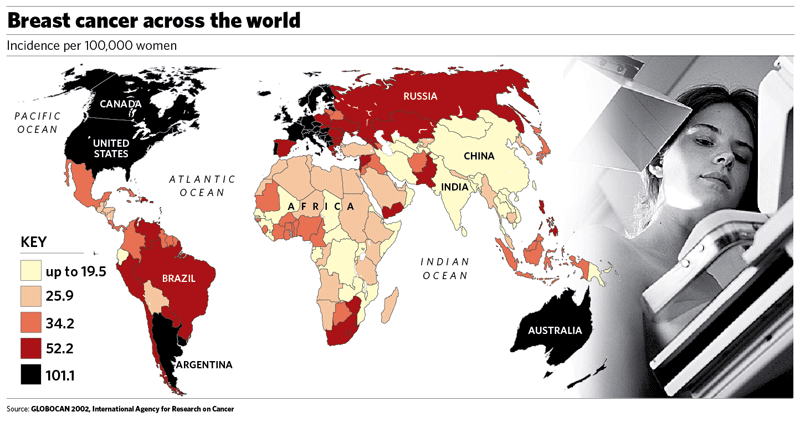
Of all the exports from our modern world, breast cancer ranks as among the most dubious. Once thought to be a disease of the rich, it is now a global epidemic.
The rise of the cancer in Europe and America – cases have jumped 80 per cent in the UK since the 1970s – is being mirrored across the world. And scientists say increasing prosperity and the "Westernisation" of traditional lifestyles is to blame.
A richer diet, smaller families, delayed childbearing and reduced breast-feeding have driven the increase in the West, together with rising obesity and increased alcohol consumption, specialists say. Now these trends are being seen everywhere – with a growing burden of malignant disease in their wake.
An estimated 1.3 million new cases were diagnosed around the world last year. It is the commonest cancer in the UK and across Europe, even though it affects almost only one gender. In 2006, it outranked lung cancer, which affects both sexes, for the first time.
In Japan, Singapore and Korea – countries once renowned for their low rates – cases have doubled or tripled in the past 40 years.
In China, urban cancer registries have recorded 20 to 30 per cent increases in the past decade. India has seen similar rises and cases have doubled in parts of Africa. There are doubts, especially in Africa, about how far better recording has contributed to the apparent rise. But scientists agree that the disease is rampaging across the globe.
However, they disagree about the best way to curb it. Some claim the best hope lies in developing a preventive drug – a hormonal cocktail that would act like a vaccine and provide lifelong protection – and criticise the world's failure to focus attention on it.
Others demand political action, raising public awareness and galvanising governments to provide screening and early treatment that gives women the best chance of surviving. A third school of thought emphasises the need for a public health strategy to highlight the risks of alcohol, obesity and lack of exercise.
Peggy Porter, of the Fred Hutchinson Research Centre in Seattle, Washington, writing in the current New England Journal of Medicine, says the world must wake up to the growing threat.
"As more countries modernise, more women will enter an increasingly sedentary workforce, delay childbearing, exert control over their reproductive lives, live longer and eat a more Westernised diet. Their breast cancer rates will no doubt increase. It is crucial that women's awareness of their risk and their expectations of their government and the medical community regarding detection and treatment increase at a similar rate."
Professor Porter said the biggest barrier to improved care for women was ignorance. "In a lot of countries, women are still afraid to know. When Betty Ford [wife of US President Gerald Ford] admitted she had breast cancer in 1974, it changed the world. Women who had seen it as a death sentence became willing to talk about it, pushed for more care and more research. Other countries need to follow that lead."
Valerie Beral, head of the Cancer Research UK epidemiology unit at Oxford University, said that to blame Westernisation was to miss the central cause – changes in child-bearing.
"We don't need to seek subtle explanations when we know the main one. China has gone from the six-child family to the one-child family in a couple of generations. Most women in the past had six or seven children – it was fairly standard across the world. Each child was breast fed for two to two-and-a-half years, which meant they stopped ovulating and didn't conceive. The hormonal changes that occur around child-bearing and during breast-feeding are protective for life."
We need to investigate the nature of this hormonal protection and synthesise it, she said. "If we could find out why child-bearing gives life-long protection against breast cancer we might develop a hormonal cocktail that could be given to women at age 18 for a year which would have the same effect. I am frustrated that this is not a research priority."
Peter Boyle, head of the International Agency for Cancer Research in Lyon, which will publish global cancer rates next month, said alcohol was the most worrying driver for younger women. "The rise is a huge problem and one which is growing enormously quickly. There are places which 30 years ago had very low rates where it is growing very rapidly. In every region it is the commonest or second most common cancer.
"My concern is over the rise in drinking, especially among young women. For each single unit of alcohol per day, the risk rises by 7 per cent. It's the ladettes who hit the bars on a Friday night that I worry about."
Why rates have risen
* The rising breast cancer rates around the world are linked to increased exposure to the female hormone oestrogen, because of changes in reproduction and diet.
* Improved nutrition means girls reach puberty earlier and women have the menopause later. A century ago, girls had their first periods at 16 and 17, but today it is morelikely to be 12 to 13.
* Each year that the menopause is delayed increases the risk of contracting breast cancer by 3 per cent.
* Increased numbers of women going out to work has led to later births, smaller families and fewer women breastfeeding. Each year that childbirth is postponed beyond the mid-20s increases the breast cancer risk by 3 per cent.
* The more children a woman has, the lower her risk of breast cancer so the trend towards smaller families has increased many women's exposure.
* Breast cancer rates vary widely around the world. Japan has one fifth of the cases diagnosed in the US. However, Japanese women who move to the US rapidly acquire the same risk as American women.
* Breast cancer in the UK has risen by 84 per cent since the 1970s. In 2005, 38,212 women were diagnosed with the disease.
* Breast cancer is the commonest cancer in the UK even though it mostly affects one sex (there are a few hundred cases in men). Lung cancer, the next most common, which affects both sexes, was diagnosed in 30,997 men and women in 2005.
Join our commenting forum
Join thought-provoking conversations, follow other Independent readers and see their replies
Comments