Governments accused of panicking over swine flu
A blizzard of inquiries into the handling of the swine flu pandemic, which began one year ago, have been launched amid allegations that governments around the world over-reacted to the threat.
The World Health Organisation (WHO) has been accused of crying wolf over its decision last June to declare the H1N1 virus a pandemic, the first for 40 years, which could turn out to be the weakest in history. Up to 15 April there had been 474 deaths from swine flu in Britain, mostly in the age group 15 to 44, compared with 2,000 to 4,000 from seasonal flu in an average year, which targets the elderly.
Seasonal flu was driven out last winter by the novel H1N1 pandemic virus, which may therefore end up having saved lives overall from flu in the 2009-10 season.
Early in the pandemic, the Department of Health said it was planning on the basis of a "worst case scenario" of up to 65,000 deaths. That figure was revised down to 1,000 deaths in the autumn, as the virus turned out to be milder and to have spread further than had been thought.
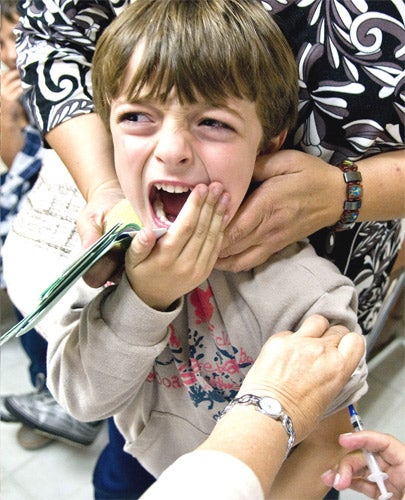
About 5.5 million people have been vaccinated in Britain, but uptake has been low among frontline health workers and groups at risk, at just 30 per cent. The Government, which ordered 100 million doses of vaccine, announced earlier this month that it had "over-bought" 30 million doses, worth £150m, which were now being exchanged for other products.
The most advanced inquiry, being conducted by the Council of Europe, began in January. Paul Flynn, the British Labour MP who is drafting its report, has called attention to the discrepancy between the scale of the warnings and the actual threat. "The next time someone cries wolf over a pandemic, the overwhelming majority will not take it seriously. A pandemic cannot be whatever the WHO declares it to be," he said. The WHO has launched its own inquiry and the European Commission is under pressure from MEPs to establish a separate investigation. In Britain, the Government has announced an independent review chaired by Dame Deirdre Hine.
British experts defended the national and international response to swine flu at a briefing organised by the Science Media Centre in London yesterday. Professor Robert Dingwall, former director of the Institute for Science and Society at the University of Nottingham, said it was better for governments to prepare for the worst and then scale measures back than be faced with having to do the reverse. "Governments are damned if they act and damned if they don't," he said.
Professor Neil Ferguson, of the department of Infectious Disease Epidemiology at Imperial College, London, said assessments of the pandemic in the early months were broadly accurate.
"The difficult thing was tracking how many people were being infected. That was critical to tell how severe the virus was. We saw some people dying but we couldn't put those numbers in perspective." The uncertainty led to predictions that the autumn wave of infections could be up to three times greater than the summer wave but in the event it was about the same size. "The challenge is to develop more rapid diagnosis to overcome the problem of tracking the pandemic. Aspects of surveillance could be improved. Had we known what we were getting we would have responded at a lower level."
Join our commenting forum
Join thought-provoking conversations, follow other Independent readers and see their replies
Comments