Pandemic? What flu pandemic?
First we were told swine flu could kill 65,000 Britons. Now the death toll is unlikely to top 1,
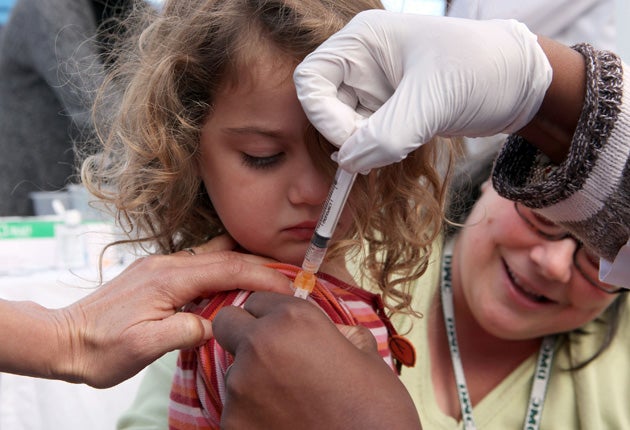
The 2009 swine flu pandemic may turn out to be the weakest in history. It is spreading more slowly than expected and the latest figures show a flattening, or even a dip, in new infections. It is mild in most people but severe in a few and, while it readily infects children, it appears to spare the elderly. With the vaccine being rolled out, its impact should be further curbed.
So far in the UK, 154 people have died from the virus, around half of whom were under 45. In addition, 1,431 were admitted to hospital with swine flu last week. But in comparison with previous pandemics – or even seasonal flu epidemics – this is a relatively low toll.
In July, shortly after the World Health Organisation declared the first flu pandemic for 40 years, Britain's Chief Medical Officer, Sir Liam Donaldson, published a worst-case scenario suggesting the country should plan for up to 65,000 deaths. That planning assumption has since been revised downwards twice. In September the "worst case" was cut to 19,000 deaths, and in October it was cut again to 1,000 deaths. This compares with an average annual toll of 4,000 to 8,000 deaths from seasonal winter flu.
Previous pandemics have had higher death tolls. In 1918 Spanish H1N1 flu claimed an estimated 230,000 lives in Britain and up to 50 million worldwide. In 1957-58, Asian HN2 flu caused 1.5 to 2 million deaths worldwide and 33,000 in Britain. That was followed by Hong Kong H3N2 flu in 1968-69 which caused one million deaths worldwide of which 30,000 were in Britain. So far, 2009 "novel H1N1" flu has caused 6,394 deaths worldwide, of which 154 have been in the UK.
Doctors say the key difference with seasonal winter flu is that it does not normally kill the young. Swine flu is worst among the under-fives, whose hospitalisation rate is four times higher than in older age groups. Pregnant women are also vulnerable.
Doctors have also been dismayed by the unpredictable ferocity with which it attacks some people. The biggest concern is the number in critical care which has risen sharply in recent weeks. In England, of 848 patients in hospital on 4 November, 172 were in critical care.
Dr Steven Field, chairman of the Royal College of GPs, said: "I thought the original predictions for the number of deaths were incredibly high. Hospitals are coming under pressure but, because the care is so good, fewer people are dying."
Dr Laurence Buckman, chairman of the British Medical Association's GPs committee said: "The original government masterplan was for a maximum of 250,000 dead. But that was based on avian flu. It became clear that swine flu did not pose the same risk. Compared with those earlier assumptions it is looking pretty tame."
The H1N1 swine flu virus that emerged in Mexico last April was the first novel flu virus seen for more than 40 years. But it has since become clear that H1N1 virus is not quite as novel as it appeared. Unlike seasonal flu, swine flu has spread much less among the over 60s, leading scientists to speculate that they have some immunity.
Flu viruses are, however, notoriously unpredictable. The 2009 H1N1 swine flu strain proved its capacity to surprise early on by triggering the first serious flu outbreak in summer in living memory last July, when cases peaked at over 110,000.
But it could yet hold more surpises in store. John McCauley, director of the World Influenza Centre at the National Institute of Medical Research in Mill Hill, north London, said: "Of the three pandemics in the last century it is nothing like 1918 Spanish flu and it may well be milder than 1957 Asian flu or 1968 Hong Kong flu. But it is too early to tell. In the pandemic of 1968-69 we had more illness in 1969."
Professor John Oxford, a flu expert and director of Retroscreen Virology Ltd, said: "So far, this pandemic is the weakest. But the paradox is it could be worse next year. We cannot let up our guard."
Professor Angus Nicoll, head of the influenza programme at the European Centre for Disease Control in Stockholm, said: "It is a potentially manageable pandemic but there will certainly be a number of deaths among younger people that we don't normally see. For that reason I would be resistant to saying it is the weakest pandemic, especially if that were used as a reason not to be immunised."
Flu deaths: the numbers
65,000
Number of deaths in worst-case scenario for Britain published in July
19,000
Revised worst-case scenario outlined in September
1,000
Revised worst-case scenario last month
154
Number of deaths in Britain so far
4-8,000
Average annual death toll in Britain from seasonal winter flu
Join our commenting forum
Join thought-provoking conversations, follow other Independent readers and see their replies
Comments