Paxman to donate brain to charity
Newsnight presenter's bequest to help fight against Parkinson's disease
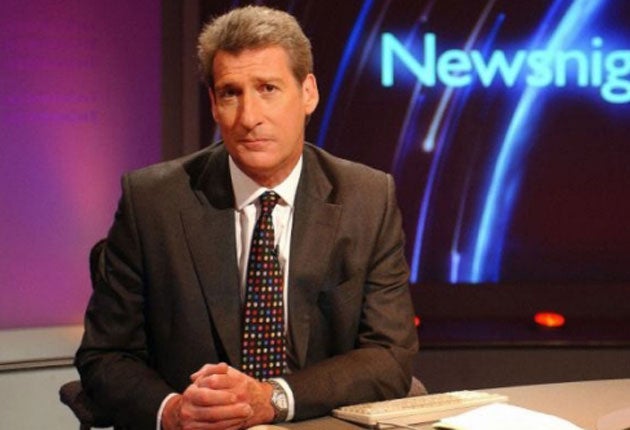
During his time as host of University Challenge, Jeremy Paxman has acted as mediator in countless intellectual jousts featuring some of the brightest young minds in the country.
Now the presenter has said he intends to donate his brain to charity when he dies, so that it can be used for medical research into what happens when the brain grows old.
The TV presenter's mass of grey matter will join 296 others currently stored in a "brain bank" at Imperial College in London. Tissue samples from the organs, which are carefully preserved at the optimum temperature of -80C, are available for use in as many as 50 different research projects into Parkinson's disease around the world.
The progressive disease is caused by a loss of nerve cells in the brain that produce the chemical dopamine, and leads to difficulty in movements such as walking, talking and writing. It affects one in 500 people in the UK.
Mr Paxman's decision came in response to an appeal by the Parkinson's Disease Society, which has also signed up the actress Jane Asher and television presenter John Stapleton for its brain bank. Currently the society has just 1,000 names on a Brain Donor Register, and says a shortage of donated brains is hindering scientists seeking a cure for the disease. The society aims to collect the donated tissue within 24 hours, but can accept it up to 48 hours after death.
According to research carried out for the charity, only 7 per cent of people are comfortable with the idea of donating their brains after they die, whereas more than 60 per cent are comfortable pledging their hearts or kidneys. More than a quarter of people polled said they were worried it would cause distress to their families.
Although most of the brains in the Imperial College brain bank come from Parkinson's sufferers, those donated by healthy people are just as important for experiments, as they allow scientists to carry out comparisons to help establish the causes of the disease.
The donated tissue has already led to several medical breakthroughs in the treatment and understanding of Parkinson's, including the development of drugs such as levodopa which can help to control symptoms.
Mr Paxman said his primary motivation was to encourage other people to follow his example: "There's currently no cure for Parkinson's, which affects 120,000 people. If you register to donate your brain, you can help to find a cure. After all, it's not as if you'll be needing it yourself."
Ms Asher said she had no hesitation in donating her brain after death for medical research. "I volunteered as soon as they asked me. I had already assumed that any bits that anyone wanted would be going to medical science,'' said the actress, whose brother-in-law, Gordon Scarfe, brother of the cartoonist Gerald Scarfe, was diagnosed with Parkinson's six years ago. Ms Asher added that she had visited the brain bank at Imperial College, the biggest such bank in the world.
Mr Stapleton said brain donation was crucial to helping researchers find a cure. "Sadly, my mother lived with Parkinson's and for many years went through the daily struggle of coping with a multitude of disabling symptoms," he said.
Join our commenting forum
Join thought-provoking conversations, follow other Independent readers and see their replies
Comments