Revealed: why risk of infertility and birth defects rises with age
Study pins blame on declining protein levels

Sign up to our free Living Well email for advice on living a happier, healthier and longer life
Live your life healthier and happier with our free weekly Living Well newsletter
Women who discover they cannot have children after trying to start a family too late have been given new hope by scientists in a major advance in understanding the causes of infertility.
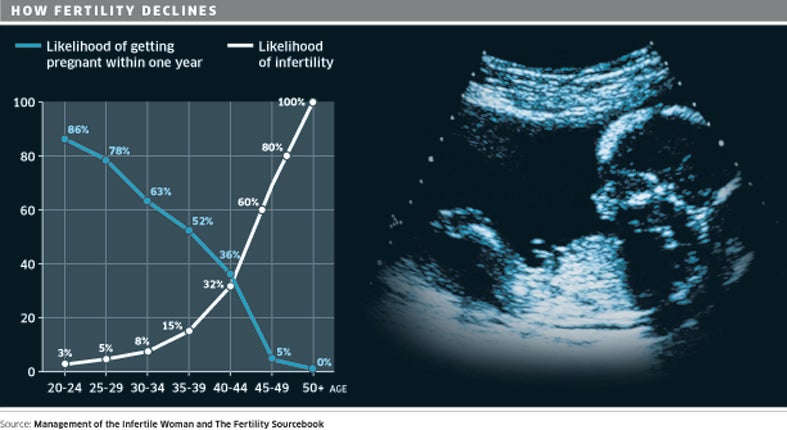
Researchers at Newcastle University have uncovered the mechanism of "reproductive ageing" which causes female fertility to decline rapidly after the age of 35.
The discovery brings scientists a step closer to explaining why older mothers have less chance of conceiving and a greater risk of giving birth to an abnormal baby, and could point the way to a remedy. The research is published, with two other papers, in the journal Current Biology.
The trend of later motherhood is one of the most significant social developments of recent times, but it has brought heartache as an increasing number of women discover they have left it too late to have a baby.
Obstetricians have warned that the "bio-panic" women used to suffer on their 30th birthday has moved to their 40th, and have suggested that instead of searching for Mr Right they should perhaps settle for Mr Good Enough if they want a family.
Some experts have predicted that a fertility time bomb hangs over Britain over the coming decades as women delay childbearing. One in seven couples have problems conceiving, and this could rise to as many as one in three if present trends continue.
Births to women aged 35 and over have soared 56 per cent in the last decade and among women in their 40s by 90 per cent (to 2009). Down's syndrome pregnancies rose by more than 70 per cent in the 20 years to 2008, driven by the trend to later motherhood. Almost half of all births are to women of 35 and over today, but doctors say the "biologically optimal" time for childbearing is from 20 to 34.
The Newcastle study, led by Mary Herbert, reader in Reproductive Biology at the Institute of Ageing and Health, has shown that declining levels of proteins called cohesins, which act like a glue holding chromosomes together, are the key to reproductive ageing.
Loss of these proteins causes the chromosomes to split unevenly when eggs and sperm are being formed. To create eggs and sperm suitable for reproduction, the chromosomes must be halved equally. In eggs, the problem is compounded by the fact that the physical attachments holding the chromosomes together are established before birth and must be maintained by cohesins until the egg is created by cell division just before ovulation.
"Reproductive fitness in women declines dramatically from the mid-30s onwards. Our findings point to cohesin being a major culprit in this," Dr Herbert said.
She and her team compared egg creation in specially bred mice aged two and 14 months and found a "marked age effect".
"The aged mice we used are equivalent to a woman in her early 40s. Cohesin levels were very much reduced in eggs from older mice and the chromosomes underwent a messy division, resulting in the wrong number of chromosomes being retained in the egg."
She added: "We are at the stage of saying how the engine works and what is broken. The next stage is answering the question: can it be fixed? Could you add cohesin that would do the job [of holding the chromosomes together]? A lot of effort is going into answering that."
However, no solution to infertility was imminent. "The main message is for women not to delay childbirth. The best way for women to avoid the problem is to have their children earlier. If there are social reasons why they are delaying then we should look at these and make it easier for them."
Subscribe to Independent Premium to bookmark this article
Want to bookmark your favourite articles and stories to read or reference later? Start your Independent Premium subscription today.
Join our commenting forum
Join thought-provoking conversations, follow other Independent readers and see their replies