Simply eating your five a day will <u>not</u> protect you against cancer
Focus of research shifts to specific fruit and veg that could ward off certain tumours
It has been a shibboleth of healthy living for decades: eat more fruit and vegetables to beat cancer. Now, scientists have found that the anti-carcinogenic properties of such a diet are weak at best.
In one of the largest and longest studies into the link between diet and the killer disease, scientists surveyed the fruit and vegetable consumption of almost 400,000 men and women in 10 European countries including the UK over almost nine years, during which they developed 30,000 cancers.
They found that eating an extra 200g of fruit and vegetables each day, equivalent to two servings, reduced the incidence of cancer by about 4 per cent. The finding confirms the pessimistic view of a growing body of scientists over the last decade: that the protective effect of fruit and vegetables against cancer is very limited.
It represents a dramatic reversal from 20 years ago, when as high as 50 per cent potential reductions in cancer risk were suggested. The World Health Organisation in 1990 recommended five servings of fruit and vegetables a day.
Is that recommendation now history? No. The latest finding is undoubtedly a serious blow, demolishing one of the pillars of the cancer-protective lifestyle. But there is still good evidence that fruit and vegetables protect against heart disease and stroke.
In the same population of men and women which showed virtually no effect of fruit and vegetable consumption on cancer, there was a 30 per cent lower incidence of heart disease and stroke among those eating five servings a day compared with those eating less than one and a half servings.
Separate studies have shown that increasing fruit and vegetable consumption reduces blood pressure, a major cause of heart disease.
But how were researchers misled over the decades? Paolo Boffeta of the Mount Sinai School of Medicine in New York, who led the study published in the Journal of the National Cancer Institute ( JNCI), said other factors linked with a high fruit and vegetable consumption, such as lower alcohol intake, not smoking and having higher levels of physical activity "may have contributed to a lower cancer risk".
The over-emphasis on fruit and vegetables may also have come from the way the early research was conducted. "Case control" studies formed the basis of the evidence, in which the diet of a person with cancer was compared with that of someone who did not have cancer but who was matched in age, sex and other factors.
These studies rely on people's memories of what they ate, and depend on people volunteering to be controls who have a strong interest in health. Thus, the tendency to exaggerate the benefits of the diet is built in from the start.
Later in the 1990s, case control studies were replaced by prospective studies in which participants were asked about what they were eating at the time, thus avoiding the problems of recall, and followed to see who developed cancer in the ensuing years.
Results from these studies were consistently less impressive than the earlier ones. Now, one of the biggest studies has confirmed the disappointing conclusion that an apple a day is unlikely to save you from cancer.
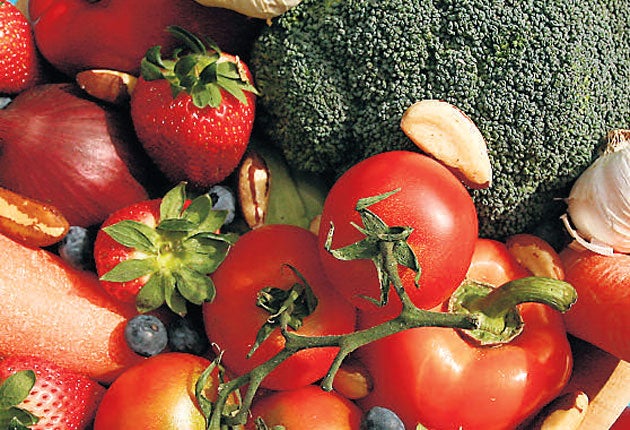
It remains possible that specific foods have preventive effects against specific cancers, and that the overall effect of a diet high in fruit and vegetables is greater in younger people. In an accompanying editorial in the JNCI, Walter Willett of the Harvard School of Public Health singles out lycopene, a constituent of tomatoes, for which there is "considerable evidence" of a protective effect against prostate cancer. Many other foods including blueberries, broccoli and strawberries are also said to have anti-cancer properties.
"The findings add further evidence that a broad effort to increase consumption of fruit and vegetables will not have a major effect on cancer incidence," Professor Willett concludes. "Such efforts are still worthwhile because they will reduce risks of cardiovascular disease, and a small benefit for cancer remains possible. Research should focus more sharply on specific fruits and vegetables and their constituents and on earlier periods of life."
Dr Rachel Thompson, science programme manager for the World Cancer Research Fund, said: "This study suggests that if we all ate an extra two portions of fruits and vegetables a day (about 150g), about 2.5 per cent of cancers could be prevented.
"Given the fact that there are many types of cancer where there is no evidence eating fruits and vegetables affects risk, it is not surprising that the overall percentage is quite low. But for the UK, this works out at about 7,000 cases a year... a significant number."
Super foods: The produce now under the microscope
Red and orange peppers
An excellent source of vitamin C. Half a red pepper provides all the vitamin C an adult needs in one day. They also contain anti-oxidant flavenoids and beta-carotene.
Strawberries
As well as vitamin C and flavenoids, they contain the phytochemical ellagic acid, which research has shown can help inhibit the growth of cancers.
Carrots
Good source of beta-carotene, which the body converts to vitamin A. This keeps skin healthy and helps the immune system.
Tomatoes
The antioxidant lycopene is what makes them red. Studies have linked tomatoes, especially when cooked, canned or in pastes and sauces, with a lower risk of prostate cancer.
Onions
Contain allium compounds and are rich in quercetin, a phytochemical. Both of these are thought to reduce cancer as well as improving circulation and blood pressure.
Broccoli, cabbage, sprouts
Members of the brassicas family, linked with lower rates of cancers of the digestive system.
Garlic
Contains allylic sulphides, garlic has long been used as a natural medicine. May help ward off cell damage.
Blueberries
Full of vitamin C and a good source of the antioxidant anthocyanin, believed to boost the immune system, help keep the heart and skin healthy.
Brazil nuts
Rich in selenium, a mineral, important to people in the UK who mostly have low intakes. Some studies have suggested low levels increase the risk of cancer and heart disease.
Join our commenting forum
Join thought-provoking conversations, follow other Independent readers and see their replies
Comments