Spain takes on Germany after cucumber scare cripples farm exports
Spanish farmers say the panic has cost them €200m a week, with three million kg of fruit and vegetables wasted, while the transport industry has lost €15m
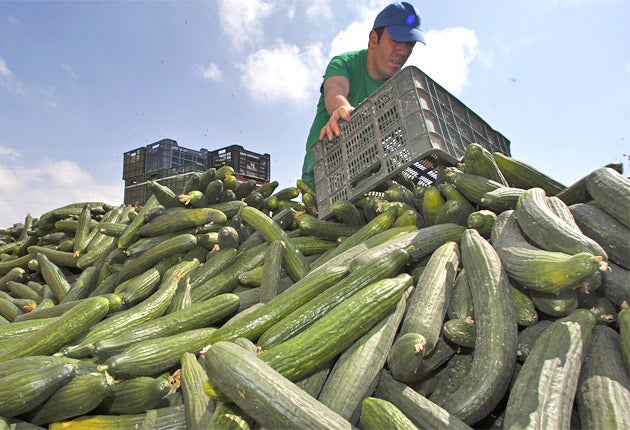
Spain could launch legal action against Germany over accusations that Spanish cucumbers caused the E.coli outbreak that has so far killed 16 people in Germany and one in Sweden.
Spain's Deputy Prime Minister, Alfredo Perez Rubalcaba, said that the government in Madrid may issue a legal challenge to officials in the German port city of Hamburg, "who have questioned the quality of our products".
Spain has complained that German authorities pointed the finger of suspicion at Spanish produce before the result of tests were known. The latest death came in Germany and officials have said more than 1,500 people in nine nations – mostly all in Germany – have now been infected.
The German allegations have virtually paralysed exports of Spanish fruit and vegetables. After days of uncertainty, Hamburg officials said on Tuesday that tests showed that Spanish cucumbers had traces of E. coli bacteria, but not the strain that caused the outbreak.
But growers are still reeling from the so-called "cucumber psychosis" that turned the suspect Spanish vegetable into a market pariah throughout Europe and placed all Spanish produce on an unofficial blacklist.
Spanish farmers say the wave of panic cost them as much as €200m a week. The transport industry lost another €15m as delivery trucks were turned away at Spanish borders. Roughly 3m kg of unwanted fruits and vegetables rotted as the accusations surfaced. According to Spain's trade unions, the scare also jeopardises as many as 70,000 jobs, mostly in Almeria, Malaga, and other regions hard-hit by Spain's economic slump. "The damage is so enormous because the brutal alarm has affected so many products. We don't know how we'll recover," said Carlos Blazquez, president of Asaja Malaga, a farming co-operative representing the 4,000 vegetable growers whose losses total €6m so far.
"We just got word that Russia has closed its doors to the Malaga lemon and that the United States has started to raise entry barriers for our citrus growers, causing incalculable losses," he added.
The Spanish government says the accusations were made "without any proof". Brussels is now studying how to compensate the industry.
Spain's agricultural sector generates 15 per cent of the country's GDP and creates more than 300,000 jobs. Each year, the country produces roughly 16 million tons of fruit and vegetables, more than half of it for export to the rest of Europe. This large external market makes it especially vulnerable to a panic-provoked boycott.
And so, as the death toll in Germany mounted, the Spanish media flashed image of goats feeding on mountains of discarded cucumbers. A photo in El Mundo on Wednesday showed a sign at a Berlin marketplace boasting: "Here we don't sell Spanish products!"
"Yesterday I had two trucks of cucumbers and tomatoes loaded for Romania, but they told us that they didn't want anything grown in Spain," a worker for an Almeria grower, MartiGarcia, complained.
Following news of the outbreak, Russia prohibited imports of all Spanish vegetables, while Austria, Belgium, Germany and the Czech Republic instituted partial bans. Vegetable deliveries to France were put on hold, too. Vendors in several countries even cancelled orders for summer fruits like peaches and nectarines. Cucumber sales plummeted from the usual high of 70,000 tons to a meagre 2,000 tons.
Farmers now worry about a drop in prices for all produce. Before the cucumber scare, watermelon sold for €0.35 to €0.38 cents per kilo, for instance. Now the price is roughly half that.
Echohal, an association of produce vendors in Andalusia, announced that "hundreds" of workers have been fired, including 550 packagers in Almeria, Granada and Malaga. Warehouses in Almeria have already given an unpaid "day off" to more than 100 workers.
But there seems to be light at the end of the tunnel. Juan Antonio Diaz, a produce distributor in Almeria, said: "We're happy. One of the biggest supermarkets in Germany and Austria just ordered from us again."
Join our commenting forum
Join thought-provoking conversations, follow other Independent readers and see their replies
Comments