The birth of hope for Afghanistan's mothers
The number of women dying in childbirth every year is 10 times higher than the civilians killed in the conflict. But a new clinic is offering a brighter future
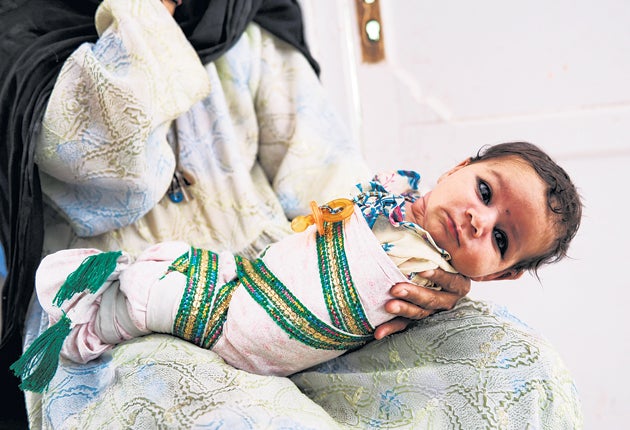
Abdul Manan stood expectantly outside the maternity unit awaiting the birth of his first child, his calm facade only betrayed by the way his head snapped around each time the delivery room door opened. On the other side of the door, his teenage bride Firoza barely whimpered as she entered the final stages of a long labour, assisted by an increasingly fraught looking midwife.
In many parts of the world, it would be a variation on an entirely normal scene. But in Afghanistan, where the number of women who die in child birth annually is 10 times higher than the civilians killed in the bloody conflict, Abdul's insistence on bringing his wife to the newly built hospital unit represents a dramatic sign of progress. The country competes with Sierra Leone for the highest maternal mortality rate in the world. Every year, 24,000 women perish from complications in pregnancy that would be easily treatable in the UK. Only the day before, Dr Abdul Latif explained mournfully, he had lost a patient who had just given birth. By the time her husband capitulated and brought her to hospital, she was haemorrhaging so badly he and three of his fellow doctors could not save her.
Afghanistan's atrocious maternal mortality rate is down to numerous factors. Particularly in rural areas such as Helmand, women give birth in the mud compounds of their homes, husbands refuse to bring them in to hospital until complications are near fatal and many are so young their frail bodies cannot cope.
They suffer from ruptured uteri and eclampsia along with a variety of other problems, explained Dr Latif. "Some are 10 or 12, generally they are 14," he said. "Because of these problems they will die. If the women came in earlier, we could do something."
More than half of Afghan girls are married off under the legal age of 16, according to United Nations figures, and in the poverty stricken villages of Helmand, the problem is acute. Girls who have babies before the age of 15 are five times more likely to die in childbirth than women in their twenties. At the other end of the age scale, Dr Latif explained, he was dealing with women who had borne 20 children in their life time: "The oldest was a woman of 60, who had 25 children – 12 survived."
Four months ago, Gereshk District Centre hospital, with £32,000 in British Government aid and the support of a Military Stabilisation Support Team, built a new maternity unit that is beginning to attract patients from across the province.
The sign above the door may read rather quizzically "Delivery Service" but the pristine cubicles provide a rare level of care from an understaffed but dedicated team of nurses and midwives. A lone incubator with a yellow baby blanket awaits its next infant. The freshly painted pink walls are plastered with cartoon posters promoting the benefits of healthcare to predominantly illiterate patients. One shows a husband leading his wife gently by the hand up the path to the hospital, a rare ideal in Afghanistan.
In one cubicle, Firoza grimaced in pain, looking much younger than her 18 years with her mother beside her. Occasionally, the masked midwife burst through the curtains, her furrowed brow glowing with sweat. The young woman's husband, an earnest 19-year-old student, insisted on bringing his wife in from their village outside Sangin: "I told her I know these things. I know there are some dangers to pregnancy. It is important to come here. I am very happy. Every child is from God but I hope it is a boy. I will call him Naqibullah."
It is a hopeful sign that educational projects by community health workers may be getting through. "It is very important. Most of our society is illiterate. They really have no information," said Dr Mohammed Tahir, of the Ministry of Health, agreeing that men remain reluctant to bring their wives to hospital. "It is still a problem but not as bad as before especially with people from the city but there are more issues in the countryside."
Dr Latif continued: "They don't like coming to the clinic. Education is a top priority because it is very important they know about the problems and come to hospital in good time."
A UN report in December 2010 stated that Afghanistan had the worst maternal mortality rate in the world due to early marriage, frequent pregnancies and lack of awareness linked to low levels of literacy. It said that 24,000 women die each year – in comparison to 2,412 conflict-related deaths recorded in 2009 – and many are under 18. Furthermore a child born to an under-age girl had a 60 per cent less chance of surviving. The Save the Children index this May described Afghanistan as the worst place in the world to be a mother – one in 11 women perishes in pregnancy while one child in every five dies before reaching their fifth birthday, "meaning that every mother in Afghanistan is likely to face the loss of a child".
In a province with a population of almost 1.5 million, the new unit deals with just five deliveries a day – but women are beginning to travel in from far and wide. It now performs Caesarean sections and Dr Latif is determined to expand. One obstacle so far has been the difficulty of finding female doctors and more midwives. He blames a low salary of just $300 a month. "And we need a blood bank," he added. "A lot of the deaths are because they have lost too much blood."
Built by local contractors, the new unit was part of a major renovation of the hospital, explained RAF Sergeant Karen Swallow: "Previously the maternity ward was what can only be described as a broom cupboard with two old beds side by side. Now it is a completely new building with up-to-date facilities, giving privacy and respect to the women before, during and after labour."
The maternity unit has proved an oasis in a war-torn province where British soldiers and civilians continue to lose their lives – and far more women perish in childbirth.
Join our commenting forum
Join thought-provoking conversations, follow other Independent readers and see their replies
Comments