The Lancet retracts controversial MMR research paper

Sign up to our free Living Well email for advice on living a happier, healthier and longer life
Live your life healthier and happier with our free weekly Living Well newsletter
An eminent journal which published a controversial research paper sparking concerns over a possible link between the MMR vaccine and autism retracted it from the public record today.
The Lancet said following the judgment of the General Medical Council (GMC) fitness to practise panel last Thursday it had become clear that several elements of the 1998 paper by Dr Andrew Wakefield and others were incorrect.
The panel made a number of criticisms of Dr Wakefield, including that he was misleading and irresponsible in the way he described the study.
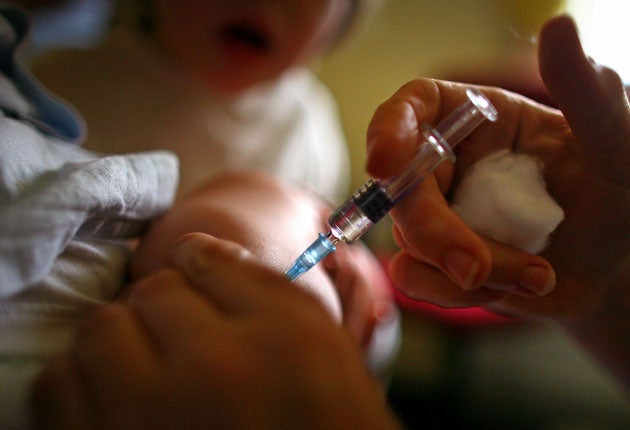
The research sparked a massive drop in the number of children given the triple jab for measles, mumps and rubella.
The editors of the Lancet said it had become clear that several elements of the paper were incorrect, contrary to the findings of an earlier investigation.
"In particular, the claims in the original paper that children were 'consecutively referred' and that investigations were 'approved' by the local ethics committee have been proven to be false. Therefore we fully retract this paper from the published record."
The fitness to practise panel ruled last week that Dr Wakefield "showed a callous disregard" for the suffering of children and subjected some youngsters to unnecessary tests.
Dr Wakefield "abused his position of trust" as he researched the possible link, it said.
He also brought the medical profession "into disrepute" after he took blood samples from children at his son's birthday party in return for £5 payments.
He and two colleagues involved in the research, Professors John Walker-Smith and Simon Murch, face being struck off if they are found guilty of serious professional misconduct at a later date.
It ruled that Dr Wakefield "failed in his duties as a responsible consultant" and went against the interests of children in his care in conducting research.
He further acted dishonestly and was misleading and irresponsible in the way he described the study.
It said Dr Wakefield, whose contract prevented him from carrying out clinical research on youngsters, had not acted in the children's best clinical interests.
He ordered some youngsters to undergo unnecessary colonoscopies, lumbar punctures (spinal taps), barium meals, blood and urine tests and brain scans.
Some of the tests were carried out by Professors Walker-Smith and Murch.
The GMC said the children did not meet the criteria for inclusion in the research and the doctors did not have ethical approval to investigate them.
The panel heard Dr Wakefield later took blood from his son's friends at the birthday party and joked about it during a US presentation in March 1999.
Dr Wakefield was an honorary consultant in experimental gastroenterology at London's Royal Free Hospital at the time of his research.
A decision on serious professional misconduct and any sanctions are not expected for a matter of months.
Dr Wakefield said after the GMC hearing: "The allegations against me and against my colleagues are both unfounded and unjust - I repeat unfounded and unjust - and I invite anyone to examine the contents of these proceedings and come to their own conclusion."
A statement from an earlier investigation, by the Royal Free and University College Medical School and the Royal Free Hampstead NHS Trust, which was carried in The Lancet in March 2004, said: "We are entirely satisfied that the investigations performed on the children reported in the Lancet paper had been subjected to appropriate and rigorous ethical scrutiny."
It added: "The investigations were those thought appropriate in the light of the severity of the children's symptoms according to the clinician's judgment at the time."
Professor Adam Finn, professor of paediatrics at University of Bristol Medical School, said today: "This is not before time. Let's hope this will do something to re-establish the good reputation of this excellent vaccine.
"And I hope the country can now draw a line under this particular health scare and move on to new opportunities for vaccination."
Dr David Elliman, consultant in community child health, Great Ormond Street Hospital For Children, said: "I feel this is a very reasonable decision. To be fair to The Lancet, they did publish a commentary at the time urging caution that wasn't picked up.
"I think the reality of the world today is that academic papers on major public health issues do not remain the property of academia.
"Therefore it is incumbent on us all in science, in journals and in the media to be very certain of the strength of a study before rushing to publish, and to be aware of the potential effects."
Dr Michael Fitzpatrick, GP and author of two books on autism and the MMR scare, said: "Good news - only 10 years late!"
Subscribe to Independent Premium to bookmark this article
Want to bookmark your favourite articles and stories to read or reference later? Start your Independent Premium subscription today.
Join our commenting forum
Join thought-provoking conversations, follow other Independent readers and see their replies