The transplant revolution
Medical breakthrough sees 10-year-old boy's stem cells used to grow donor organ inside his body
A 10-year-old boy has undergone pioneering surgery in which his own body worked as a "bioreactor" to help a donated windpipe, seeded with his own stem cells, grow into a fully functioning organ.
The boy, who is British, is the first child in the world to undergo the revolutionary transplantation. The development takes transplant surgery a step closer to the goal of replacing damaged or worn-out organs with functioning replacements that are not rejected by the body, which are in increasing demand as life expectancy grows.
It also opens up the prospect of treating damaged organs with stem cells to stimulate self-repair, potentially avoiding the need for a transplant.
The nine-hour operation was carried out at Great Ormond Street Hospital in London on Monday by a British and Italian team of specialists. The boy has not been identified, at his family's request, but doctors said he was out of bed, breathing freely and speaking.
"He says it is easier to breathe than it has been for many years," said Professor Martin Elliott, the surgeon who carried out the operation.
In a previous similar case, a team led by Professor Paolo Macchiarini, of Careggi University Hospital in Florence, transplanted a trachea [windpipe] into a 30-year-old woman, Claudia Castillo, which had first been stripped of its cells by an enzyme process and then "customised" with her own stem cells so it was not rejected by her body. The customised trachea was grown in a bioreactor in the laboratory for four days before being transplanted. Ms Castillo remains well today.
But in the case of the British boy, instead of growing the customised donor trachea in the laboratory, it was transplanted immediately after being seeded with stem cells so that the patient's body acted as the "bioreactor" to help it grow into a fully functioning organ. This refinement of the technique makes it quicker and cheaper, so it can be applied in hospitals around the world.
Professor Martin Birchall, a specialist in regenerative medicine at University College London, who was part of the boy's surgical team, said: "I believe this is a real milestone. Only a few hundred children and adults will benefit directly from this operation but we can immediately apply the technique in other settings. It will be many years before it replaces [conventional] transplants but it is a serious step on the way."
Conventional transplant surgery involves the transfer of organs from dead donors and means the living recipients have to spend the rest of their lives on powerful drugs to suppress their immune systems, putting them at risk from infections and diseases such as cancer.
The operation on the 10-year-old boy is the first to be announced using the new technique. A sample of bone marrow was taken from his hip, stem cells were separated out from it and injected into the "scaffold" of the donor trachea before it was implanted into the boy, in place of his own trachea.
The team carried out a similar operation on a 53-year-old woman in Barcelona last year and were preparing to announce the results when details of the British case leaked to the Italian media, forcing them to hold a press conference in London yesterday. Professor Macchiarini said: "Rather than wait till an organ fails we may [in the future] be able to use stem cells to repair it – by trying to replace the function not the organ. The question is can we avoid replacing the organ by just improving the function?"
The doctors said it would be months before it was clear whether the operation had been a success. He was born with a windpipe measuring just one millimetre across and could not breathe. He has had repeated operations to patch it and hold it open but suffered a serious haemorrhage in November. His doctors said he had run out of options and the revolutionary transplant was his only hope.
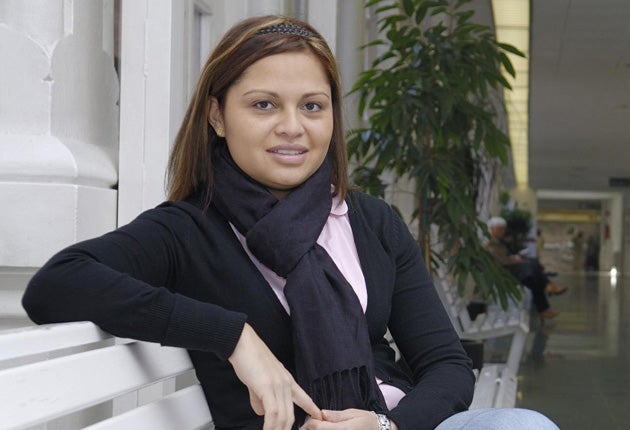
Claudio Castillo: Medical pioneer
*Claudia Castillo made medical history in 2008 when she became the first patient to receive a whole organ transplant grown using her own cells. Her trachea, which had been damaged by tuberculosis, was replaced by one injected with with her own stem cells and grown in the laboratory before being implanted (in the British case, announced today, the donor trachea was transplanted immediately after being injected with stem cells, making the procedure simpler and cheaper) . Originally from Colombia, Ms Castillo lives in Barcelona with her two children, Johan, 16, and Isabella, five. Shortly after her case was made public in November 2008 she contracted an infection and needed a stent – a metal tube – fitting to prevent her trachea collapsing. She has since recovered, the stent has been removed and she remains well.
Join our commenting forum
Join thought-provoking conversations, follow other Independent readers and see their replies
Comments