Health & Families

5° London Hi 8°C / Lo 4°C

Warning over triathlon death rate

Participants twice as likely to die as marathon runners, study concludes
By Jeremy Laurance, Health Editor

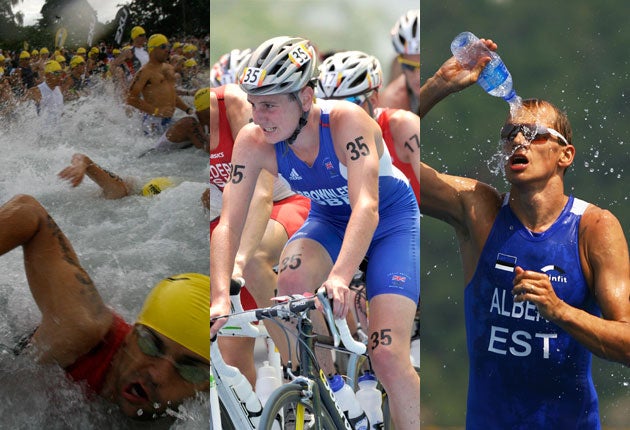
100,000 people took part in more than 700 triathlon events in the UK last year

REUTERS; GETTY; DAVID ASHDOWN

100,000 people took part in more than 700 triathlon events in the UK last year

It is one of the fastest-growing Olympic sports and one of the most gruelling. But a series of deaths among competitors in the triathlon has raised concerns about whether the physical demands of the race are too great.

A record 100,000 competitors took part in 700 events in the UK last year, organised under the auspices of the British Triathlon Association and that total is set to be exceeded this year. All the races involve three phases – swimming, cycling and running – but can be of varying lengths from the "sprint" to the punishing "iron man" – a 2.4-mile swim, 112-mile bike ride and 26.2-mile run (as for a marathon).

Now a study has revealed that the risk of dying in a triathlon, though low, is nearly double the risk of dying in a marathon. A study presented to the American College of Cardiology Conference showed there were 14 deaths among almost one million competitors, a rate of 1.5 per 100,000. A further four deaths occurred among non-officially recognised events.

No study has been conducted in the UK, but two deaths have occurred in recent British triathlons, one during the bike race and one involving a competitor who died after the event, while asleep. Both had heart abnormalities.

In the US, 13 of the 14 deaths occurred during the first portion of the swim phase, leading doctors to speculate that the stress of jumping into cold water under competitive conditions could cause vulnerable people to hyperventilate or suffer a heart attack.

Cold water constricts blood vessels, forcing the heart to work harder which can trigger a heart attack. Most competitors train in pools and may not be used to swimming in open water where the combination of cold, wind, thousands of rivals splashing alongside and the lack of anything to cling on to may lead some into difficulty.

Kevin Harris, a cardiologist at the Minneapolis Heart Institute of Abbott Northwestern hospital who presented the results, said the risk was not large, but was also "not inconsequential". Triathlons were events that people "just signed up to," without a medical check-up for heart problems and they trained by swimming lengths in their local pool which was "lot different from swimming in a lake or river".

USA Triathlon has recorded 23 deaths in the event since 2004 of which 18 have occurred during the swim. At least seven of these were experienced competitors. Postmortems have shown people in good health without an obvious cause of death, such as blocked coronary arteries, suggesting heart rhythm problems may have been the cause.

Cardiologists have speculated that swimming may trigger a type of heart rhythm malfunction called long QT syndrome. This is an inherited condition affecting about one in 2,000 of the population that can result in the heart skipping a beat after which its electrical system goes haywire, which can be potentially fatal. The adrenaline rush at the start of a race could aggravate conditions such as long QT syndrome. Zara Hyde Peters, chief executive of the British Triathlon Association said deaths during the event were "very rare" and had a variety of causes. Suggestions that swimming could trigger an abnormal heart rhythm were speculative.

"I cannot comment on the US research because we do not know enough about the circumstances in which the deaths occurred ... We operate an event-permitting system to ensure the event is safe for competitors and that anything that can be prevented is prevented. But individuals still have a responsibility to follow the advice that is given."

Gary O'Donovan, an exercise physiologist at the University of Exeter, said the idea that triathlons were dangerous was nonsense.

"It is sedentary living that is killing people, not exercise. The last thing we need is a suggestion that exercise is bad for you."

Post a Comment

View all comments that have been posted about this article.

Offensive or abusive comments will be removed and your IP logged and may be used to prevent further submission. In submitting a comment to the site, you agree to be bound by the Independent Minds Terms of Service.

Comments

Triathlon death rates
[info]miceal wrote:
Tuesday, 26 May 2009 at 08:44 am (UTC)
it's not a good comparison i.e. triathlons with marathons. the triathlon is just harder. what next? comparing death rates for mountaineers on mount everest with death rates for hill walkers?
Generalisation?
[info]serenasyeddesai wrote:
Tuesday, 26 May 2009 at 10:02 am (UTC)
Many more unique factors which havent been taken into account. Serena
Could we have some figures we can compare against
[info]kuma2000 wrote:
Tuesday, 26 May 2009 at 05:50 pm (UTC)
For example, smoking-related deaths per million over the last four years for smokers?
Re: Could we have some figures we can compare against
[info]copycat7 wrote:
Tuesday, 26 May 2009 at 06:57 pm (UTC)
like people slipping in the bath tub and banging the head (one of the most popular ways to die apparently).
triathlons
[info]hargreaves999 wrote:
Wednesday, 27 May 2009 at 12:20 pm (UTC)
gary O'donovan is right thta sednetary life is bad for the heart - BUT his comments are intemperate as deaths amongst competitive athletes have a different cause from the common or garden heart attack in the smoking obese population. We screen high level athletes for the sort of inherited conditions that can kill people under conditions of strenuous exercise. I personally work with a premiership football club to do this. really, anyone contemplating this level of exercise should have a proper cardiac screen. It is mandatory in Italy - these daths are preventable

Dr Duncan Dymond
Consultant Cardiologist
Swim nerves
[info]starttri wrote:
Friday, 29 May 2009 at 03:02 pm (UTC)
We've worked with clients concerned about the swim start of triathlons.
Check out our article on the subject: http://www.start-tri.com/Home/Entries/2008/8/1_Calming_Open-Water_Swim_Nerves.html
[info]bron7 wrote:
Tuesday, 11 August 2009 at 07:49 am (UTC)
Heart attack- you guys needed to research this more, there is already a study out where the consensus was permeability of the vascular system of the lungs that leads to blood filling up the respiratory system with fluid, thus drowning the athlete. The current theory is a genetic predisposition to pulmonary blood leakage through vein walls under high stress/physical exertion. They are still researching the phenomenon to try to prevent this occurance. It has been happening for years, and has been misdiagnosed for years, just another example of misinformation/misdiagnosis, the only difference is now there is a larger sample size/larger occurence.
[info]ds77vm86 wrote:
Tuesday, 11 August 2009 at 01:55 pm (UTC)
they never said exercise was dangerous or bad for you. we all know exercise is beneficial. but when youre pushing your body to do things it isnt made to do, youre going to come across problems. even if you train for years.
Like most news articles
[info]texastri wrote:
Tuesday, 11 August 2009 at 02:23 pm (UTC)
Since I learned that most accidents will happen within 5 miles of my home, I've moved...
Seriously though, like any news article you really have to get to the source to really learn anything. If anyone can get past the sensationalism, the study gets down to some basics about regular checkups and more detailed ones for athletes, and the importance of training for the race environment and a proper warmup.
For my last tri (last weekend), I trained in an 85 degree(f) outdoor pool and was reminded of the HUGE difference when I jumped into the 76 degree (f) indoor pool for the start.
Sensationalism vs. Preparation
[info]trimark wrote:
Tuesday, 11 August 2009 at 02:58 pm (UTC)
Having completed my first two triathlons this year, I can safely say that I am a lot fitter than I was a year ago: the regular cardio training mixed with strength training has reduced my weight, reduced my stress levels & enhanced my fitness as well as my general well-being.

Part of my training (as advocated in all the books, magazines & articles I've read) includes open water swimming: it is considered essential that you've trained in the conditions that you will encounter! No other athlete would expose themselves to an unknown environment without any prior training.

Before entering the water, you are encouraged to splash water on face to start adjusting to the change in temperature. You are advised not to jump into the water but ease yourself in, allowing your body (normally encased in a wetsuit in colder climates) to adjust.

If people aren't doing this, then they haven't prepared adequately enough.

I'm not even going to comment on the sensationalist headlines: it would be too easy to point out the health benefits & ask for comparable figures in other sports, never mind smoking/alcohol death rates!
triathlon deaths
[info]sandmier wrote:
Tuesday, 11 August 2009 at 03:22 pm (UTC)
It should be noted that while all 'marathons' are 26.2 miles; all triathlons are not. The full size triathlon of 2.4 mile swim, 112 mile bike and 26.2 mile run turns people away by intimidation alone. Smaller triathlons with as little as an 800 yd swim, 12 mile bike and three mile run coax people off the couch but sometimes delude them into thinking they don't have to train for it. Further, to a non swimmer who over estimates their water skills 800 yards is a very long swim. Far more of the 'tin man' variety triathlons are hosted than the 'iron mans' and I wonder if maybe they are the major source of fatalities.

Most popular in Life & Style


Free gym pass

Get fit for summer with Fitness First gyms in London

Download a free gym pass from Fitness First today

Article Archive

Day In a Page

Sun | Mon | Tue | Wed | Thu | Fri | Sat

Select date