Winter 1893: Greece is bankrupt. Summer 1896: It hosts the first modern Olympics
The same spirit that allowed a troubled nation to stage the first international sports festival can rescue it again.
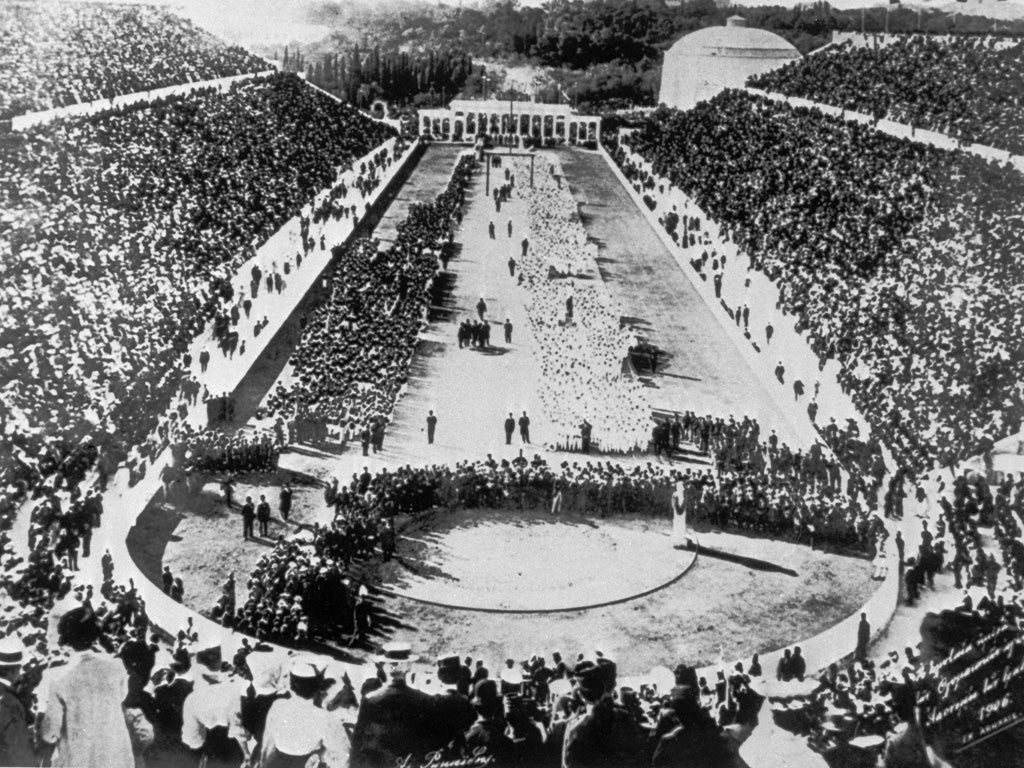
There may have been a few times in the past when Athenians were as unpopular as now – during the Peloponnesian War, for instance, or the plague in 430BC – but not many. Their generous retirement benefits and reluctance to pay taxes, plus the almost heroically irresponsible lending to them by Western banks, have made nearly everyone full of resentment at the huge debts the Greeks owe us.
Next year, however, the entire planet will have a chance to appreciate instead what we owe them. It will come with the 2012 Olympic Games, the 30th celebration of an event which the Greeks conceived in ancient times, and were crucial in reviving in the modern era. And the story of how – against ludicrous odds – they did so is one that might not only diminish our resentment, but also perhaps inspire them to believe their present difficulties can be overcome.
December 1893 was the previous nadir of Greek finance. On the 10th of that month, Prime Minister Trikoupis rose in parliament and uttered the words: "Regretfully, we are bankrupt." In a dash for modernisation and growth, Greece had woefully over-borrowed. Repayments might have proved troublesome even if the economy had been buoyant, but state revenues stuttered, and overseas earnings sagged alarmingly. Currants made up nearly three-quarters of the country's exports, and the collapse in demand for them, and so prices, was devastating. By mid-1893, more than half of the Greek budget was being used to service existing loans. It couldn't last, and it didn't. The country had to cede control over its finances to a commission of officials from Britain, France, Germany and elsewhere.
Seven months later, an event took place in Paris which led to Greece proving it was a great deal more than a mere bankrupt state. It was the Congress for the Restoration of the Olympic Games, and was organised, only after considerable difficulties, by Baron Pierre de Coubertin, a determined French educationist and sports enthusiast. From first to last, the event was saturated in reverence for Ancient Greece, so much so that, instead of awarding the first modern Olympics to France, Sweden, or Hungary, all of which were willing to host them, the delegates gave them instead to Greece – a very reluctant Greece, as far as its government was concerned.
Trikoupis was privately opposed, yet publicly non-committal. But the body which controlled nearly all serviceable sports facilities in Athens was run by an old ally of his, and this, to the horror of Coubertin and chums, met and declined to stage the Games while Greece was "in the throes of a great economic crisis". Coubertin hurried off to Athens, and was told by Trikoupis that Greece "does not have sufficient funds to accept the mission you wish to entrust to her".
But the little Frenchman (he was only 5ft 3in tall) was not to be beaten. He knew the Greek royal family were on his side (being transplanted Danes, they were anxious to bang the patriotic drum whenever they could), and he called a public meeting. His speech was a verbal tour of Greek achievements over the centuries, referred to the formidable challenge of Greece staging the games, and then added: "The dishonour here would consist not of being beaten; it would consist of not contending." Thus did the familiar Olympic slogan "not the winning but the taking part" begin life not in reference to an athletic event, but to the very staging of the Games themselves.
Before King George returned from abroad, to declare the royals four-square behind the Games, Trikoupis resigned, and the Crown Prince was put in charge of the Athens Organising Committee. It met for the first time on 13 January 1895 to devise a detailed schedule of events, cultural as well as athletic, to ensure all who were expected could be accommodated, get existing venues up to scratch, build new ones, and, most pressing of all, to turn the derelict Panathenaikon Stadium into a fitting arena for the world's first international sports festival. To do all this they had precisely 14 months, and no funds. In a bravura act of faith for a bankrupt nation, they decided that not a penny, cent, or franc would be accepted from foreign sources. Every drachma would have to come from Greek sources.
What now followed was one of the most remarkable examples of peacetime mobilisation in modern history. Round went the begging bowl. Municipal authorities organised collections within the country, embassies and consulates dealt with expatriates, and, in places, the effort took on the fervour of a crusade. Donations came in from all over Greece, and from Greek communities in the Balkans, London, Copenhagen, Ireland, Boston, Cairo, Vienna, Odessa and Marseilles. Individual merchants gave as much as 10,000 drachmas, and even the monks of Mount Athos sent cash. Within a month, more than 130,000 drachmas had been given. But all this paled into insignificance compared with the generosity of a shy, but rich, Greek merchant living in Alexandria, Egypt. Georgios Averoff agreed to underwrite the entire cost of restoring the Panathenaikon Stadium. It would cost him more than one million drachmas.
Averoff's generosity, once broadcast, inspired a further flood of giving and, in the end, donations by his fellow Greeks totalled more than 332,000 drachmas. To this sum, in due course, would be added 400,000 drachmas from the sale of the first Olympic stamps, more again from selling commemorative medals, and, finally, the gate receipts of 200,000 drachmas. All told, Averoff's gift apart, the Greeks raised more than 1.5 million drachmas. It was 10 times Coubertin's back-of-the-envelope estimate and an heroic effort from an impoverished nation then still stuck in the age of the donkey and cart.
At the ancient Panathenaikon Stadium – plundered for its stone for the past two centuries – 500 labourers worked day and night, and by April 1896, all was ready for the opening of the first Olympic Games in 1,500 years. They were, necessarily, a homespun affair in a country which was then a sporting backwater. But, personal squabbles apart, they were a successful experiment in friendly international competition. Despite bankruptcy – or maybe even because of it – Greece had given birth to the modern Olympics. As the athletes were seen off at Athens station, they stuck their heads out of the train windows and shouted "Zito Hellas!" ("Long live Greece!").
It's a sentiment worth remembering not only next summer, at the opening of London 2012, but today, as the land that has given the world so much struggles with debts again. It beat them back then. It surely, somehow, deserves to do so again. Zito Hellas!
David Randall's 1896: The First Modern Olympics is published by Black Toad as an ebook. Details at www.1896Olympics.com
Join our commenting forum
Join thought-provoking conversations, follow other Independent readers and see their replies
Comments
Bookmark popover
Removed from bookmarks