Eat your greens: September is foraging month and there's a way for city-dwellers to enjoy edible flora
Nothing smells as good on a weekend morning as field mushrooms simmering in a pan with proper bacon. And conditions for fungi must be perfect this month, because they have been bouncing up all over the place. On the lawn outside my hut, field mushrooms appeared overnight to join hands in an enigmatic dark circle of grass. It's never happened before. But the ground was well warmed by the gorgeous weather we had earlier this summer. Then it rained and up they came.
In our field on the other side of the valley, there's a forest of parasol mushrooms. Luckily, like field mushrooms, they are easy to identify. The snakeskin stalk is finely streaked cream and purple. The top is cream, flaked with brown, and the parasol rises to a distinct bump in the middle, which is all brown. The gills are cream coloured and the whole thing, once fully opened, can measure more than 20cm across.
Parasols are meaty things (slightly more chewy than field mushrooms) and one, scattered with herbs and bacon, provides a complete meal. Fortunately, there's no difficulty in telling it apart from the three really dangerous amanita fungi, the panther, the death cap and the destroying angel. All of these can, in a hideously sci-fi way, destroy body tissue – especially liver cells. To be sure you know what you are eating, you need a book that's simple to use and that has plenty of pictures. Then you can check out all the distinguishing features: habitat, season, height, smell, form, colour of gills. I use the Eyewitness Handbook, written by Thomas Laessoe (Dorling Kindersley £14.99).
For food foragers, September is a terrific month. Blackberries, elderberries, rowan berries. Chanterelles, inkcaps, chicken of the woods. Hops and crab apples. Cobnuts and hazelnuts. "It's all very well, this Earth Mother stuff," said a city friend bitterly, as I was going way over the top on wild food (as I sometimes do). "But where am I supposed to forage? Among the children's swings and slides in Grafton Square?" But she's got an allotment. And that's when we started talking about food plants from a nursery called Edulis.
Paul Barney, who set up Edulis in the Nineties, reckons that "adventurous allotmenteers" are now his core customers. "It's partly one-upmanship, I suppose. Having something that's different. A talking point. But people who like growing food are much more adventurous than they used to be. Szechuan pepper. American mandrake. Yacon. They are not frightened to try these things."
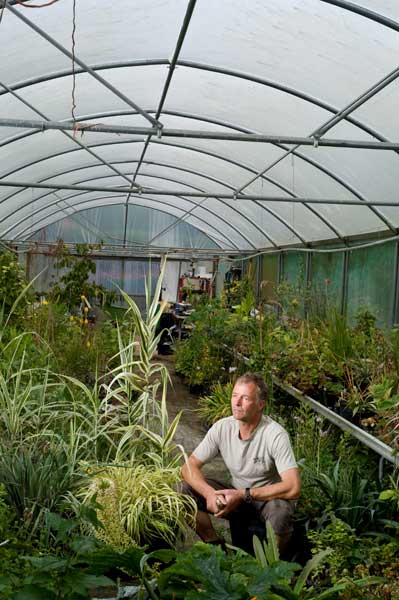
Barney, aged 51, has been growing plants all his life. One look at his boots is enough to tell you that he knows what he is talking about. In those boots he's gathered gooseberries from Bhutan and guavas from Chile. They've taken him to the Vikos Gorge in Greece to collect medicinal opopanax and to the Andes to get the vast tubers of a dahlia relative called yacon (Polymnia sonchifolia). I came home with yacon (£7.50), not on account of its edible tubers, but its foliage, which is incredibly handsome.
Triangular is the quick description, but it's more complicated than that. The green of each leaf runs narrowly along either side of the stalk that joins it to the main stem. That makes each separate leaf seem unusually important. From the midribs, two veins curve out to support the leaf at its widest part, then billow elegantly in again to a point at the top. The texture is strangely soft.
A really ambitious yacon tuber can weigh as much as 12 kilos and Barney says it is equally good raw or cooked like water chestnut. In Peru, it's used as a liver tonic. It's sweetish, but not in the way that matters to diabetics. Dried, it's being used as a sugar substitute in muesli.
His most recent foraging trip was to Mizoram, a strange finger of northeast India that drops down between Bangladesh and Burma. "Incredible markets," he said. "It's what I most love about travelling. The character of a nation is right there in its markets." From Mizoram, he brought back an unnamed allium, which the locals use as we might a spring onion. But the leaves are as broad as agapanthus and the flower head like a white globe thistle. Four divisions of his original plant were growing with immense vigour in pots in front of the nursery polytunnels.
Where these polytunnels now are, his father, a disciple of Eve Balfour (who founded the Soil Association in the Forties), once grew vast quantities of organic vegetables. We're sitting in the shade of a 'Lord Derby' apple tree which his father planted in the brick and flint walled garden of the house where Barney grew up. Before he was even eight, he knew what macrobiotic meant. His heroes were Lawrence Hills, pioneer of organic growing and, later, Bill Mollison, the Australian who in the Eighties developed the idea of permaculture, a philosophy built around a sustainable way of life.
There are plenty of people who talk about these things (and plenty of us who've stifled yawns while listening). Barney's different. He's practical – a terrific grower of unusual plants, particularly edible ones. And the principles that are so important to him are well underpinned by degrees in geology, environmental biology and soil sciences. The surprise is the landscaping business, which he started after studying the subject at Sheffield. On the back of that, he set up the nursery, because it was the only way of getting the kind of plants he wanted to put in his landscaping schemes.
He sort of knows that he ought now to drop some of the ornamentals and concentrate on the 500 edible plants on his list. Over the past two years, that's where the growth has been. That's what the "adventurous allotmenteers" are queuing up to buy. But if you aren't yet one of that band, I asked, where should you start? These are his three suggestions:
Japanese ginger (Zingiber mioga)
A hardy ginger for a sheltered site. Happy in part shade. Edible young shoots and yellow flowers. Height 80cm; £6.
Yacon (Polymnia sonchifolia)
Tall dahlia relative with large triangular leaves. Yellow flowers in late autumn. Excellent juicy tubers can be eaten raw or cooked. Height up to 5m; £8.50.
Nepalese raspberry (Rubus nepalensis)
Evergreen ground cover which produces masses of white flowers and raspberry-like fruit. Sun or part shade. Height 10cm; £4.50.
Edulis is at The Walled Garden, Bere Court Farm, Tidmarsh Lane, Pangbourne, Berks RG8 8HT, 07802 812781, e-mail edulis.nursery@virgin.net, website edulis.co.uk. Open by appointment only. Send 4 x 1st class stamps for list. Foodies new to foraging should get 'Wild Food' by Roger Phillips (Macmillan £14.99)
Join our commenting forum
Join thought-provoking conversations, follow other Independent readers and see their replies
Comments