Raise the rafters: A green roof can be a thing of beauty - and fun
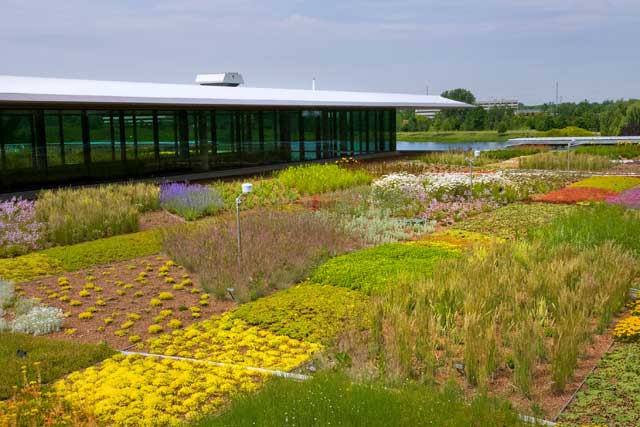
The advantages of green roofs have been drummed into us pretty thoroughly over the past couple of years. But we've still got plenty to learn about maintaining them. The self-sustaining ideal is not as easy in practice as it appears on paper.
This past season has been testing for all gardeners: an unusually long, cold winter followed by a superb but very dry spring. But for green roofs, it's been particularly difficult. Succulents died in the cold. Herbaceous plants, with only four inches of soil under them, shrivelled in the drought that followed.
So I was particularly interested this spring to wander over the green roof designed in 2009 by Oehme van Sweden for the new plant conservation and science centre at Chicago's superb Botanic Garden. The weather that we made such a fuss about this winter would be looked on as pleasantly mild in Chicago. And the typical difference in temperature there between winter and summer stretches a plant's tolerance much further than anything our gardens experience.
Laid out in grids on a flattish roof (the slope is just 1 per cent) are 320 different plants, North American natives on the southern half and a mix of native and introduced species on the north. Three stations are continuously monitoring air temperature, soil moisture, heat transfer and light levels. The plants themselves are set in three different depths of soil – four inches, six inches and eight inches. After a couple of years, the data retrieved from this huge site (it covers 16,000 sq ft) will provide a very practical guide to the plants that can survive these testing conditions.
Modern green roofs are built up on top of a series of membranes that trap enough damp to keep plants alive but stop it seeping through your ceiling. Chicago's roof is slightly more complicated than most because of the EFVM (Electric Field Vector Mapping) conductors built into the system. The bottom-most layer is gypsum board. On top of that there's an EFVM screen, then a felt separator and a waterproof membrane (essential on any green roof). Above that are the EFVM conductors with another felt separator between them and a layer of extruded polystyrene insulation. Then comes the water retention mat and a series of panels made of cups filled with minerals and soil. There's a filter fabric between that and the actual layer of "soil" which is a mix of expanded clay, shale, perlite, vermiculite and sand, with just 5 per cent organic matter. Finally, the plants.
The insulating qualities of green roofs are well rehearsed: less central heating in winter, less air conditioning in summer. They sop up rain – when there is any – and save it being wasted down our overloaded drains. They provide a stopover for insects and birds (hummingbirds regularly visit Chicago Botanic Garden's green roof). They filter pollutants from the air. They can help make a building quieter – soil blocks low frequency noise, plants take care of the higher frequencies.
So we know they can be useful. Planners like them and adding a green roof to your scheme can sometimes be the way to get permission for a building in an environmentally sensitive area that would otherwise be rejected. But can they go beyond the worthy and be beautiful, too? In the Monaco garden she designed at the Chelsea Flower Show, Sarah Eberle installed a lovely "field" of lavender on the roof of a garden building. In this Mediterranean context, it looked wonderful, but how would it survive in the UK?
There was a green roof in Marney Hall's SKYshades garden at Chelsea and various sedums uncomfortably plastered on the pavilion featured in the Ishihara Kazuyuki Design Laboratory's exhibit. Neither lifted the heart. The prettiest green roof was perched on an old shipping container refurbished as a studio in the rain garden designed by Nigel Dunnett and The Landscape Agency. Shipping containers have moved very rapidly from the shabby to the chic. The art dealer, Neil Hobhouse – an infallible guide to chicdom – has two, fitted out as libraries, perched in the grounds of his Somerset home.
Seen from the ground, this green roof seemed to be mostly moon daisies. I've always been soft about these flowers as I carried a bunch of them on my wedding day. But in a wildflower context, they are bullies. They'd probably survive on a roof though and a container roof is a manageable size. You could do most of your gardening from a ladder not too far off the ground.
But Sheffield-based Nigel Dunnett is universally recognised as the King of the Green Roof. If he can't come up with a good one, there's little hope for the rest of us. Perhaps, too, on a garden building, you wouldn't be quite so worried about the load-bearing sums and the substrates as you certainly would be if you were spreading a green roof over the whole of your house.
Covering the roof of a garden building with a mat of sedums or sempervivums is considered a bit boring by dedicated green roofers, who prefer experimenting – sometimes fatally – with agaves and dasylirions, cistus and helianthemums.
Sedum is a good place to begin though, if you are just starting out as a green roofer. They are sold in mats like strips of carpet, usually a mixture of low growing types such as S. album, S. kamtschaticum, the vigorous evergreen S. spurium and S. rupestre (now naturalised in Britain). The substrate won't be plain earth – it's too heavy – but you can make it up from recycled materials such as crushed breezeblocks, bricks and tiles, mixed with expanded clay granules and lightweight materials such as perlite and vermiculite. There should also be some compost in the mix, but usually not more than 10-20 per cent of the whole. It depends what you want to grow.
Small-scale structures such as sheds and summerhouses, log shelters, workshops, dustbin compounds, porches and bike sheds are ideal for greening. When Nigel Dunnett customised a shed in his own garden, he supported the green roof on 4in x 4in posts sunk into the ground a few feet from its corners and braced the posts to the shed. He draped a heavy-duty pond liner over the sloping roof and rested a grid framework of wood on top of the liner, to make 10 separate compartments. His shed had a sloping roof and this was his way of ensuring that the contents didn't slide off. You can't easily green a roof that slopes more than 20 degrees. It will be too steep for the plants to stay in place.
On top of the waterproof pond liner Dunnett put a drainage layer of crushed concrete breeze blocks and then filled up the rest of the space in each compartment with a 10cm layer of substrate. His was a 50/50 mix of John Innes compost and expanded clay granules, which when dry, are very light. He used more compost than is usual because he wanted the roof to support a diverse collection of plants: dwarf bulbs, bladder campion, thrifts, thymes, campanulas, pinks and other alpines. Trial and error is the name of the game. Especially this year.
The green roof on the shipping container at Chelsea was installed by The Grass Roof Company, 07967 733720. For more on sedum matting, visit enviromat.co.uk or call 01842 828266. For more on green roofs, go to greenroofs.com/projects
Join our commenting forum
Join thought-provoking conversations, follow other Independent readers and see their replies
Comments