The market premium: where house prices are booming
As city-dwellers move out, values are soaring in smart market towns
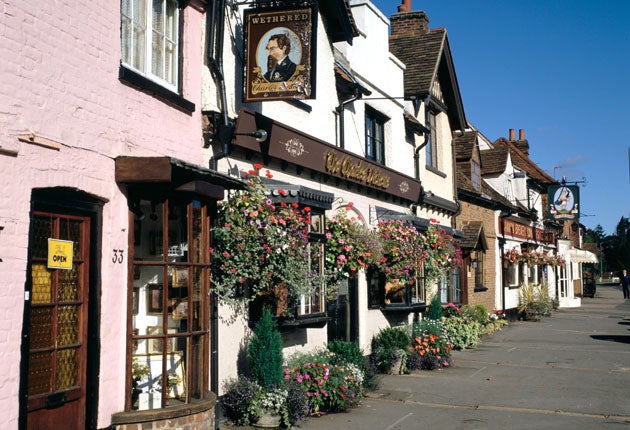
The future was looking grim for England's market towns in the 1980s, when it was feared that a combination of large supermarkets, spreading car ownership and rush-hour congestion was condemning them to a slow decline.
People who did not want to travel miles to work stayed close to their offices, which for most was in a large city. Those who did not mind the travel, and had enough money, could enjoy a middle-class lifestyle in the rural solitude of a small village. Medium-sized towns offered neither one thing nor the other.
That was then. The picture now is very different, according to research which shows that the average price of a home in a market town includes a £30,000 premium – the extra value that comes with a desirable location. It does not alter the bigger picture – that people are better off in the south, where the jobs are, than in recession-hit parts of the north – but it flags up some striking local variations.
The most startling example is the town of Beaconsfield, in the Chiltern Hills, in south Buckinghamshire. Not only are its properties more expensive than in any other market town in England, with an average house price of £736,585, but a more striking statistic is how much more expensive they are than in other parts of the same county, where the average is £300,397. The figures imply that Beaconsfield has a 145 per cent "premium" over the rest of Buckinghamshire.
The figures have been put together by Lloyds TSB, which tracked house price movements in 111 English market towns with populations of between 3,000 and 30,000. "In a market town you can have all the advantages of the larger towns or cities without some of the distractions. There is less congestion, less heavy traffic, and lower levels of crime," said the bank's Martin Ellis.
Lloyds released three league tables yesterday, showing the market towns with the highest "premiums" over their surrounding counties as well as the most and least expensive.
It is perhaps unsurprising that the most expensive market towns are all in the southern half of England, with only two located outside the Home Counties – Winchcombe, in Gloucestershire, and Chipping Norton, in Oxfordshire. All of the least expensive are either in the West Midlands or further north. Three of the four least expensive are in County Durham.
There is a more even geographic spread in the third table, which lists market towns where average house prices are at least one and a half times higher than in the surrounding county. Average prices in Wetherby, for example, are almost twice those in West Yorkshire as a whole. A house in Bakewell is, on average, 90 per cent more expensive than in the rest of Derbyshire.
Most market towns have a history going back centuries, and owe their existence to their location near a main communication centre, either a river or an ancient road, which made them convenient places for peasant farmers to come and sell their produce. They also needed political contacts, because holding a market required permission from the King.
Beaconsfield, for instance, benefited from being precisely half way between London and Oxford, and was therefore a useful stopping off place for travellers. That still works in its favour, because the motorways heading out of the west side of London pass nearby. The town topped two out of the three leagues tables, having both the highest house prices and the greatest contrast with the rest of the county. This helps explain why Bernard Hodgson, who has 30 years' local experience of the property business, decided to buck the recession last year and set up his own estate agency in the middle of the town.
"Beaconsfield is doing and has always done extremely well," he said. It's not just one single facet that attracts buyers – there are numerous facets. The schools are second to none, it's very accessible by train or by road and it's only 20 or 25 minutes to Heathrow. There is a model village that still attracts people from far and wide and a market in the old town every Tuesday."
But it is a different story in the market town of Ferryhill, a mere 200 miles north of Beaconsfield in Co Durham, where house prices have been falling since the banking crisis of 2008. According to Lloyds, it is the cheapest market town in England, and the only one where average house prices have dipped below £100,000. The average property is yours for £98,799 – a seventh of what it would cost in Beaconsfield.
One Ferryhill estate agent, who asked not to be identified, said current prices had fallen by between 10 and 30 per cent in two years. "We're selling a property for £18,000," she said. "It's a two-bedroom terraced house with gas central heating and double glazing. It needs a little bit of work, but there's not an awful lot wrong with it at all.
"We're advertising four-bedroom, three-storey houses for £118,000. They've got everything – heating, rooms, parking facilities, gardens. We can't even give them away. Ferryhill is like a blank space at the moment. That's a shame, because it's a very nice place to live. It has got every facility that you can possibly think of, and very friendly people. There's no reason to go anywhere else."
Priciest market towns
* 1. Beaconsfield, Buckinghamshire (Average house price £736,585)
* 2. Winchcombe, Gloucestershire (£360,451)
* 3. Cranbrook, Kent (£353,726)
* 4. Midhurst, Sussex (£342,975)
* 5. Ringwood, Hampshire (£341,076)
* 6. Chipping Norton, Oxfordshire (£333,834)
* 7. Lewes, Sussex (£329,594)
* 8. Petersfield, Hampshire (£324,808)
* 9. Saffron Walden, Essex (£322,378)
* 10. Tenterden, Kent (£321,317)
Source: Land Registry
Join our commenting forum
Join thought-provoking conversations, follow other Independent readers and see their replies
Comments