Mercedes guilty of exaggerating emissions of new cars
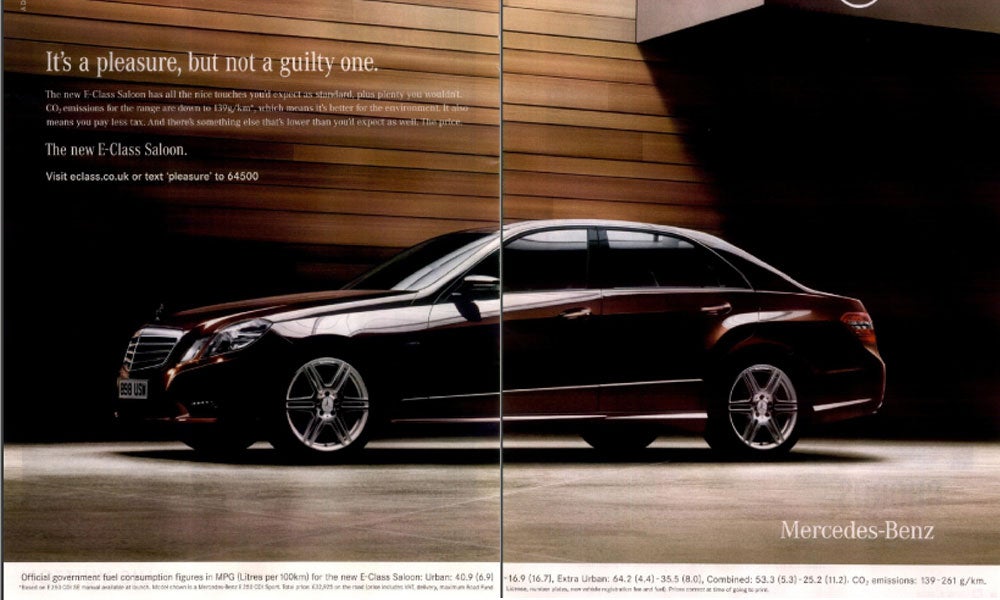
The German car manufacturer Mercedes-Benz misled the public by claiming low emissions for a range of executive cars that are among the most polluting on the road, according to the Advertising Standards Authority today.
"Its a pleasure, but not a guilty one,” the automaker said in a magazine advert for the E-Class Saloon range priced between £26,000 and £47,000, adding that its emissions were “down to” 139grams of Co2 per kilometre
Following a complaint the ASA investigated and found that only two out of a possible 24 E-Class cars corresponded with the emissions figures, warranting an E band in the Government’s banding system which ranges from A to M.
Some were in the M band, the highest set by the Department for Transport to warn drivers about high levels of fuel consumption, taxation and pollution.
The case is the latest example of ‘greenwashing’, where companies have been found to have made spurious environmental claims. During the past two years, the ASA has banned ads from Shell for promoting its heavily-polluting extraction of oil from tar sands in Canada, British Gas for misleading businesses about its emissions performance, and easyJet for suggesting its aircraft were 22 per cent less polluting than rival planes with the use of figures skewed by its high passenger loads.
Last month, the Malaysian palm Oil Council was criticised by the ASA for suggesting that oil palm plantations were good for the environment and local people.
This year several car-makers including Lexus and Volkswagen have had environmental ads banned for four-wheel drives and saloons.
In the latest case, Mercedes-Benz suggested that drivers would switch to its new range safe in the knowledge that they would be helping the planet. "CO2 emissions for the range are down to 139g/km*, which means its better for the environment. It also means you pay less tax,” the company said
The model shown was a Mercedes-Benz E250 CDI Sport, which has emissions of 139g a kilometre. A footnote stated that the range’s emissions varied from 139g to 261g a kilometre,.
Mercedes-Benz told the ASA it believed it had taken reasonable steps to substantiate its claims and had not misrepresented emissions levels.
However the ASA said that the claim that the E-Class was “better for the environment" was likely to be understood as meaning the range as a whole was low in emissions compared with previous models and rival models.
Depending on model, fuel, gearbox and tyre sizes, only two vehicles out of the 24 in the range compared favourably with competitors’ vehicles of a similar class, while “a number of vehicles in the range had emissions levels that were at the higher end of the DfT emissions bandings.”
The ASA acknowledged the footnote. “However, we considered that the headline claim would give the impression to readers that a significant proportion of the range had achieved the lowest emissions figure, or a figure that was relatively low for the class, when that was not the case.”
The ad was banned under rules on truthfulness, motoring and environmental claims.
Join our commenting forum
Join thought-provoking conversations, follow other Independent readers and see their replies
Comments