Don't get caught by pension reforms
The minimum age rises from April, so anyone over 50 should act now if they want to finish work early. Chiara Cavaglieri investigates
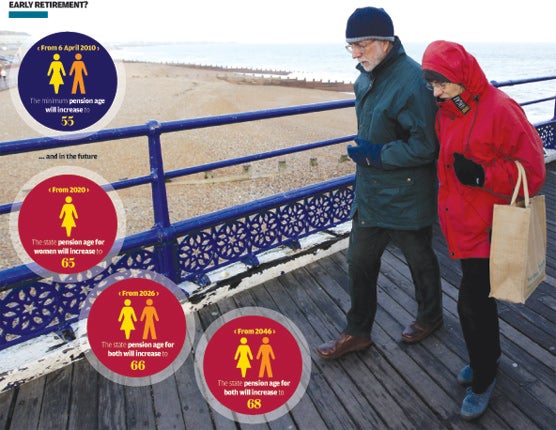
There is little more than five weeks left until new pension reforms kick in and those who fail to act now could miss out. On 6 April, several changes introduced by the Department for Work and Pensions will come into force aimed at helping women, carers and low earners in retirement, but is it good news for everyone?
One of the most significant changes to come into play will be the increased minimum age for withdrawing a pension. Today, anyone aged 50 or over with a private pension is free to draw on their pension fund, taking a 25 per cent tax-free lump sum and, if they choose, an annuity. From 6 April, however, the minimum pension age will rise to 55, affecting more than four million people who were born between 6 April 1955 and 5 April 1960 and will have to wait for up to five years to draw their pension.
Although most people cannot and should not retire early, in some cases it can be advantageous to use the tax-free lump sum – perhaps to pay off debts or a mortgage – and leave the rest of the fund invested for when they actually retire. If this is the case, there is precious little time to act.
"If you have an occupational pension, you should just about have time to get your retirement request in before door closes. But if you want to transfer funds by moving into a drawdown plan, or buy an annuity, you've probably left it too late now," says Tom McPhail, pensions expert at independent financial adviser (IFA) Hargreaves Lansdown.
The state pension age for women will also start rising from 6 April until it reaches 65 in 2020. By 2026, it is set to rise to 66 for everyone, until it ultimately reaches 68 in 2046. For women turning 60 before the new tax year this won't be an issue, but the rest will have to wait longer to receive their state benefits which could affect their current retirement plans.
Simon Webster of IFA Facts & Figures says that this change can be approached from two sides. Firstly, for those wanting to retire at 65, more money must now be put aside to fund for the state shortfall. However, for those who accept they will have to work longer, there is more positive slant because they have longer to save and can therefore materially improve their overall pension.
"The key thing to remember is the more money you put away now, the more choices you have later. The longer you leave it, the more expensive it gets," adds Mr Webster.
Other changes include a reduction in the National Insurance (NI) contributions required to qualify for the full basic state pension, which rises from £95.25 a week to £97.65 a week from 6 April. Under the current rules, men need 44 years of NI contributions to qualify but women need 39, which is still beyond many who stop working to look after their children.
Once the changes take effect, men and women will need to build up just 30 years of contributions, which the Government predicts will allow for an extra 40,000 women who reach pension age in the next tax year to qualify for the full state pension.

Get a free fractional share worth up to £100.
Capital at risk.
Terms and conditions apply.
ADVERTISEMENT
Get a free fractional share worth up to £100.
Capital at risk.
Terms and conditions apply.
ADVERTISEMENT
"It's quite a mixed bag of reforms. There are some good changes in there and this is one of few things the Government has given back," says Mr McPhail.
There will be some who still miss out if they reach the state pension age before 6 April and don't have enough qualifying years. Women, part-time workers and anyone who has worked abroad are particularly vulnerable because they are more likely to have erratic NI contributions records. What they can do to combat this, however, is buy back any missing years of contributions. This will normally cost £626 for each year bought before 6 April but the price will almost certainly go up after this. Anyone needing to pay extra contributions should act quickly.
The state second pension will also be affected by the reforms. At present, the level of payment is linked to an individual's past earnings but from the next tax year, payments within the upper earnings threshold have been reduced from 20 to 10 per cent. Further down the line this will be moved to a flat-rate payment, rather than an earnings-related pension and will continue to be linked to inflation, not earnings.
"Those middle and higher earners not in contracted out pension schemes need to take action now. They should obtain a state pension forecast and review their existing pension provision as a matter of urgency," says Duncan Carter from IFA Clearwater Financial Planning.
Finally, a new credits system will replace the current Home Responsibilities Protection (HRP) scheme, which is designed to help parents and carers to qualify for the state pension. The current system works by reducing the number of years worked to qualify for a full state pension, but from 6 April, qualifying years can be built up through weekly credits.
These can then be added on to any paid contributions made when at work, with no limit on the credits awarded, as long as the qualifying rules are met. For those reaching state pension age after this change takes effect, each complete years of HRP, up to a maximum of 22 years, will be converted into qualifying years for the basic state pension.
Join our commenting forum
Join thought-provoking conversations, follow other Independent readers and see their replies
Comments
Bookmark popover
Removed from bookmarks