Meltdown on the high street
It's not just the recession. Competition from the internet and superstores on the doorstep is killing traditional town centres. Laura Chesters reports

For free real time breaking news alerts sent straight to your inbox sign up to our breaking news emails
Sign up to our free breaking news emails
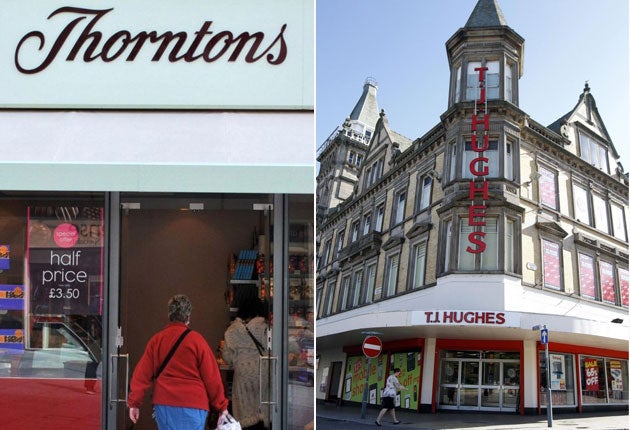
Chocolatier Thorntons is closing 180 shops, but Hotel Chocolat is opening more outlets. Jane Norman has gone into administration, but sales at Karen Millen and Zara are booming.
TJ Hughes has collapsed, but Debenhams has just revealed an increase in like-for-like sales.
The story of the high street is a tale of Jekyll and Hyde. Although most retailers are suffering from rising inflation, higher costs and consumers cutting back, the most successful are keeping more than their heads above water. Austerity measures by the Government have finally taken their toll on the consumer, bringing a plague of falling sales, forcing the weakest on our high streets to crumble.
Although the names to have lost the battle to survive recently may not be a surprise to some – Jane Norman and TJ Hughes have been struggling for a long time – the job losses and the empty shells left in many town centres are a problem for everyone. The estimated number of jobs lost from last week's administrations is 6,000.
Malcolm Dalgleish, a retail expert at CB Richard Ellis, says: "The early part of this crisis was a financial recession. But now we are seeing the effects of the recession hitting the real people, the people on the street. We have seen the retailers with financing and debt problems go first. But good retailers don't become bad retailers overnight. There is still opportunity for some to take market share, and not all retailers are suffering at the same rate."
In the past 30 years, Britain has lost more than 300,000 shops. Last week Habitat, Jane Norman and TJ Hughes fell into administration, while Thorntons and Carpetright announced plans to close shops when the leases expire.
This is just the tip of the iceberg. Topshop's parent company, Arcadia, Dixons, Mothercare, JJB Sports and HMV all plan drastic reduction in store numbers. A quick tally finds 15,462 shops earmarked for closure.
Christine Elliott, the chief executive of the Institute for Turnaround, says: "Some have said the woes are the fault of the recession. But this is not just about recession. The failures have been about the retailers that have not got their act together despite warning signs.
"These retailers have not been capable of fulfilling the basic requirements of getting to know what their customer wants and acting on it; activating the right channels to market and adjusting their cost base."
Too much debt
Jane Norman had £140m of debt which was unsustainable, and it finally went into administration last Monday. Last month, Life & Style, the cheap fashion chain run by Elaine Macpherson who bought the stores when the Merseyside chain Ethel Austin went into administration on two separate occasions, went into administration for a third time.
Elliott adds: "We have seen the advent of retailers that have gone into administration more than once. This is not a healthy phenomenon.
"The reason they have failed again is that, although there had been financial restructuring, changes to the operational business have not been made. Shareholders should be monitoring businesses and acting early to restructure before it is too late."
Michael Ziff, the chief executive of the footwear group that owns Barratts and Priceless Shoes went through a pre-packaged administration in 2009. "You should not run a business in the current climate with more than a week's turnover in bank debt," he says. "The sums of money that some of the retailers have been carrying is monopoly money.
"In my old business, we were carrying too much debt, and that is where the problems started. But now we have just a small overdraft. Retailers need to keep stock tight and work with suppliers."
Following the boom-time era of cheap debt, many businesses are still heavily laden, which could have an impact on their future. The fashion chain New Look is one such retailer labouring under £1bn of debt.
Mike Shearwood, the chief executive of Aurora Fashions, which owns brands including Oasis, says: "Trading conditions are brutal. We are fortunate that our consumer likes the differentiation we have brought through our brands. We are outperforming the market, but we have sympathy with those businesses that are indebted to banks in a way that doesn't enable them to get through this tough period."
Internet beats the high street
What is driving the revolution on our high streets is expansion of alternative sources – from online, from retail parks and from supermarkets. The major growth is online. Verdict Research predicts that internet spending will grow by £14bn – 61 per cent – by 2014. The structure of town centres will have to change.
The shutters are predominantly falling on small towns where the local shoppers today save their pennies for online purchases, trips to supermarkets or large shopping centres: these they visit less often but spend more money when they go, leaving the local centres struggling.
Statistics from the Local Data Company show the retail failures are increasingly hitting northern towns worse than their southern counterparts: the average northern town is likely to have double the number of empty shops compared with the south.
But Kay Chaldecott, the group executive director of property at Capital Shopping Centres Group, says it is the smaller towns that are being affected – no matter where they are in the UK. "We are not seeing a North-South divide," she explains. "Large centres which are destinations and provide strong leisure and catering are continuing to see strong footfall, and our experience is that the big cities outside London are still doing well."
In prime areas such as central London, the Trafford Centre in Manchester and Bluewater in Kent, rents are still rocketing and retailers are fighting to take space – in contrast to the secondary centres up and down the country where retailers cannot even afford to pay the rent. The cost of rents and rates is just too high to make opening a shop in some towns viable.
Too many shops
But the issues for the high street are more structural than just geography. There are too many shop premises – everywhere. In the credit-fuelled property boom, too many were built, leaving the oldest shops in towns empty when retailers favoured more modern buildings. Retailers, flush with cash from over-zealous banks or private equity backers, took more and more new shops – thinking it was the only way to increase sales.
Supermarkets to blame?
Some landlords blame large supermarkets that sell everything under one roof for some towns' woes. Tom Tyler runs Chester Properties and has managed retail schemes in more than 12 towns including Walsall, Yeovil and Motherwell. "Town centres have been damaged by edge-of-town supermarkets. Out-of-town supermarkets, shopping centres and retail parks are not the problem.
"It is an issue when a supermarket – usually more than 80,000 sq ft – is built just on the edge of the town centre. It is the worst scenario. Asda or Tesco sell everything from food to furniture to pet products to travel insurance. All the things that you might have popped in to town for."
Tyler blames the planning system for allowing the supermarkets to open so many large stores.
"Up and down the country, supermarkets are getting planning permission to extend their stores by up to 50,000 sq ft. They have room to sell 40,000 sq ft of non- food and that is enough to put 12 unit shops out of business in each town. Nothing is being done to stop this."
The future
Over the next few months more shutters will come down for the final time and more windows will be boarded up. New uses will have to be found for such shops if they are not to lie empty. But there are pockets of good news where retailers are still planning to open new stores.
Despite the difficult trading environment, overseas retailers still plan to set up shop on our shores – from the US, Urban Outfitters, Forever 21, and American Eagle, and from Europe, The Kooples and Sacoor Brothers are just a few of the names planning to open, rather than close, shops here.
Hugh Radford, the head of UK retail at property adviser DTZ, explains: "The recent administrations will provide some shops in prime locations that will be snapped up by other retailers looking to grow market share. It is only the already struggling secondary centres where these shops will stay empty."
For the best retailers, shoppers will still part with their cash, ensuring that Britain continues to be a nation of shopkeepers and not just shop closers.
Subscribe to Independent Premium to bookmark this article
Want to bookmark your favourite articles and stories to read or reference later? Start your Independent Premium subscription today.
Join our commenting forum
Join thought-provoking conversations, follow other Independent readers and see their replies