Business

Partly Sunny with Showers 11° London Hi 11°C / Lo 6°C

The mystery of rising house prices

With unemployment up and people avoiding debt, why aren't property prices falling? Sean O'Grady reports
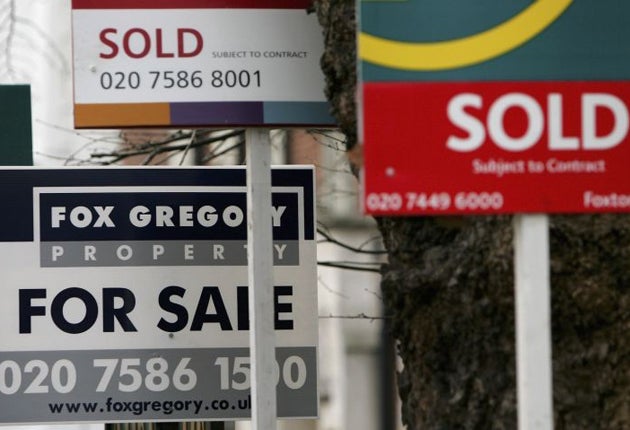
Households and businesses are experiencing a credit squeeze as lenders react to the bleak economic outlook

GETTY IMAGES

Prices ought to be tanking. And yet ... the Royal Institution of Chartered Surveyors sees a gathering wave of optimism among surveyors

What on earth is happening in the housing market? Of the many economic puzzles thrown up by the recession, this is the most mind-boggling – for homeowners, first-time buyers and the wider economy.

The conundrum is this. Unemployment is close to 2.5 million and will go higher. Pay rises are rare. People fear debt. The credit crunch has hardly gone away, meaning that mortgage finance, especially for first-time buyers with slim deposits, and movers with little equity, is expensive, if available at all. Mortgage approvals may be up on last year, but the new money going into the market isn't sufficient to secure rising prices. Values are steep by long-term historical standards in relation to earnings, especially in London.

So prices ought to be tanking. And yet ... the Royal Institution of Chartered Surveyors sees a gathering wave of optimism among surveyors watching their local property scenes, and the Nationwide has just reported rising prices for the sixth month in a row. Prices are stabilising, even rising – 0.4 per cent during October, up 2 per cent on last year (though prices are still about a fifth off their peaks). Why? And can it last?

The immediate answer given by all those involved is "shortage of supply". Owners are just not putting their properties on the market, and those that are are often asking unrealistically high prices, though the chill of recession has jolted more into narrowing the gap between what they ask for (as monitored by Rightmove) and what they settle for (as recorded by the Nationwide, Halifax and the Land Registry).

This is not just a question of sellers being in denial about negative or inadequate equity, though there is a psychological reluctance on the part of sellers to accept a loss. That lack of equity in many homes has a more concrete effect – it means that moving is difficult at a time when lenders are imposing more demanding terms, such as lower loan-to-equity ratios and more conservative multiples of household income. New rules from the Financial Services Authority that tighten up rules for self-certified and other unconventional customers will exacerbate this trend.

Plainly, banks are only really willing to take on the best credit risks: their precarious balance sheets and losses prevent them from shouldering risks that would have been routine three or four years ago. So, perversely, the lack of mortgage finance has actually pushed prices higher by artificially constricting supply.

Second, the waves of repossessions during the property slump of the early 1990s hasn't materialised, and seems to be another perverse product of the credit crunch. Again, such is the fragile state of many bank and building society balance sheets that few want to crystallise losses by foreclosure. One of the reasons why the bad debts being reported by the banks aren't as high as they might be is because they can't afford any more write-offs – so they just let the arrears run. Possibly also because of political pressure, lenders are exercising extreme leniency with wayward mortgage holders. This unprecedented forbearance is blocking another source of ready supply – auction sales from distressed sellers.

Third, there are signs of increased demand. Confidence is better, after the apocalyptic mood of much of the past year or so. And there are those out there who are cash-rich. Very cash-rich. At one end, Russian oligarchs and other wealthy foreigners and investment funds are attracted by Britain's real-estate double whammy – depressed values plus a sharply depreciated pound adds up, in crude terms, to a 40 per cent discount on peak 2007 prices. Tempting, for some, including speculators who buy some of the best real estate in the capital and allow it to crumble or be squatted.

Banking bonuses seem hardly dented this year, another underpinning. Other pluses are opportunistic buy-to-let investors seeking yields (compared to gilts or deposit accounts, say); those whose parents can supply a cash injection; and those who sat out the bubble and are ready to pounce on bargains now. Much of this activity is in the South, one reason why this part of the country has enjoyed a healthier market.

Yet it is in the nature of markets that most, if not all, of these perverse effects are short-term, and that the fundamentals will eventually re-assert themselves. There will come a point when the pound stops falling; a moment banks can no longer let arrears run; and when the Bank of Mum and Dad runs out of funds.

Other factors, too, are liable to grow more difficult next year at least. The stamp duty holiday on homes costing up to £175,000 will end in the new year, as will the cut in VAT. Next year will see more tax rises, modest pay rises, if any, and interest rates begin to return to slightly more normal levels – perhaps 2 per cent by the end of 2010.

The Countrywide chain of estate agents says that the average interest rate for mortgage applicants is 5.13 per cent, down 0.31 per cent from September but still high in real terms. The average deposit required for mortgages monitored by Countrywide is 25 per cent – 6 per cent up on September. The 125 per cent mortgage is but a distant memory.

We'll also see higher fuel and energy prices as demand from China and other fast-growing emerging economies push them back towards their old peaks. Unemployment will also be higher. All this means a tight squeeze on people's disposable income – their ability to service a home loan.

So there is plenty to suggest that the stabilisation and small rise in values now being witnessed may be no more than a false market, a short-term "boomlet" that will dissipate as the market faces new problems. Prices seem back on their long-term trend level now, but there is every reason to think an undershoot may also be possible, as in the past.

The truth is that the credit crunch is still a reality – wholesale money markets remain dysfunctional and only tiny quantities of mortgage-backed securities are being issued. Those markets and the now-disappeared foreign banks are what funded the housing boom. They have been largely replaced by money from the Treasury and the Bank of England. That cannot last for ever, as schemes such as the Bank's Special Liquidity Scheme expire next year and in 2011. Economists are almost unanimous that the bottom of the market has not yet been reached; then again, only a couple of years ago they told us that prices would be flat in 2008 before resuming their upward march this year ...

The property conundrum remains unsolved.

Post a Comment

View all comments that have been posted about this article.

Offensive or abusive comments will be removed and your IP logged and may be used to prevent further submission. In submitting a comment to the site, you agree to be bound by the Independent Minds Terms of Service.

Comments

Why Aren't House Prices Rising?
[info]moonrakin wrote:
Tuesday, 10 November 2009 at 02:34 am (UTC)
No brainer pal - there's only 5% of the market from 18 months ago and pretty much zero lending going on - what do you expect?

The only minor mystery is why prices haven't tumbled ~30%++

You say about lenders :
"They have been largely replaced by money from the Treasury and the Bank of England."

I say check out :
http://burningourmoney.blogspot.com/2009/11/its-very-simple-were-skint.html

Really, head in the sand or up a_r_s_e - I really can't decide

Nobody's doing real morgages - nada, zip, nuttin - Labour have seen to that.
rising house prices
[info]abbo49 wrote:
Tuesday, 10 November 2009 at 06:53 am (UTC)
Yes another well written article,very informative.
[info]sameen wrote:
Tuesday, 10 November 2009 at 07:22 am (UTC)
Fair enough on addressing some of the issues.
I think historically, house price indices tend to behave with volatility (at a local level) during periods of recession and/or high unemployment.
[info]mitaman wrote:
Tuesday, 10 November 2009 at 07:28 am (UTC)
Wait for interest rates rising, those landlords not selling and hanging on for better times, will be wiped out and the banks will have no choice but to realise losses on their balance sheets and when they come, they are going to be big, very big! Mark my words.

Sell your property now, maybe take a bit if a haircut on the sale price and sit and wait or take what profits you have. By then end of 2010/ Q1 2011 you will get the bargain of a lifetime.
Bricks and mortar.
[info]hodgeey wrote:
Tuesday, 10 November 2009 at 07:49 am (UTC)
Always the best investment, growth guaranteed over time and you can live in it.

Better than those bits of paper that get peddled.
House prices should be rising
[info]bandit1970 wrote:
Tuesday, 10 November 2009 at 08:16 am (UTC)
I somewhat agree with moonrakinn that prices should be rising. But my reason are the opposite, banks are lending and lending lots to those with a deposit, 5x joint salary, this equates to the average house price being about 12x the average salary after you add in a 25% deposit. If you can 'afford' the average house it only takes 2 years to save up the 70K deposit by a couple at the same rate the mortgage would cost. Houses havn't got as high as 12x joint salary but they could go there as they are not restrained by 'affordability', only deposits that the bank think are required to avoid potential toxic assets in the future. Unfortunately I think they under estimate the future falls, because high interest rates will only serve to suppress prices further as salaries will not follow.
Milton-not-Keynes
[info]miltonnotkeynes wrote:
Tuesday, 10 November 2009 at 08:35 am (UTC)
Curious indeed. Another reason is that there is a lack of alternative investment opportunities. Cash earns virtually zero, the stock market is rising but vulnerable and bonds (for retail investors) have secondary market risk and yields have been shrinking. Basically, there remains a lot of cash in the economy and London house prices, in particular, were as much fuelled by cash as by debt (bonuses, wealthy cash buyers etc). So the deleveraging of the economy has less of an impact on London prices than the fact cash investors are looking for a home that yields above 1%. Prices have come down from their highs - making London housing look cheap compared to 2007 - and quantative easing has created a long-term fear of inflation, making bricks and mortar, as well as gold, look a safer bet. I have friends who set up funds to buy distressed housing stock at auction, they are finding they are not the only people who had teh same idea. Indeed, the market is a lot more sophisticated than in the early 1990s - online sites give everyone access to distressed sales and there are a lot more people and specialist funds looking for bargains (especially as a deleveraged buy-to-let protfolio has strong proven yields). Before you know it that 30% discount is down to 5%. It is London today - will be in London-like centres (Manchester/Brighton/Edinburgh) tomorrow and feed out from there. Good old free markets!
Cash is the reason
[info]miltonnotkeynes wrote:
Tuesday, 10 November 2009 at 08:36 am (UTC)
Curious indeed. Another reason is that there is a lack of alternative investment opportunities. Cash earns virtually zero, the stock market is rising but vulnerable and bonds (for retail investors) have secondary market risk and yields have been shrinking. Basically, there remains a lot of cash in the economy and London house prices, in particular, were as much fuelled by cash as by debt (bonuses, wealthy cash buyers etc). So the deleveraging of the economy has less of an impact on London prices than the fact cash investors are looking for a home that yields above 1%. Prices have come down from their highs - making London housing look cheap compared to 2007 - and quantative easing has created a long-term fear of inflation, making bricks and mortar, as well as gold, look a safer bet. I have friends who set up funds to buy distressed housing stock at auction, they are finding they are not the only people who had teh same idea. Indeed, the market is a lot more sophisticated than in the early 1990s - online sites give everyone access to distressed sales and there are a lot more people and specialist funds looking for bargains (especially as a deleveraged buy-to-let protfolio has strong proven yields). Before you know it that 30% discount is down to 5%. It is London today - will be in London-like centres (Manchester/Brighton/Edinburgh) tomorrow and feed out from there. Good old free markets!
[info]marflow wrote:
Tuesday, 10 November 2009 at 09:10 am (UTC)
I take it there're lots of chip money available and not everybody is eager to pump another stock market bubble. So if you have money now it's better to invest it into smth stable like houses. Or gold - as we see it now
[info]twallox wrote:
Tuesday, 10 November 2009 at 09:24 am (UTC)
its down to supply and demand is it not ?

there is not the abundance of houses for sale to fuel a downturn. First time buyers have been prices out of the market for many years .So there is not the house owners have lost the ability to downsize to save money like they have done in previous housing downturns .Add to that the many people who are still in good jobs and are able to take advantage of low interest rated and relatively cheap upgrade housing .
Rising House Prices
[info]alfaman159 wrote:
Tuesday, 10 November 2009 at 09:40 am (UTC)
Its a question of supply and demand, as one comment puts it. But no one has mentioned the virtual collapse in the new house building market. Housebuilders have suffered greatly in the downturn due to the almost immediate cutting off of sales at the start of the recession. THe industry in Scotland alone has lost over 25,000 people (virtually unreported in the press) and it is not possible to simply pick up supply immediately.
Bizarre
[info]2barrows wrote:
Tuesday, 10 November 2009 at 09:45 am (UTC)

It is crazy that the measure of "good" is based on house price</> inflation (again) rather than house sales volume. Any salesman in a proper industry saying he had lousy sales but good prices and loads of excuses would be encouraged to find alternative employment, perhaps to become an Estate Agent. Whose comments, incidentally is what the RICS survey is based on - estate agents. And they never lie or mislead, of course....
Mystery what mystery
[info]davidproperty wrote:
Tuesday, 10 November 2009 at 09:47 am (UTC)
As ever what we are failing to see is the rush of foreign investors eager to snap up a bargain as with places like Florida, Spain and Turkey. The UK is an Island where land is at a premium this suggests now that buyers are looking to invest globally that for those sophisticated enough the UK will remain a good investment. Prices will recover quicker than the above mentioned as we are already seeing. What we really need is the banks to start pumping our money back in to the system.
[info]martynb9999 wrote:
Tuesday, 10 November 2009 at 10:20 am (UTC)
"Plainly, banks are only really willing to take on the best credit risks: their precarious balance sheets and losses prevent them from shouldering risks that would have been routine three or four years ago. So, perversely, the lack of mortgage finance has actually pushed prices higher by artificially constricting supply."

I would have thought a lack of mortgages would constrict the supply of buyers rather than sellers.
The mystery of rising house prices
[info]alphatango241 wrote:
Tuesday, 10 November 2009 at 11:06 am (UTC)
home prices are certainly not rising. The average price of the finalised transactions is rising but that's because the average house that is sold currently is far bigger than historic average. Indeed, banks are more restrictive in their mortgage loans and only the wealthier of their clients can get a loan. These kind of clients are looking for bigger houses. In consequence, the average value of the transactions realised is increasing. If we were measuring the price per square meter, we would see that the fall in house prices is not over yet.
Credit Crunch Hasn't Happened.
[info]chipmem1 wrote:
Tuesday, 10 November 2009 at 11:25 am (UTC)

It's sitting in the BOE, it's sitting on the public finances. The real credit crunch will
be spread over the next 10 years and wouldn't get too excited about a return..
our banks have years of digging ahead of them, yet.

The estate agent hasn't paniced, some areas are so wealthy they can ride this out.

Then there's creative accounting, keeping assets artificially high. Perhaps some
have noticed the latest one, where mysteriously offers are being put on 5K above
the price, ( totally out of character with the market ). Don't underestimate the agents
ability for some artificial ratcheting. Some advertise houses without the government
assistance......

Then there's the cash market, which others have pointed out.

Them there's the method of statistic, it's not straight calculation. Some are based
on the loan itself.

Isn't money just wonderful.
[info]starlingnl wrote:
Tuesday, 10 November 2009 at 11:54 am (UTC)
The reason house prices are still going up in this area (they never went down) is that there are student landlords who literally have hundreds of houses, and whenever a large, family-sized house comes along, they snap it up and rent it out to students. They can afford it, the rent they get from students is much higher than the mortgage the landlord pays (if he has a mortgage at all). They make so much, they'd rather leave a house empty for a year than sell it.

Meanwhile, families are stuck in teensy two-up-two-downs.
[info]dogsolitude_v2 wrote:
Tuesday, 10 November 2009 at 02:29 pm (UTC)
...Or priced out of the market altogether...
Houses for Homes
[info]kerrygold wrote:
Tuesday, 10 November 2009 at 01:20 pm (UTC)
Another reason is that my house is my home. I didn't buy it to make money and I won't sell it to make money. I think many people are in this position, and when you realise how long people look before deciding what is just right for them you know that it is not just about money.
Its no mystery at all
[info]tuskerdeman wrote:
Tuesday, 10 November 2009 at 03:08 pm (UTC)
The reason house prices are going up is because the banks have continued to lend or prescribe mortgages for the foolish that feel the need to own their own home. A market exists.
The banks also know that the USA will declare bankruptcy within a few months which will be the signal for the introduction of the new Amero currency for North America and the birth of the New World Government.
The global economy will be allowed to collapse. Food will be priceless. The corporate work environments that govern our incomes will fail. Millions will suffer.
As a consequence of this, home owners without incomes will once again lose their homes to the banksters who will run this New World Government.
Thanks to acceptance of the Lisbon Treaty implies Europe is already run by this same elitist group.
So millions will disenfranchised from their property and land and spend a lifetime of enslavement to debt.
Fantasy. Its happening right in front of your eyes

All this drivel about percentage interest and market conditions has absolutely nothing to do with this growth. The banks know what is coming, so they want as many people borrowing long term from them at the highest loan value quickly as they stand to profit handsomely.

If you cannot afford to invest in gold or other commodities then invest in banking. They are set to make another killing.
No mystery at all
[info]tuskerdeman wrote:
Tuesday, 10 November 2009 at 03:17 pm (UTC)
The reason house prices are going up is because the banks have continued to lend or prescribe mortgages for the foolish that feel the need to own their own home. A virtual market exists.
The banks also know that the USA will declare bankruptcy within a few months, the dollar will crash, which will be the signal for the introduction of the new Amero currency for North America and the birth of the New World Government.
The global economy will be allowed to collapse. Food will be priceless. The corporate work environments that govern our incomes will fail. Millions will suffer.
As a consequence of this, home owners without incomes will once again lose their homes to the banksters who will run this New World Government.
Thanks to acceptance of the Lisbon Treaty implies Europe is already run by this same elitist group.
So millions will be disenfranchised from their property and land spending a lifetime of enslavement to debt. Those able to concert deals with their lender will become slaves to this debt.
Fantasy. Its happening right in front of your eyes.

All this drivel about percentage interest and market conditions has absolutely nothing to do with this growth. The banks know what is coming, so they want as many people borrowing long term from them at the highest loan value quickly as they stand to profit handsomely.

If you cannot afford to invest in gold or other commodities then invest in banking. They are set to make another killing.
Nukes
[info]trojan_horace wrote:
Tuesday, 10 November 2009 at 03:41 pm (UTC)
Let's see what happens in a 25 miles radius of the 10 new power stations proposed!
far too corrupt to be trusted
[info]ebbi581 wrote:
Tuesday, 10 November 2009 at 03:55 pm (UTC)
it really depends on who is giving out these statistics !!!! there are contradictory data almost every day but i rend to believe that the whole thing is just a load of pure 24 carat bs. repossessions , bankruptcies and insolvencies are at highest but some still have the audacity to claim house prices are rising !!!
the problem is that there are too many self appointed gurus who just create made to measure statistics to lure the public one more time into the market whether stocks ,commodities or housing.
the system is far too corrupt to be trusted.
Building prices.
[info]snotcricket wrote:
Tuesday, 10 November 2009 at 04:24 pm (UTC)
For just the same reasons the housing market overheated.

Estate agents are over-valuing, taking every opportunity to 'talk the market up' & are seen as the only place to go for opinion by the national media, just what to expect a sector to say when it's income relies on increasing its product price?

In actual fact many houses are still below the market value of 07 when residential properties were still being 'talked up' well after the market was in decline, many belong RICS which oddly holds a 'royal warrant'

Most of the calculations seem to be based on the usual suspect, London whereas the rest of the UK is still in decline.
No mystery...
[info]blu_rogers wrote:
Wednesday, 11 November 2009 at 12:26 am (UTC)

1)The bankrupt banks now have endless "liquidity" from QE but ONLY make ultra low risk loans to those with the cash for a sizeable down-payment.

2)The BTL bubble has been given a stay of execution with a 0.5% base rate. Rents are propped up courtesy of the government's overgenerous Housing Benefit give-away.

3)The Labour government has in effect placed a moratorium on repossessions, paid for with mountains of taxpayers' money. People who can't afford their overpriced property are now bailed out by those without mortgages. Those FTBs entering the market will be paying for their overpriced shoebox and someone else's! Not exactly fair.

4)The property propaganda machine has been in full swing - for every dreadful economic indicator the property fraternity has an illogical and perverse argument as to why prices can only go up. (So a housing shortage is a good thing?)


The question is how long can this last and what happens when it stops?
Your prices are dropping in aussie dollars
[info]mattc71 wrote:
Wednesday, 11 November 2009 at 07:00 am (UTC)
You would be much better off converting your money to Aussie dollars or some other hard currency like Euros than buying a house in the UK. Rising values in pounds are obviously meaningless as the currency is being turned into scrap paper. Good luck.
8a Certification Tutorials says Good Post
[info]aanap wrote:
Wednesday, 11 November 2009 at 07:00 am (UTC)
Hey that was a really nice post... we are 8(a) Certification Tutorial company and appreciate it a lot...
8a Certification says - Very Illuminating
[info]aanap wrote:
Wednesday, 11 November 2009 at 07:04 am (UTC)
Hmm that was a very illuminating post... we are 8(a) Certification Tips company and we liked your article quite a lot...
useless artitle
[info]indeiscrap wrote:
Wednesday, 11 November 2009 at 07:32 am (UTC)
Its obvious why prices have not dropped like 1990's, interest rate are virtually zero! There's no conundrum, what are you on about? Don't you understand anything? The cause of the last bust (1989-1995) was interest rate that went from 7 to 15%. We are in a recession now where interest rates have gone to 0.25% and mortgage repayments have dropped!

Please do some proper research before publishing such inaccurate rubbush
A politically motivated boomlet
[info]itscommonsense wrote:
Wednesday, 11 November 2009 at 08:34 am (UTC)
Any fool can see what's happened here...... Without all the support this crippled economy has had house prices would be down over 30% by now. Brown has manufactered this upturn at huge expense to all of us, purely to help the governments return to power at the election.

It's a huge gamble that the medicine will work in time before it runs out!

It's all very well owning a home, but I wouldn't want to do anything speculative with property just now.....anyone with an ounce of sense can see what's going to happen when the plug gets pulled!
They aren't rising here
[info]carolb_uk wrote:
Wednesday, 11 November 2009 at 08:44 am (UTC)
Where we live (just outside Greater Manchester), house prices aren't rising. We watch the Rightmove feed for several areas, and asking prices are falling in £5-20,000 jumps. Other houses are just sitting on the market unsold, as they have been for the past two years. We had a rush of houses onto the market recently, which are now just sitting there.

Only the best houses, at reasonably reduced prices from the peak of the bubble, are selling.

The operative idea is sell it now, while you can. Prices are going to fall further next year, and the year after.