David Prosser: Ireland's sacrifice may well sink the eurozone, not save it
The EU cannot deal with Spain: its sovereign debt totals around €560bn, around €30bn more than Greece, Ireland and Portugal combined
For a moment yesterday morning, it looked as if the announcement of a bail-out for Ireland had impressed the markets: share prices began rising, the euro strengthened and government bond yields eased. Sadly, the respite proved strictly short-lived: by lunchtime, all three trends had reversed.
No wonder. Those in Brussels who bullied the Irish into accepting a rescue they would not have needed, had Germany not stoked up this crisis with its calls three weeks ago for a new financial restructuring deal, have added error on error. Rather than drawing a line under the crisis, the bail-out of Ireland will make it tougher to prevent a disastrous domino effect.
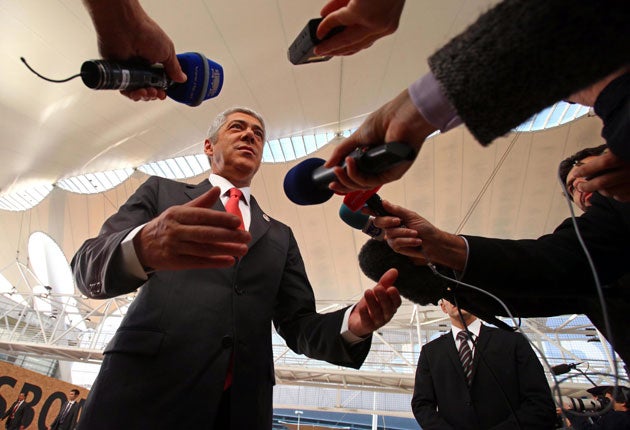
José Socrates, the Portuguese Prime Minister, toured the television studios yesterday, insisting his country does not need a bail-out. His arguments are logical: Portugal's banks are better funded than those of Ireland, its property sector less bombed-out and its public finances more secure.
To which the markets' reaction can be broadly characterised as "so what?" Portugal's efforts to bring its deficit down have yet to convince those who buy and sell its debts. And with a major fund-raising exercise due next April, it is running out of time to secure the markets' confidence. Its bond yields remain sky-high and money continues to flow out of the country. By accepting that the markets' demands for assistance for Ireland made a bail-out inevitable, the EU has condemned Portugal to the same fate. There may be no obvious trigger – though January's public finance data may show Portugal has missed its 2010 target for deficit reduction – but nor was there for Ireland. Greece and Ireland dealt with, Portugal is simply the next target. Then it is the big one: Spain. And while the first three are manageable rescues for the EU, Spain is not. The rescue facility set up by the European Union is not of sufficient scale to deal with a Spanish crisis. Its sovereign debt, for the record, totals around €560bn (£478bn), around €30bn more than Greece, Ireland and Portugal combined.
The thinking in Brussels may be that while the markets are focused on knocking off these smallertargets one by one, the bigger fish are getting a little more time to sort themselves out. In other words, that Spain's finances will be sufficiently robust to stand up to scrutiny by the time the scrutineers arrive. Even leaving aside the questionable moral and political justifications for sacrificing countries such as Ireland in this way, this is an unprecedented economic gamble.
Meanwhile, the denials of political reality continue. The bail-out of Greece underlined the weakness of the single currency project: that the bill for fiscal irresponsibility by one member of the zone has to be paid by everyone else. Ireland emphasises the point once more. Yet having forced the Irish into this deal, it is clear that the EU is struggling to extract much in the way of fiscal reform in return – even on the notorious 12.5 per cent rate of corporation tax.
As a result, one of the mostsurreal aspects of this bail-out will be that European taxpayers are being asked to subsidise tax rates in Ireland that are set so low they have robbed those same taxpayers of jobs and wealth.
Little time left for a deal on bank reform
What are we going to do about banking regulation? The mini spat that broke out yesterday between George Osborne and Vince Cable over disclosure of bankers' pay will have been noted by those who expect the two men to eventually fall out irreparably over the banks. But the wider story is that the international will to regulate the sector more closely is dissipating by the day.
It is true we have a deal, courtesy of the Basel III agreement, on capital funding. But on almost every other aspect of banking regulation, the collective determination for improvements that was so in evidence in the immediate aftermath of the financial crisis is now almost impossible to find.
The lack of international agreement on how best to regulate the banks mirrors the economic infighting within the G20. At the height of the crisis, countries put their differences aside simply to keep the economic show on the road. Two years on, those differences have resurfaced and appear to have magnified.
Even if one suspects that George Osborne is, by instinct, less enthusiastic than some about holding bankers to account, it has to be acknowledged that the lack of international agreement on regulation leaves him with a quandary.
We should not be unduly cowed by the banks' thinly veiled threats to quit the UK. But, logically, there must be tipping points: reforms that would leave the UK so out of step with other jurisdictions that banks really would begin to depart.
The difficulty for the Chancellor is that this is not a level playing field. The UK, as one of the world's top three financial centres, has more to lose than most from getting financial regulation wrong. It is in the interests of many of our rivals to sit on their hands. As their banks are of less importance to their economies, their need to supervise them more closely is less pressing. And if one side-effect of this is that Britain's banks begin thinking about relocating to their shores, so much the better.
The issue of how much detail banks should be forced to make public about their biggest earners seems less likely to represent a tipping point than taxation, where Mr Osborne has already begun to hint that he now plans to scale back the new duties the banks will have to pay. But the principle is the same. The G20's members are increasingly focused on their own narrow national interests, rather than a co-ordinated response. Time is rapidly running out for an international deal on banking regulation. And Britain can do only so much on a unilateral basis.
Join our commenting forum
Join thought-provoking conversations, follow other Independent readers and see their replies
Comments