Stephen King: Imbalancing act as G20 ministers still fail to deliver
Outlook: If we treated the euro area as a single economy – as we treat the US – we would only worry about the eurozone as a whole
So there was some progress at the G20 finance ministers' meeting in Gyeongju, South Korea, at the weekend after all. Specifically, membership of the International Monetary Fund (IMF) will now shift, raising the profile of some of the bigger emerging nations at the expense of Europe. It's about time. Beyond IMF membership, however, there wasn't much to cheer, largely because the world's major political and financial players still can't reach any meaningful agreement on the important things in economic life. The communiqué offered no more than the usual platitudes: G20 members will "move towards market-determined exchange rate systems that reflect market fundamentals and refrain from competitive devaluation of currencies".
I wonder how this statement will be interpreted by the key protagonists. The Americans want a stronger Chinese renminbi because they rightly believe China doesn't have a "market-determined exchange rate". The Chinese, however, will presumably say that a stronger renminbi is the same thing as a weaker dollar and will accuse the Americans of wanting to achieve a "competitive devaluation" (via quantitative easing) designed to benefit American exporters at the expense of their Chinese brethren. As for the UK, I really don't know what to say: sterling's collapse in 2008 surely counts as one of the biggest competitive devaluations of all time, so it looks like slapped wrists all round.
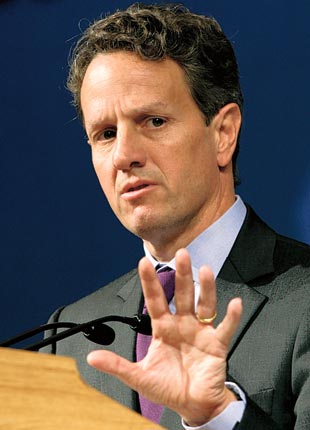
Yet there was more than a hint of the ways in which nations are beginning to re-think the architecture of global finance. The joint suggestion by Tim Geithner, the US Treasury Secretary, and the Korean hosts that countries should prevent their current account surpluses and deficits from rising beyond a certain specified amount is intriguing. In a letter sent to other G20 members, Mr Geithner suggested: "G 20 countries with persistent [current account] surpluses should undertake structural, fiscal and exchange-rate policies to boost domestic sources of growth and support global demand." He said those "running persistent deficits should boost national savings by adopting credible medium-term fiscal targets consistent with sustainable debt levels and by strengthening export performance". As the discussions developed, it turned out that the Americans and Koreans thought imbalances should be limited to no more than 4 per cent of a nation's GDP. Other nations – notably the Germans – rejected this proposal.
That is hardly surprising. HSBC's projections suggest Germany will have a current account surplus this year of 5.1 per cent of GDP. Under the 4 per cent rule, Germany would have to take immediate action to reduce its surplus. Other "guilty" nations this year include Spain (a deficit of 5.0 per cent of GDP), Norway (14.2 per cent surplus), Switzerland (13.7 per cent surplus), Russia (4.3 per cent surplus), Saudi Arabia (7.8 per cent surplus), China (4.5 per cent surplus) and a host of other Asian nations including Malaysia, Singapore and Taiwan (all substantial surpluses). Funnily enough, neither the US (3.2 per cent deficit) nor South Korea (3.4 per cent surplus), the joint protagonists of the 4 per cent limit, would be under any obligation to act at all.
One problem in focusing on surpluses and deficits as a percentage of a single country's GDP is that no reference whatsoever is made to the global consequences of these imbalances. For example, while America's deficit seems quite small as a share of its own GDP, that has more to do with the large size of the US economy than the small size of its deficit. In absolute terms, America's current account deficit this year may amount to around $470bn, an absolutely huge number in global terms and significantly larger than China's surplus ($380bn).
And while Switzerland's surplus is vast as a share of its own national income, it's relatively modest in global terms, amounting to a little under $70bn. Under the 4 per cent rule, countries such as Switzerland would have to make a huge adjustment even though the impact on global imbalances would be insignificant (fortunately for Switzerland, it's not a member of the G20 so presumably it can continue to export financial services: nevertheless, the broad point still holds).
The means of adjustment for "guilty" countries are decidedly unclear. Mr Geithner's suggestion that surplus nations should use "structural, fiscal and exchange rate policies" to deliver smaller surpluses is all very well, but what happens if a nation happens to be a member of a monetary union? Germany has a huge current account surplus, suggesting that the euro should go up. Spain, in contrast, has a vast current account deficit, suggesting that the euro should go down. Spain, however, is not a member of the G20 so the implication seems to be that the euro should rise. Poor Spain.
The euro conundrum reveals quite a lot about the political problems associated with imbalances. If we treated the euro area as a single economy – as, indeed, we treat the United States of America or the United Kingdom – we wouldn't have balance of payments data for individual nations within the euro. We'd only worry about the eurozone as a whole.
Funnily enough, in aggregate the eurozone's balance of payments position has oscillated between small surpluses and small deficits, notwithstanding Germany's own inflated surplus. The eurozone makes no contribution to global imbalances. The Germans, therefore, should simply push for the abolition of intra-European balance of payments data because, that way, their surplus would become invisible, reducing the pressure for adjustment.
Given all these practical – and, indeed, logical – conundrums, why do nations persist in demanding action on imbalances? There are three reasons. First, should the Americans continuously run current account deficits, they will have to sell assets to foreigners to fund those deficits. Either that means the Chinese and others end up owning the commanding heights of the American economy or, instead, the Americans let the dollar drop in value, reducing the foreign currency value of Treasuries and other IOUs. Either way, the result is heightened political and financial tension.
Second, countries can use imbalances as a means to blame each other for home-grown problems. Is American unemployment is high because US citizens are now living through the financial equivalent of cold turkey? Or is it easier to blame the Chinese, with their undervalued exchange rate, for problems which originated in America's backyard.
Third, global imbalances may be symptoms of excess domestic savings or investment reflecting the misallocation of global capital. Given the extent of the financial crisis, that's a reasonably safe conclusion. But whether action on only the symptoms of capital misallocation will provide the necessary prophylactic to avoid future crises is another matter. The Japanese tried to get rid of their current account surplus in the 1980s. They ended up with the biggest bubble known to man and then 20 years of stagnation. Imbalances may be a symptom of deep-rooted economic problems but they are not, in themselves, the cause.
Stephen King is the managing director of economics at HSBC
Join our commenting forum
Join thought-provoking conversations, follow other Independent readers and see their replies
Comments
Bookmark popover
Removed from bookmarks