Stephen King: The question that went unanswered in Davos: who ultimately pays?
Can debtor nations deliver austerity year after year or must creditor nations take some of the burden?
Who pays? This was the missing question at the World Economic Forum in Davos this year. The mood was relatively upbeat. Fears of a Great Depression Mark II – prevalent last year – had receded. Most economies, with the UK a notable exception, were now expanding. Some economies in the developing world were expanding a bit too quickly. And whereas last year, many participants were fretting about deflation, the word on everyone's lips this year was inflation.
But who pays? While the volume of economic activity may now be heading upwards, this recovery is creating both winners and losers. Davos routinely tends to be full of winners: losers might lower the tone. Yet, a long way away from the champagne receptions, the ski slopes and the pseudo-intellectual posturing, the world has more than its fair share of losers. The costs of the global financial crisis are still being revealed. As they become more visible, the threat of political and social unrest will only increase.
Earlier last week, and in Newcastle rather than Davos, the Governor of the Bank of England revealed one set of losers. In recent times, UK inflation has persistently been higher than expected. Today's inflation, however, is not of the old-fashioned kind seen in the 1970s, when prices chased wages ever higher. Today's inflation is of a different hue altogether. Reflecting earlier declines in sterling and the more recent spike in global commodity prices, the cost of living is now rising at a 3.7 per cent annual rate and will be rising even faster in the months to come as January's VAT hike hits home. Wage growth, however, is extraordinarily modest, running at an annual rate of a touch over 2 per cent. Put another way, workers are steadily becoming worse off.
Mr King explained in Newcastle that this was a necessary adjustment following years of excess. That may be true. It's a completely different message, however, to the one offered by the Bank two or three years ago. Back then, the big fall in sterling was supposed to "rebalance" the UK economy away from debt-fuelled consumption towards investment and exports. No mention, however, was made of the likely reduction in living standards associated with a sudden rise in inflation. The Bank simply didn't expect inflation to rise (even though the pursuit of quantitative easing both in the UK and in the US may have contributed to the gains in commodity prices now being blamed for the UK's sudden inflationary surge).
Then we have the crisis in the eurozone. Tensions have eased over the past few days, helped by commitments by anyone in power prepared to offer a Davos soundbite that the euro could not possibly break up (would anyone have been foolish enough to have said anything else?). But despite the bailouts which have provided a near-term easing of pressures in eurozone bond markets, the underlying problem remains. Can the debtor nations really deliver austerity, year after year, or will some of the burden of adjustment have to be taken by the creditor nations, whether in the form of persistent fiscal transfers or a debt restructuring? Who pays: the Irish, Greeks and Spanish who borrowed too much and either lied or invested the funds in dodgy property ventures, or the Germans and others creditors who lent at stupidly low interest rates to the debtor nations in the first place?
Inflation is on the rise in the emerging world. Western nations have used all sorts of desperate measures to kick-start their economies but many of the benefits of monetary and fiscal stimulus have leaked out into China, India and Brazil. They are suffering from what might be termed "policy pollution". Their growth rates are now too high and inflation is, as a result, on the rise.
The Americans – and many Europeans – argue that emerging nations should simply allow their currencies to appreciate to prevent inflation from rising too quickly. The argument is simple enough. If these countries are to bring inflation under control, interest rates need to go up. And it is difficult to raise interest rates without accepting some degree of currency appreciation.
But many emerging nations are reluctant to allow their currencies to rise too far. China worries that a rapid renminbi appreciation will only lead to huge speculative inflows, fuelling an even bigger property boom. As a major commodity exporter, Brazil is struggling to keep a lid on its currency, fearing that an excessive commodity-fuelled appreciation will damage prospects for its manufacturing exporters.
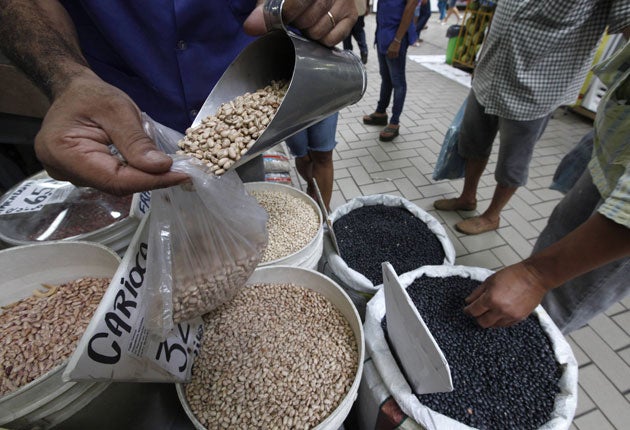
The cost of currency stability, however, has been a rise in inflation. If inflation is a worry in the developed world, it's a much bigger problem in the emerging world. In poorer countries, people spend proportionately a lot more of their (meagre) incomes on the essentials of life, most obviously food and energy. And it is these prices which have been rising so quickly. As a result, income inequality is heading upwards as those left behind in the race towards higher living standards are feeling the pinch. Inevitably, political tensions are on the rise. Some governments are coping by providing subsidies on food (at considerable fiscal cost). Other governments are suddenly discovering that their legitimacy is now in question.
It would be wrong to suggest that the uprisings in Tunisia, Yemen and now Egypt are a direct consequence of rising commodity prices and, thus, an indirect consequence of the monetary stimulus measures coming from the US and Europe. But it's not so difficult to believe that rapid gains in food prices may have been a catalyst for all that has followed. Experimental policies in one part of the world may be having hugely disruptive effects elsewhere.
Given all these problems, it's not so surprising that Americans at Davos were relatively upbeat. After all, while other nations seem to be suffering, the US economy is doing a bit better. Or at least that's what American captains of industry seem to believe. Yet their view is biased. US profits have rebounded massively over the past few years but only because there has been the most enormous shake-out of labour. And, increasingly, those extra profits are not being invested in the US but, instead, in other parts of the world where labour costs are a lot lower.
Still, it now looks as though the US economy will expand at between 3 and 4 per cent this year, which really doesn't sound too bad. But it's only going to deliver this rate of growth because, unlike most European countries, it still believes it can carry on borrowing with no real regard for the interests of its foreign creditors. Yet, as Europe's sovereign debt crisis has demonstrated, countries cannot for ever live on loans from others on exceedingly generous terms.
Will the US also eventually be faced with a day of reckoning? And if the creditors turn their backs on the US, triggering either a bond market rout or a dollar collapse, what then would happen to the US economy? Put another way, who ultimately pays?
Stephen King is managing director of economics at HSBC
Join our commenting forum
Join thought-provoking conversations, follow other Independent readers and see their replies
Comments