Dubai debt shock knocks £14bn off bank shares
Britain is in the front line as fears grow over exposure to the Gulf emirate's financial problems. Sarah Arnott reports on a day that sent global stock markets reeling
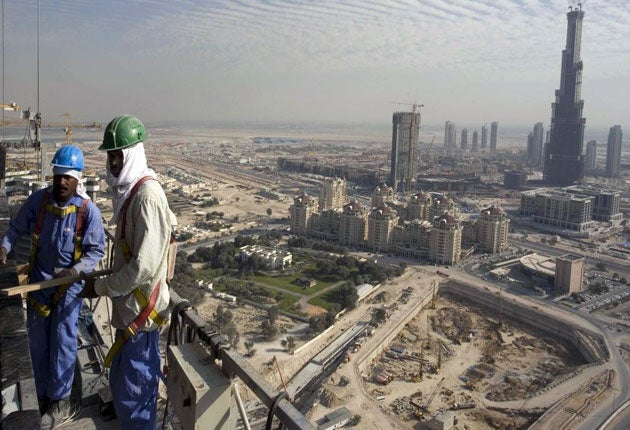
Dubai was the poster child of the economic boom: a world of unimaginable luxury, impossibly tall towers, and islands shaped like palm trees. This week it became the epitome of recessionary bust.
Global stock markets were left reeling yesterday after the city-state's spectacularly debt-ridden Dubai World holding company asked for an extra six months to pay the $4bn (£2.4bn) chunk due next month. In London, the stock market dropped by 3 per cent, its worst day since March. The French and German markets fared little better, and America's Dow Jones was only saved by being closed for Thanksgiving. Even sterling wavered, falling to its lowest rate against the euro for a month. But it was Britain's battered banks that were the worst affected. Fears over the extent of their exposure to Dubai's $80bn debt knocked nearly £14bn off their value by the end of the day.
The Gulf emirate's financial problems come as no surprise. It has already been bailed out to the tune of $10bn by fellow United Arab Emirates (UAE) member Abu Dhabi, and it had managed to scrape together another $5bn from two Abu Dhabi banks hours before the request for a "standstill agreement" to give Dubai World time to "restructure" itself. But global financial confidence is only just starting to recover from last year's banking crisis. And it is not yet known how much is at risk, and where.
Part of the problem is the scale. Dubai World's reach is truly vast. Within the main holding company are 10 subsidiaries, each a monster in its own right. The highest profile is the Nakheel property group, which owes the $4bn due next month. Nakheel is behind the Palm project that has become synonymous with Dubai's ballooning property market. The three palm-shaped islands, built in the waters of the Gulf, looked like a developer's triumph. The first island – the self-proclaimed Eighth Wonder of the World – sold its initial 2,000 villas within a month and included David Beckham and Brad Pitt on its star-studded list of buyers. But Nakheel is just one part of the sprawling empire. DP World, another division, is the world's fourth biggest ports operator, which includes the UK's London Gateway and Southampton facilities, and the Tilbury Container company, in its global portfolio. Other divisions span everything from hedge funds to Scotland's Turnberry golf course.
By yesterday lunchtime, Europe's financial markets were awash with rumours about which banks are the most in danger from the Dubai debt and what the implications might be. But while estimates of European institutions' exposure gyrated from $13bn to $40bn, there was widespread agreement that the British are the most exposed. "Everybody is looking at who is affected the most and the UK banks are standing in the front line," Shahin Vallée, BNP Paribas's head of Middle East strategy, said.
Nobody expects Dubai to default on its debt, and there is little immediate danger for the state's holdings abroad. But the shock has real financial repercussions, and even if Abu Dhabi does step in with more funding, Dubai World's reorganisation will cost its creditors money. Beyond that, the bigger danger is the blow to global economic confidence, not least because no one knows the scale of the problem. "There are layers of cloud and uncertainty," Mr Vallée said. "Dubai World is not a company, it is a conglomerate with very limited corporate governance and financial transparency so no one knows what its assets are or what the real debt is." The danger is that the crisis stamps out the signs of life helping lift the world's economies out of recession. "The consequences could be to slow down global capital flows again because banks are reluctant to stretch their balance sheets," Mr Vallée said.
For Dubai itself, the money may prove to be the least of the problem. Until now, the Dubai experiment began in the 1950s by Sheikh Rashid, the father of the current ruler, has been an incredible success story. The revenues from the state's minimal oil revenues were initially used to turn it into a major regional trading hub and before long most of all the goods flowing into the Arabian peninsula were going through Dubai. When Sheikh Mohamed, the present incumbent, decided to take the scheme a step further and turn the city into a financial centre and global tourist destination, Dubai hit the big league. Vast amounts of money were spent on property, infrastructure and tax breaks to turn it into the playground of the rich and famous. Such was its success in luring buyers from around that world that between 2003 and 2007 property prices in some parts of the city quadrupled. There seemed to be no limit to the luxury: the opening night of the Palm Island's Atlantis Hotel cost a whopping $20m and included a set from Kylie Minogue and $1m of fireworks.
But the key to the metamorphosis was image, and all the growth was built on debt. "Brand Dubai is not just sun, sea, sand and luxury, it is that everything is possible, the sky is the limit," Professor Gerd Nonneman, a Middle East expert at Exeter University said. "It was a cycle: the brand brought in buyers, which pushed up prices further."
By the end of last year, with property prices slumping by up to 70 per cent, development stalled, plans for the third Palm Island were scaled back, plans for a tower a mile high were cancelled, and more than 400 projects with a total value topping $300bn were put on ice.
On the ground, the congestion which plagued the city has eased as tens of thousands quit after losing their lucrative jobs. The bars in Dubai's luxury hotels still buzz with weekend revellers, but the teeming crowds which once flocked to popular nightspots such as Left Bank in the sprawling Madinat Jumeirah hotel complex have become noticeable by their absence. The property sector, once the lifeblood of the Dubai expatriate workforce, is now shattered, with thousands laid off. Architects, estate agents and construction staff have vanished after building projects ground to a halt. Dubizzle, a local website similarto eBay, has been flooded with adverts from people selling.
But a charm offensive from Sheikh Mohamed had just about held world opinion together. And even this time, Abu Dhabi will not let Dubai drown. "Though there is rivalry between the two ruling families, is it important for Abu Dhabi that people in the outside world don't get the impression that the UAE is a busted flush," Professor Nonneman said. The balance of power in the UAE must shift as Abu Dhabi extracts what political capital it can from its injections of cash he thinks. And the debacle will tarnish the gilded image that was the bedrock of Dubai's success. "It has taken decades to build up 'Brand Dubai' and this is a spectacular blow."
Additional reporting, Ed Alexander, Dubai
Join our commenting forum
Join thought-provoking conversations, follow other Independent readers and see their replies
Comments