Free market has turned us into 'Matrix' drones
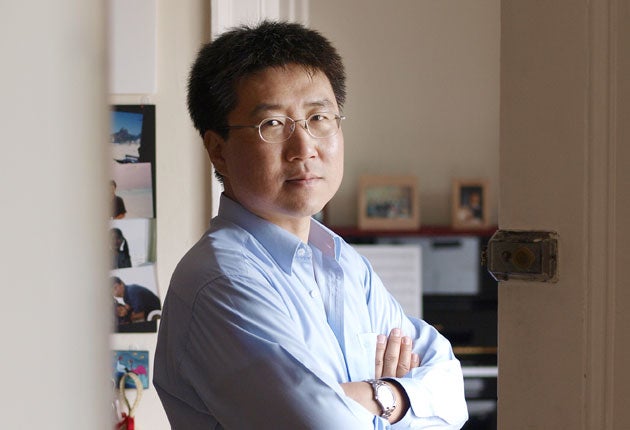
Ha-Joon Chang, the new kid on the economics block, is out to bust open a few myths

For free real time breaking news alerts sent straight to your inbox sign up to our breaking news emails
Sign up to our free breaking news emails
A leading economist has likened the nation's acceptance of free-market capitalism to that of the brainwashed characters in the film The Matrix, unwitting pawns in a fake reality. In a controversial new book, the Cambridge economist Ha-Joon Chang debunks received wisdom on everything from the importance of the internet to the idea that people in the United States enjoy the highest standard of living in the world; an iconoclastic attitude that has won him fans such as Bob Geldof and Noam Chomsky.
Dr Chang's 23 Things They Don't Tell You About Capitalism is one of a spate of tomes published in recent weeks that question the future of the current system, including Capitalism 4.0 by Anatole Kaletsky, and Ian Bremmer's The End of the Free Market. Economists are keen to tap into the market for popular books on seemingly impenetrable subjects – highlighted by the runaway success of Freakonomics, which has sold more than four million copies since it was published in 2005 and is about to be made into a film.
South-Korean born Dr Chang aims to disprove what he sees as economic myths, including the idea that people are paid what they are worth, that the "trickle down" effect of increasing wealth among the rich helps the poor, and that education makes countries more prosperous.
One of the modern idols Dr Chang seeks to bring down is the internet. He claims that we overestimate the importance of new technologies compared to older inventions – such as the washing machine – and criticises the way in which internet access has been seen as key to countries' development.
"If you had everything, then I'm in favour of it. But when children don't have safe drinking water and free school meals, is it really important?" he said. "We have a fascination with the new, and we have to be careful not to project our own vision on to other people's lives."
A leading development economist, Dr Chang was much lauded for his 2007 book Bad Samaritans, which looked at the negative effects of globalisation on developing countries. He is now bringing his focus closer to home, considering problems in the UK. "It is like The Matrix. There is a reality where things could and should be better," he said. "In order to wake people up to that alternative reality, you need to show them that it isn't impossible. I'm not necessarily saying that I have a solution, but we have to recognise that some of the things we accept as inevitable aren't."
But while Dr Chang may not have the answer, he is sure of the problem – arguing that free-market capitalism has left the global economy more unstable, and people with less job security and greater feelings of insecurity, than ever before. His conviction that, post-recession, we should be rebuilding our country in a "moral" way – by acknowledging the social consequences of economic choices such as benefit cuts and job losses – will strike a chord with many.
"Another myth that needs to be busted is the idea that we can discuss economics without any moral implications," he said. "What kind of economy we build changes us, so what we do in terms of monetary policy determines who we are."
Dr Chang also highlights the way in which economics impacts not just on our wages and living standards, but also on our characters. He said: "In conventional economic theory, it is thought that we are born as perfectly formed, rational, self-serving agents. But where you work and what kind of work you do are important in determining your character."
While Dr Chang may have many fans, his belief that the welfare state should be expanded has prompted criticism from some economists.
"It is a very unfashionable thing to say at the moment, but people have to realise that cuts have long-term implications on the fairness of the culture," he said.
Dr Chang, who moved to the UK in 1986 as a 23-year-old graduate student, argues that an emphasis on equality of opportunity is futile – likening life to a race which everyone starts at the same time, but where some have weights strapped to their legs – and that we should instead work towards greater equality of outcome.
"People have been drilled into thinking that there is equality of opportunity and whatever comes out at the end should be accepted. But the effects of not having equality of outcome are felt by the next generation. It is not simply that you don't have enough money; if your parents are from a certain background, you don't even aspire to another background. You can ameliorate some of these things through the school system, but not all of them."
What his peers say...
'I think the internet has probably changed the world more than the washing machine'
Dr Ruth Lea, Economic advisor to Arbuthnot Banking Group
'Different organisations do behave differently, and structures have an effect on our actions'
Professor Robert Wade, London School of Economics
'Of course the crisis revealed the futility of the dominant system of economics'
Professor James Galbraith, Lyndon B Johnson School of Public Affairs
'Just about every economic decision that you make has a moral aspect'
Dr Timothy Leunig, Reader, London School of Economics
'The dominant paradigm about capitalism being best for all is an illusion'
Professor Bob Rowthorn, Professor emeritus, Cambridge University
Subscribe to Independent Premium to bookmark this article
Want to bookmark your favourite articles and stories to read or reference later? Start your Independent Premium subscription today.
Join our commenting forum
Join thought-provoking conversations, follow other Independent readers and see their replies