Wall Street humiliated by nationalisation of banks

For free real time breaking news alerts sent straight to your inbox sign up to our breaking news emails
Sign up to our free breaking news emails
The US government is set to become the largest shareholder in its national banks, pumping in $250bn (£143bn) to prop up its financial system and marking one of the most startling moments in a credit crisis that has broughtquasi-nationalisation to the home of free-market capitalism.
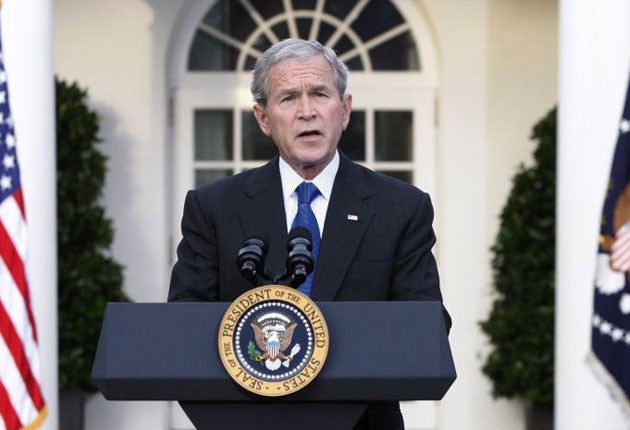
President George Bush appeared in the White House Rose Garden yesterday morning to declare that his government was immediately taking stakes in nine of the biggest banks in America, and would extend its hand to hundreds and possibly thousands more.
The moves are "not intended to take over the free market but to preserve it", he promised. "This is an essential short-term measure to ensure the viability of America's banking system."
With the government as their most important new shareholder, some of the most powerful companies in the banking world will face tough curbs on executive pay, including on the "golden parachutes" that give millions in compensation to bosses who are fired.
In return, the banks will get cheap capital that they can use to lend to each other and to the businesses and consumers that rely on credit to fund wages and buy houses – and without which the US economy is threatening to plunge into a deep recession.
The White House had resisted the part-nationalisation of the country's big banks until days ago, when a panic on the stock market and dramatic moves in Europe led by Gordon Brown forced its hand. With European governments guaranteeing bank deposits and lending, the US could ill-afford not to follow suit for fear that capital may flee to the country to safer banks across the Atlantic.
The G7 group of major nations agreed at the weekend that direct government bailouts had to be part of the solution to the banking crisis gripping the world.
Yesterday, a number of other plans were unveiled that take the US government deeper into the business of the financial markets. It will guarantee all deposits in business accounts, start buying corporate debt through the Federal Reserve and underwrite future debt issues by banks in the hope that the private sector will step up to fund the banking system.
The US Treasury Secretary Hank Paulson had summoned the chief executives of the biggest US banks to a meeting in Washington on Monday to tell them that they must accept the government as a significant new shareholder, even though several declared that they did not need or want the money. Mr Paulson said yesterday that seeing Goldman Sachs, Morgan Stanley, Bank of America and other powerful banks taking taxpayer cash would reduce the stigma for others.
Congress approved a $700bn bail-out package for the US financial sector after a protracted battle last month but at the time few people realised that cash would be used to buy equity directly in banks. Instead, the Treasury had pushed a proposal to buy up the toxic mortgage debts that have been rotting the core of the banking system for the past year and a half. Now, $250bn will be carved out for direct investments, half of which was immediately earmarked for the major institutions named yesterday – Citigroup, JP Morgan Chase, Bank of America (which is acquiring Merrill Lynch), Wells Fargo, Goldman Sachs, Morgan Stanley, Bank of New York Mellon and State Street.
The actions are "not what we ever wanted to do", Mr Paulson conceded, "but today, there is a lack of confidence in our financial system – a lack of confidence that must be conquered because it poses an enormous threat to our economy."
In recent weeks, governments around the world have had to respond to the financial crisis with extraordinary measures and dizzying speed. The financial system came close to calamity in the days after the Bush administration, arguing that markets should be allowed to work difficulties through without government help, let the investment bank Lehman Brothers fail last month. Before a week was out, however, the US government had to take over the world's largest insurance giant, AIG, and promise to guarantee all the money in the $3 trillion money market industry. Last month, it became the country's largest mortgage lender when it took over the tottering mortgage finance giants Fannie Mae and Freddie Mac in a rescue bid that could cost taxpayers $200bn.
Almost without any thought, the actions usher in a new and unpredictable era in American capitalism.
"It wasn't just the right move, it was the only move," Ken Rogoff, Harvard University economist, said of yesterday's cash injection. "Thank goodness they didn't dally for another week to finally figure it out."
The details of yesterday's moves were unveiled at a hastily convened press conference by Mr Paulson, Ben Bernanke, chairman of the Federal Reserve, and Sheila Bair, who runs the Federal Deposit Insurance Corporation, which regulates US banks.
Mr Bernanke – a scholar of the Great Depression – said there would be setbacks but he believed the intervention could mark the beginning of the end of the credit crisis. "History teaches us that government engagement in times of severe financial crisis often arrives very late, usually at a point at which most financial institutions are insolvent or nearly so. Waiting too long to act has usually led to much greater direct costs of the intervention itself and, more importantly, magnified the painful effects of financial turmoil on households and businesses. That is not the situation we face today."
There were signs yesterday that the moves had an immediate effect on the credit markets, as banks became more willing to lend to each other now that there is a federal guarantee underwriting many transactions. Global stock markets – which soared on Monday by amounts that were, in some cases, new records – continued their ascent in Asian and European trading, although some investors took profits and the Dow Jones was lower by lunchtime.
Subscribe to Independent Premium to bookmark this article
Want to bookmark your favourite articles and stories to read or reference later? Start your Independent Premium subscription today.
Join our commenting forum
Join thought-provoking conversations, follow other Independent readers and see their replies