The economic malaise afflicting business in Britain, and many other parts of the developed world, has catalysed a change in the way that business leaders need to think. Yet it’s one for which few of them are well prepared.
The corporate norm of the preceding two decades was to seek competitive advantage through efficiency. Lower costs, faster speeds; getting things to work a little bit better than they did before. The economy was driven by the knowledge of how to achieve this, gleaned from around the world, transferred across sectors, sold by management consultants whose value came from what they knew that you didn’t. But the knowledge economy is no longer the driving force it was. The job of sharing the knowledge has been done so well that everyone who wants it, has it. Knowledge is a commodity. Hence the advantage that its possession provides is no longer distinctive. It’s important to have, because everyone else has it, but ergo, it doesn’t set you apart.
In a buoyant, growing economy where demand runs ahead of supply, it may pay to hunt as an indistinct member of the pack. But not during, or in the wake of, a recession. In this environment you have to offer something different. The businesses that prosper in these circumstances are those that will add value to their customers – not by cutting the cost, but by enriching the product, service or experience that they provide. The success stories of this decade won’t come from organisations that employ me-too, best-practice methodologies but from those that identify new, previously unforeseen needs; that innovate relentlessly to create solutions that are unique; that forge emotionally compelling connections with their market, and with society, engaging them in dialogue that benefits everyone involved. This is what businesses like Apple and Google do. They are fundamentally different to most other organisations in that that they are creatively driven, not process driven. Unfortunately, such businesses are few and far between.
Of course the world is full of companies who say they recognise the importance of creativity and would like to see more of it in their work. But, as much as they like to talk a good game, the reality is that they are not prepared to do what it takes to make it happen. For most, creativity is a topic that is never discussed at senior management levels and rarely does anyone own it on the Board. With its inherent unconventional nature, subjectivity, and lack of immediate measurability it’s the sort of thing most business leaders have been taught to avoid. Because it’s something that most senior executives are not personally skilled to do they assume it’s unimportant. At best, they regard it with extreme scepticism. At worst, it just gets ignored. Instead they stick to the tried and tested methods in which everyone stays busy keeping everything the same.
But now this has to change. Organisations like Apple and Google are no longer just quirky exceptions, they are changing the commercial landscape. They are setting new standards for shareholder value, aggressively growing market share and attracting their industry’s best talent to boot. To keep up in this environment other companies need to start thinking the way they do too. They need to embrace creativity as a fundamental business discipline and install it as the key driver of their future success. They need to shift mindset from a knowledge-driven economy to an ideas-driven economy where new thinking, innovation and differentiation are the priorities; where you can’t get away with just more of the same. With this change in mindset needs to come a change in how they plan and spend. My challenge to large-scale business is this: take just 10% of the fees you pay management consultancies, or of your traditional advertising media spend (marketing departments are often the least creative part of an organisation) and reinvest it in creative consultancy for your brand. Get the Board engaged in the process of innovation, of reconsidering who you are and who it is you want to be. Train your people in how to think creatively and foster their ideas to fruition. Search for ideas that will be transformational for your business, and for the market. Orientate your business around the creation of new demand, not around clinging on to old.
The future of business will be defined by people who think differently. Not by those who think the same.
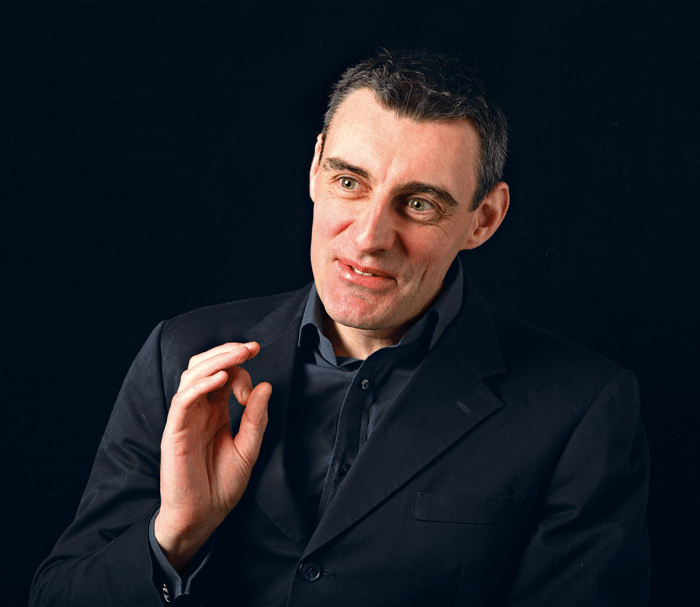
????Jim Prior is CEO of The Partners, the most creatively awarded design agency in the UK (Design Week League Table November 2009).
Join our commenting forum
Join thought-provoking conversations, follow other Independent readers and see their replies
Comments