Martin Rees: 'There is a dearth of good science teachers in our state schools'
He's the Queen's astronomer who has clashed with Richard Dawkins. Now Martin Rees is planning a new battle – to make students more scientifically literate. Richard Garner reports
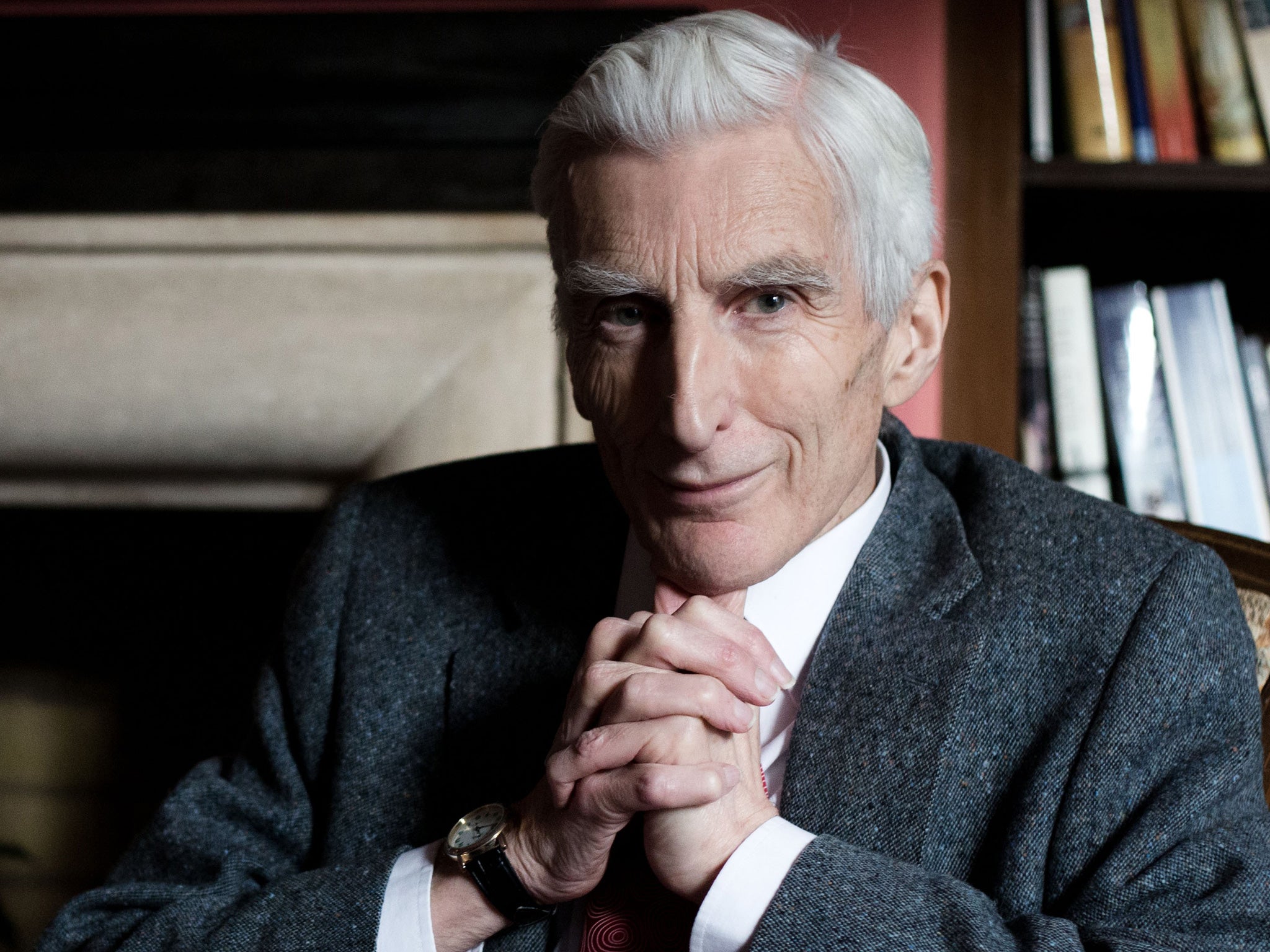
Martin Rees was content to be described as an "unbeliever" in the wake of the controversy over his acceptance of the richest scientific prize on the planet – the £1m Templeton prize awarded by a religious foundation. "I'm not myself religious but have no wish to insult or denigrate those who are," he says.
However, he now has bigger fish to fry as he dons the mantle of the president of the Association for Science Education from tomorrow as the organisation celebrates its 50th anniversary.
In his presidential address to be delivered on Friday, he intends to make out the case for ensuring that a knowledge of science is accessible to everyone – "part of their culture".
It is a difficult task, he acknowledges, because of the "dearth of good science teachers in our state schools". That has been a factor behind universities being forced to put on remedial classes for their science undergraduates – they are not developing a deep enough understanding of the subject during their school years.
Lord Rees of Ludlow, to give him his full title, is a sprightly 70-year-old who still has fingers in many pies. He is the Queen's astronomer – a largely titular role – and still has many connections with Trinity College, Cambridge, from where he recently retired as master. He enjoys the 25-minute walk along the river bank from the converted farmhouse he now lives in to the Cambridge college. He hopes that now he has given up his administrative role at the college he may have more time to devote to the House of Lords.
As he talks of the Templeton award – the money he received from it, he says, was spent on "nothing special" – he is quite dismissive of the controversy that followed winning the prize in 2011. Some of his fellow scientists – including Professor Richard Dawkins – criticised him for giving credence to the religious foundation that gave the award. The prize is given to those who have made "exceptional contributions to affirming life's spiritual dimension".
"The media just rang two or three of the usual suspects and they said what they thought they would say," he says.
In fact, his lasting memory of the saga is an email he received from a former winner of the award – Freeman Dyson, the British-born American physicist – who said it made him feel less guilty about the little effort he himself had put into receiving the award.
That is all behind him now, though. Rees spent the Christmas break preparing his presidential address for the ASE, whose conference begins at Reading University on Thursday. He will be talking about the challenges of the 21st century, the main one of which, he says, "is preparing food, energy and health for a growing population". It will require the "best science", he argues, with a scientifically literate generation encouraged to develop an understanding of the subject through their schooling.
To achieve that, though, will not be easy. "As we know, there is a long-standing shortage of enthusiastic science teachers in this country, and the sad thing is that many pupils never get exposed to a good science teacher. For the small fraction who are going on to do science at university, this is a handicap." As a result, many universities have to put on remedial classes for science undergraduates, to make sure, in particular, that they have enough knowledge of maths to start their degree courses.
Rees is critical of the sixth-form curriculum in schools as he assesses whether Britain can achieve the goal he is setting it. "It's too narrow," he says. "I'd like to see it be something more like the International Baccalaureate. There have been two attempts to widen the curriculum – the Higginson committee 25 years ago [which suggested pupils should take five A-levels] which was shot down by Margaret Thatcher on the altar of threatening the gold standard of A-level; and the Tomlinson committee [which recommended equal weight for academic and vocational studies] which was shot down for electoral reasons, too." That happened during the Blair era.
He would like to see the UK copying Finland, where teaching is one the most prestigious professions and top graduates are fighting to get jobs in the classroom. That will not happen, though, he argues, with the Government's plan to scrap annual incremental pay rises for teachers, making them dependent in future on their performance as assessed by their headteacher. We are talking on the day some people believed the world was going to end – indeed, according to the Mayan calendar, it should have ended 15 minutes into the interview. It does not. He has just turned down two radio interviews on the subject. "I refused because I think people who talk about the subject tend to be thought of as idiotic," he says. "Even the Mayans didn't really believe it would end," he says. "They just think we are entering a new age. It's like a car registering 100,000 miles on the clock and then going back to zero again."
It brings us on to discussing the real threats to the planet and one of the themes of his conference speech emerges again. "If you look 50 or 100 years ahead, the thing that comes up much more clearly as a threat is the growing population being much more demanding of energy and resources to sustain life," he says.
"It's that and the growing number of individuals or small groups who have access to new forms of technology." That, he argues, will not make the world a safer place. Far from it as the threat of terrorism continues.
Lord Rees is a cross-bencher in the House of Lords – one of the so-called "People's Peers" nominated by the public under the Blair government – even though he is in fact a member of the Labour party.
He tells of an exchange he had once with Nick Hillman, University Secretary David Willetts' special adviser. Hillman was seeking to become MP for Cambridge and came canvassing to the converted farmhouse in which Lord Rees now lives. He was sent away wih the words, "We're all Labour here!" ringing in his ears.
Nevertheless, Rees says he has immense respect for Mr Willetts, who he believes has the interests of the higher education community at heart. "I'm glad they didn't reshuffle him," he said. "I can't think of anybody else in this present government I'd like to see in his place. We're surely fortunate to have a minister for science and universities so energetically committed to his brief."
One thing he would like to see adopted here, though, is a scheme similar to that operating in universities in the US, where the elite keep some places for those who have shown promise at less highly ranked universities so they can then transfer.
It would, he argues, grant a second chance to those who have missed out on top science teaching at their secondary schools.
This life: Martin Rees
Martin Rees was born in 1942 the son of two Shropshire teachers. He studied mathematics at Cambridge University before moving into astrophysics in the 1960s
His breakthrough study of the distribution of quasars helped discredit the Steady State theory of the universe. The alternative to the Big Bang theory had proposed that the universe was constantly expanding with new matter continually created. Rees's observations in the mid-1960s pointed to a Big Bang beginning of a universe with a finite age.
He was the first to propose in the 1980s that enormous black holes at the core of quasars power the energy sources which can be as bright as 100,000 Milky Way galaxies.
Join our commenting forum
Join thought-provoking conversations, follow other Independent readers and see their replies
Comments