Minister: Every school can have a police officer

Sign up for a full digest of all the best opinions of the week in our Voices Dispatches email
Sign up to our free weekly Voices newsletter
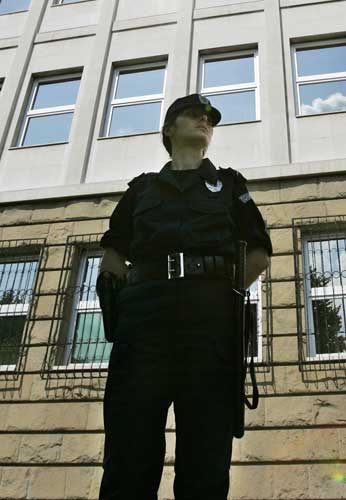
Every school that wants a police officer stationed on the premises should have one, the Schools minister said yesterday.
The Government has begun discussions with police forces around England to assign more officers to work in schools, in a plan to cut knife crime. Teachers have told ministers they are reluctant to use the new powers given to them to search pupils for knives, drugs and alcohol.
Lord Adonis, the Schools minister, acknowledged that many teachers were hesitant because of fears for their own safety. Speaking at the conference of Voice – the teachers' union formerly known as the Professional Association of Teachers, Lord Adonis said: "We've been encouraging local police forces to make more officers available to schools. No school staff should be obliged to conduct searches. Where there is doubt, police should be called in to do the searches."
In most cases, that would mean officers being stationed in schools with their own offices – an experiment already tried in many inner city schools under a safer schools partnership.
About 400 of the country's 3,500 secondary schools have a police officer working with them – although only a few so far have a full-time attachment.
"Years ago, the debate was over whether police should be in schools but now I find that, on the contrary, headteachers are warmly supportive," he said. "They [police forces] are specifically training officers to work in schools. It gives a much richer dimension to the concept of community policing."
He told the conference in Daventry: "Nothing is more imperative than that we get weapons out of schools. This legislation doesn't mean we expect teachers and the other school staff to be exposed to danger."
Philip Parkin, general secretary of Voice, welcomed Lord Adonis's announcement. "We would not advise our members to take on these search powers," he added. "It would have to be something they did independently of their own volition. Anybody who does take on these search powers would have to have the proper equipment – such as anti-stab vests. I'd much rather have trained police officers doing this job.
"I don't believe police officers will be required universally by schools but where this is needed I'd like to see the resources put in."
The move came under fire from headteachers' leaders last night. Martin Ward, deputy general secretary of the Association for School and College Leaders, which represents secondary school headteachers, accepted that teachers would be reluctant to use search powers: "They don't see their job as being a security guard. They think that might jeopardise their relationship with their pupils. Also, they have been told for many years 'Don't touch or lay your hands on the pupils'."
But he added: "I'm not sure that involving police officers when a search is carried out is going to be particularly productive either. It could sour relationships they have built up with pupils. Many schools have a neighbourhood beat officer come in and work with them to build bridges with the pupils."
David Laws, the Liberal Democrats' schools spokesman, said: "It is a sad state of affairs when the threat of violence in our schools means ministers are proposing giving each school a dedicated police officer.
"The Government must explain where these officers are coming from. Our children will not be any safer if police officers are taken off the streets." Lord Adonis also revealed that ministers are planning a major expansion of state boarding school provision – with three of its new academies providing places for children of armed services families and vulnerable young people at risk of being taken into care.
Two of the academies – Wellington near Salisbury Plain and Priory in Lincolnshire – will be sited near Army bases. The third, Harefield, near Watford, Hertfordshire, is expected to concentrate on provision for more vulnerable youngsters.
At present, there are just 35 state boarding schools in the country. The three new academies will boost provision by 300 places a year.
Lord Adonis said that boarding school places would provide "a more stable environment" to learn for children who would otherwise face having their schooling disrupted.
Subscribe to Independent Premium to bookmark this article
Want to bookmark your favourite articles and stories to read or reference later? Start your Independent Premium subscription today.
Join our commenting forum
Join thought-provoking conversations, follow other Independent readers and see their replies