Restorative justice cuts exclusions
Experiment to make disruptive pupils confront victims is hailed a success
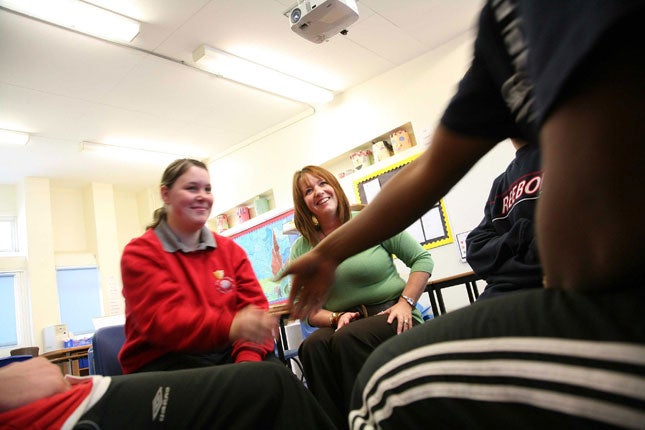
A radical plan to confront disruptive pupils with their victims has cut exclusion levels in some of the country's toughest schools by as much as half.
The "restorative justice" scheme is being trialled in 20 failing schools and a number of academies in Bristol and Sefton, Merseyside, and could soon be extended nationwide.
Under the scheme, bullies are made to confront their victims – and pupils guilty of other forms of disruption are made to explain their actions.
Sir Charles Pollard, former chief constable of the Thames Valley region, who is leading the scheme, said: "There has been a 45 per cent reduction in rates of exclusion. More importantly, it has also improved behaviour in general in the schools. This has been a fundamental part of a new approach to discipline in schools where it has been a problem.
"Pupils who have broken the school rules are told 'you're damaging your school, you're affecting other pupils'. It puts them in a situation where they will be ashamed of what they have done – the chances are they won't do it again."
In one case, five children at a Bristol secondary school ran amok in the car park after lessons, pulling parts off the cars and scratching the paintwork. The children were given a police caution and a short exclusion – and were made to tell the teachers why they had done it.
"They were allowed back into school because of the attitude they had shown at the conference," said Sir Charles. "The head has seen these kids were just plain stupid. They were full of remorse and there was no chance of them doing it again, so what was the point of giving them a long-term exclusion?"
The scheme has also been successful in dealing with bullying, seeing a 27 per cent reduction in incidents. It is based on a similar programme within the criminal justice system, which brings criminals face-to-face with their victims.
Peter Woolf gave up a lifetime of burglary after taking part in a similar conference with a victim he had beaten. He said the victim had reduced him to tears when he explained the effect the attack had had on him and his family.
"If you're sitting in a room with people you've done harm to and they're giving you pain, it really does affect you," Mr Woolf said. "For the victim, all they get normally is a statement that will be read to the court. They never get to ask 'Why me?' This gives them that."
He said he had also worked with seven "prolific" young offenders in Barnet, north London. Of them, three were now in prison but the other four had never reoffended. Three had full-time jobs. All had given up drugs. Mr Woolf is touring schools to encourage them to take up restorative justice conferences.
Researchers at King's College, London, are carrying out an assessment of the pilot project in Bristol and Sefton, which will be presented to ministers early next year with a view to extending the scheme if it is successful.
Sir Charles has held discussions with the Department for Children, Schools and Families, which had expressed interest in the scheme. In addition to the pilot scheme, an estimated 2 per cent of state schools around the country – 600 schools – have introduced some form of restorative justice into discipline codes.
Case study: Iffley Mead School
At Iffley Mead School in Oxfordshire no punishments are imposed on pupils, and students are never expelled – no matter how bad their behaviour, writes Sarah Cassidy.
Instead students who have threatened staff, vandalised school property or bullied other pupils must sit with their victims and decide how best to make amends. "Restorative justice really does work," says Kay Willett, the headteacher who introduced the scheme. "It is definitely not an easyoption for students. The restorative process is one of the most uncomfortable for a young person to go through. They do experience real remorse, shame and guilt.
"Restorative justice encourages pupils to think not only of the consequences of their behaviour on themselves, but also the impact of their actions on the community.
"I don't want to give the impression that nobody ever raises their voice or says no in our school because that is definitely not the case. You have to set very clear boundaries if this is going to work. Sometimes the process produces sanctions but it will be the young person who decides what is needed."
The school has seen remarkable improvements in attendance and behaviour since it became one of the first in England to introduce restorative justice five years ago.
The success is even more remarkable because the school caters for pupils with moderate and complex learning difficulties, and around 60 per cent have profound behavioural problems.
Ofsted inspectors have judged the school to be outstanding in personal development of pupils, arguing the scheme has enabled students to learn the value of honesty and being responsible citizens.
27%
Drop in bullying under the scheme.
Join our commenting forum
Join thought-provoking conversations, follow other Independent readers and see their replies
Comments