Top marks for good behaviour
Far from despairing about discipline, we should celebrate the huge drop in school exclusions, the previous government's 'behaviour tsar' tells Richard Garner
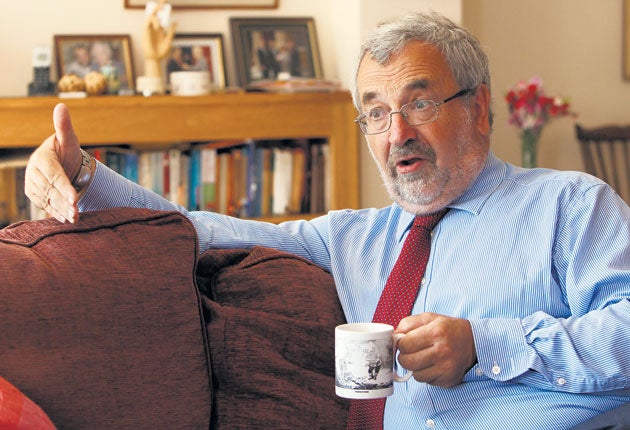
Talk of a stern clampdown on school discipline by Education Secretary Michael Gove has raised the spectre of chaos ruling in our our classrooms – not for the first time.
The former government behaviour "guru" (although he dislikes the epithet) Sir Alan Steer has an alternative viewpoint. He believes there is a good news story to be told – particularly about behaviour in secondary schools. "I'd like to ask: 'Minister, what is a good news story?'" he says, almost in exasperation, as he contemplates the latest exclusion figures.
For two years they have been falling – quite substantially. Last year permanent exclusions fell by 19 per cent and this year they are down to just over 5,000 a year – a further drop of more than 10 per cent. Yet the headlines are all about how 900 children a day are being excluded for assaulting or abusing another child or adult at their school.
The comments from Schools minister Nick Gibb accompanying the statistics are also all about how the problem must, and is, being tackled.
"Four or five years ago when the number was around 10,000 a year, to have it down to about 5,000 would have been unthinkable," Sir Alan says. "It is not because heads can't exclude [as has been suggested by ministers]," he goes on. "That is totally untrue and it is an absolute myth. What we have seen is the success of the policies that have been implemented over the past 10 to 15 years – but because that story happened before this Coalition was elected we don't hear about that."
Sir Alan was the Government's behaviour "tsar" for five years from 2005 to 2010. Just over a year after leaving office, he now feels able to give vent to his feelings about how the new administration is tackling the issue.
He would acknowledge that some of the successes predate his appointment (and, indeed, are just down to common sense rather than Government initiatives). They are also down to firm leadership in schools coupled with quality teaching.
He himself once told me that he believed it was better to resort to a "right royal rollicking" for a first offender rather than rush to exclusion when he was in post as a headteacher." It shows that you care," he says.
He also acknowledges that he was under pressure to recommend new crackdowns on behaviour during the years he was churning out reports on how school discipline should be tackled. "I was always hearing the phrase: 'will you be tough enough?'," he says. "Yet evidence from Ofsted, the education standards watchdog, is that behaviour in most schools is good and getting better – although you may not think that from reading certain tabloids. Really, though, if you're going to say the national inspection service is rubbish you have to have more evidence than 'I know that because I met a man in the Pig and Whistle, and he said it was getting worse'."
During his time as education tsar, he tried to get the message across that "respect" was key to improving discipline – and that meant respect of the pupils by the teachers just as much as respect of the teachers by the pupils.
Respect, to his mind, meant giving them good-quality teaching that made them want to learn. "After all, if you go back to your own schooldays, wasn't it the teacher who didn't have command of his subject in whose lessons you played up the most?" he asks.
He is therefore critical of the latest government initiatives to try and combat poor discipline. One centres around giving teachers the power to use "reasonable force" in trying to restrain unruly pupils. It is, he says, a concept that was pushed under the previous government and its first inclusion in the statute books even predates Labour – although Coalition ministers would argue that teachers are still sceptical about how much force they can use.
The other is the plan to allow schools to use the power of same-day detention. "I can't think of anything more worrying to parents than if you're expecting your child home at a certain time and an hour or so later they haven't turned up," he says. "It's ridiculous."
Sir Michael Willshaw, headteacher of the highly successful Mossbourne Academy in east London – who was the architect of this plan in that its use at his school impressed Education Secretary Michael Gove, has said he would always alert the parents to the fact he had taken this step. Sir Alan, though, is worried that the new advice to heads does not stress this point.
He is not complacent about discipline, though, believing there are crucial issues – even "scandals" to use his words – that need to be tackled urgently. One is the type of education children receive once they have been excluded from school. In too many instances, he says, it is still the case that a child excluded from school may only receive home tuition for about one hour a week.
"Where are they going to be for the rest of the time?" he says. "They're probably not the sort that would be found in the local library. They will be driven into crime, drugs, substance abuse or alcohol participation." Or rioting in the streets during the summer holidays.
Nick Gibb, in his reaction to the latest exclusion figures, said ministers were encouraging the idea of alternative provision for excluded youngsters – possibly through private providers tabling plans to set up "free" schools to teach them.
The Independent last month revealed how in Sunderland the local premier league football club was teaching excluded pupils in classrooms at their Stadium of Light, recreating the atmosphere of a football match as they turned up for school to make them feel better about learning.
Sir Alan says he feels it was a "national scandal" that provision should vary so much from place to place. "The Government's answer is that the market will provide, but if the market doesn't provide in any given area you still have to have the necessary provision," he says.
One plan, though, he does agree with is a move – spelt out by ministers – to ensure schools should retain responsibility for the education of excluded youngsters. "Headteachers may not like it because they may have thought they had got rid of their troublemakers ," he says. The scheme, being trialled in several areas of the country from September, would force schools to consider what they should provide for excluded youngsters. It could mean schools banding together to set up pupil referral units,
Sir Alan also believes it is a "national scandal" that child mental health care services are a lottery for children. Depending on which area of the country a child lives in, it can take up to 18 months to get an appointment.
"If a young child had appendicitis and had to wait that long for treatment, there would be an uproar," he says. "It is just wrong."
He has had 18 months out of the limelight, which has enabled him to turn his attention to other things.
He is now chairman of the Ambition AXA awards scheme, which aims to reward young people with exceptional talents in the fields of sports, working in the community, the arts, science and enterprise. The awards, to be presented in the new year, are open to 11 to 18-year-olds, who have until mid-October to apply.
He has retired from his job as headteacher of Seven Kings School in Ilford, east London – where his reputation for having run an outstanding ship led to his selection for the job of behaviour tsar.
His new role, to which – as ever – he is devoting more time than he expected, is markedly different to when he had access to the seat of power in the education world.
Why the change of direction? "I couldn't keep churning out reports on discipline," he says.
"Besides, it's positive and you've heard me rabbit on about how there is so much negative publicity about youngsters these days. It's nice to be involved with something that's entirely positive."
It is a comment, one suspects, he would like those still in the corridors of power to take note of.
Exclusions: The good news story
Last year the number of permanent exclusions in English state schools dropped from 6,550 to 5,740. There were 5,020 exclusions from secondary schools and 620 from primaries.
The number of fixed-term exclusions also fell from 363, 280 to 331, 380 (279, 260 of which were from secondary schools and 37,210 from primaries).
The rate of permanent exclusions for boys was four times higher than that of girls. Black caribbean pupils were also nearly four times more likely to be excluded compared with the average – as were children entitled to free school meals.
The most common reason for exclusion was persistent disruptive behaviour. However, the figures also show that almost 900 pupils are excluded – either permanently or for a fixed-term – every day for abusing or assaulting fellow pupils or adults. A breakdown shows that staff in primary schools are more likely to suffer assaults than those in secondary schools.
There were 510 appeals against exclusions lodged by parents in 2009/10 – of which 24 per cent were successful. Of these, reinstatement of pupils was directed in 27 per cent of cases, a decrease of 12 percentage points on the previous year.
Overall, just 30 pupils throughout the country were returned to the classroom, down from 60 the previous year. However, this fall could partly be due to the fact that information on appeals against exclusions against academies are not collected and the number of academies has been constantly rising.
Join our commenting forum
Join thought-provoking conversations, follow other Independent readers and see their replies
Comments