Top universities and cut-price courses are winners in shake-up
Middle-ground institutions fear squeeze in 'bidding war' for students
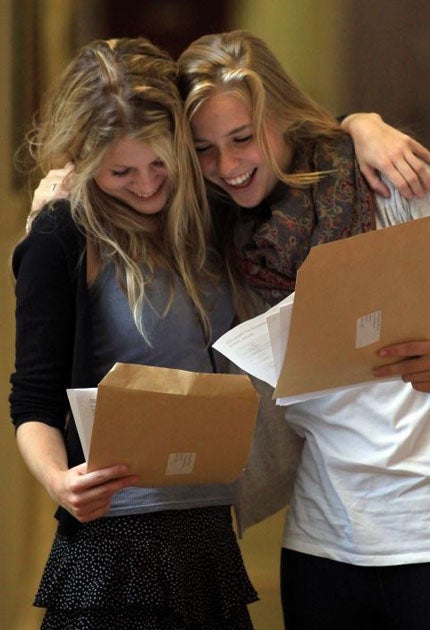
Universities will be able to enter a bidding war for high-flying A-level students under the most radical reform of higher education for decades.
The plans, published in a Government White Paper yesterday, also give the green light to more private firms to set up degree courses.
The country's most sought-after universities will be allowed to expand their student numbers to take in as many youngsters as they want who have two A-grades and a B-grade at A-level. In all, 65,000 places – about 18 per cent of the annual undergraduate intake – will be allocated this way. Universities offering cheaper degree courses – charging less than £7,500 a year – will also be able to recruit extra students, up to a maximum of 20,000 a year.
The universities minister David Willetts made it plain yesterday that the moves – which mean one in four places at English universities will be open bids next year – were the first step towards an even more radical shake-up of the university system. But student leaders warned it would lead to university closures particularly among the "squeezed middle" universities which cannot benefit from the deal on offer to cheap providers, and who are unable to attract many high-flyers.
Mr Willetts conceded that it could lead to the closures of less popular courses at middle-ranking universities, adding: "No government has ever said they will guarantee every institution." He said he doubted whether any institutions would have to fold as a result of the measures.
The carrot offered to universities charging below £7,500 a year is seen as a way of putting pressure on institutions to cut their fees. The White Paper says it may have to rethink the definition of a "university" and even talks of providers being able to offer degrees without providing any teaching for them. Other measures include:
* giving students more information about what subjects previously successful applicants have studied, and their post-degree employment status;
* allowing them to rate their lecturers as part of a student's charter;
* allowing them to complain to trigger inspections of their course;
* strengthening Offa, the admissions watchdog, by giving it more staff
* allowing employers and charities to sponsor university places above government limits, including the full cost of tuition fees;
* allowing students to pay off their loans early if they have the cash.
Student leaders have reacted angrily to the plans. David Barclay, president of Oxford University Student Union, said: "Dressing up the White Paper with the language of student choice is like putting lipstick on a pig: it cannot mask the fundamental destruction of our universities. Sky-high fees and a marketised system will only serve to hurt social mobility and cause courses and institutions to close across the country."
Q&A: What bidding wars mean for students
Q The Government has billed its plans as "putting students at the heart of higher education". Do they?
A It gives them powers they have never had before: the right to know which A-level subjects they should take to succeed in applying to university. Expect fewer pupils to take media studies as a result.
Then there's the students' charter – which should guarantee them the right to quality teaching and the right to complain and trigger an inspection of the university if they feel they are not getting it.
All these things are fairly uncontroversial but the point is many felt they did not have these rights before.
Q What about opening up competition for university places, allowing universities to expand if they take in more high-flying students? Surely that will give them more of a chance of getting into their number-one university?
A You would think so. You have to remember, though, that universities such as Cambridge (pictured above right) are reluctant to expand their student numbers. So it will not be a case of "I've got two As and a B – therefore I should be able to get into the university of my choice".
Q How did the universities respond to all this?
A Interestingly. Vice-chancellors of most hues (Russell Group, red-brick universities, former polytechnics) were quite cautious in their reaction yesterday. I thought a telling point, though, was made by Dr Wendy Piatt, director-general of the Russell Group, when she warned the plan might have "unintended consequences". She cited the instance of a university running courses in the strategic subjects such as science and modern languages that the Government is so anxious to protect being forced to close them because not enough students were opting for them. It's not only the elite universities that supply top-quality courses in these subjects.
Q How about private-sector provision? Are we going to see loads and loads of universities springing up all over the place in the image of the New College of the Humanities championed by Professor A C Grayling and charging students £18,000 a year?
A I would think not. The private providers are more likely to be offering courses at the lower end of the market – specialising in particular vocational subjects, possibly through providing distance-learning courses. A word of caution here is added by Labour. If the open-door policy towards them ends up with our system replicating that on offer in the United States, you could be in for higher drop-out rates. Research shows that 57 per cent of students enrolling with "for profit" private providers (not the Ivy League universities) drop out.
Q What is the thinking behind allowing those offering cheaper courses to expand their intake?
A David Willetts (pictured below left) has always said he would like to see more students being able to sign on at their local further-education college and be able to access courses devised by leading universities. Most of the colleges offering higher-education courses are charging less than £6,000 a year so there could be scope for expansion.
Of course, it is also no secret that ministers believe that too many universities opted for the maximum £9,000 charge and both they and vice-chancellors expect some to have to lower their fees after the first year because they have failed to attract enough students. This proposal could be seen as a sweetener towards encouraging a few to drop their prices.
Q Have students welcomed the increased powers they will have as a result of these proposals?
A Actually, the comments made by students' leaders have probably been among the most vitriolic reactions to the White Paper. At the heart of their responses is a feeling that the Government has offered them only more "student power" as a result of proposing to increase fees to up to £9,000 a year from next September. As David Barclay, president of the Oxford University Student Union, put it: "Dressing up the White Paper with the language of student choice is like putting lipstick on a pig – it cannot mask the fundamental destruction of our universities."
Q It has been billed as the most radical reform to higher education for decades. Is it?
A It probably is the most wide-ranging set of proposals since the Robbins Report in the 1960s paved the way for the expansion of the system. The only measure that could rival it, I suspect, is the decision to allow the polytechnics to have university status – granted surprisingly under the Thatcher era. As to whether it lives up to its billing, the jury – I suppose – is still out. David Willetts was stressing yesterday that this was only the first step along the road to a more competitive university system. If the number of places open for bids expands substantially, then that would truly warrant the billing. Whether it does so or not, I suspect, depends on whether there are those "unintended consequences" Dr Piatt talked about.
Join our commenting forum
Join thought-provoking conversations, follow other Independent readers and see their replies
Comments