University challenge: Does a two-year degree make more economic sense?
Lucy Hodges examines the pros and cons
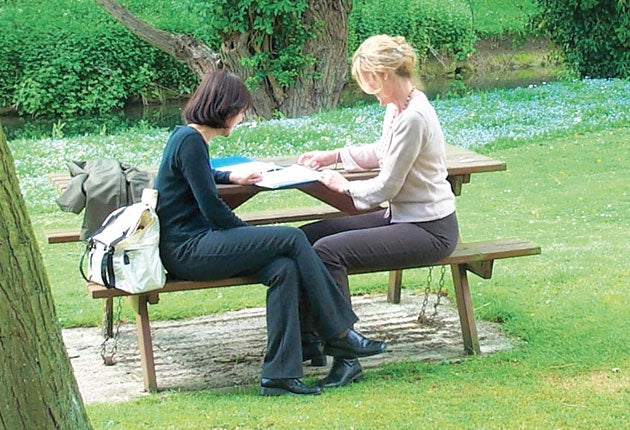
For students at Buckingham, the private university opened by Mrs Thatcher, the two-year degree is a winning option. They positively relish the rigours of a 40-week year, and prefer four terms to three, together with holidays of only two weeks; that way they keep up the momentum and get their degrees over more quickly.
"It worked for me," says Flora Seddon, 23, who has just graduated with a first-class degree in economics. "Yes, you have a lot of work to do, but then you take a break and carry on. You have to work hard. There is no let-up, but it is very stimulating."
All the signs are that other students agree with her. Ben Field, 19, who is studying English literature and journalism, says the two-year degree was a big factor in his choice of Buckingham because he didn't want to hang around. And Julia Boczko, 40, came to her law degree late in the day after a career in retail management. "You need to be a certain sort of person to do this," she says. "You need to have the stamina. It suited me because I wanted to get on with it."
Buckingham has only 1,000 students and comes top of the National Student Survey, the league table for student satisfaction. This helped to put the university at number 20 in the latest "Complete University Guide" published in The Independent. It is the first time Buckingham has appeared in the rankings.
According to its vice chancellor, Terence Kealey, the shorter length of his university's courses makes them much better. "That's because they sustain the train of thought throughout the two-year period without the long artificial gaps, particularly the summer holidays," he says.
"The common justification for the summer break is that it's an occasion for students to reflect in depth," he continues. "But if you ask students what they do in that vacation, you find they don't reflect, they just go on holiday. So when they return at the end of September they're actually completely disconnected from what they've been doing and have to spend their time reacclimatising."
For the Government, the two-year degree is a way to give students more choice – and to cut costs. The new Business Secretary, Vince Cable, is only the latest minister to espouse the idea. Squeezing a degree into two years instead of three could deliver cheaper degrees, says Kealey, because of lower costs of tuition as well as of board and lodging.
A survey by Staffordshire University, however, found that two-year degrees at present actually cost universities money, as government funding arrangements allow them to charge a mere £3,290 per student per year, and prevent them recruiting the number of students they need. "There are no circumstances in which it is financially viable for a university to offer fast-track places if it is experiencing a cap on overall recruitment," said the research. But the survey added that if universities were allowed to charge higher tuition fees, the financial viability of these degrees would be substantially enhanced.
This is exactly what former BP chief executive Lord Browne is looking at as part of his inquiry into university funding. So, the higher education world is expecting that fees will be allowed to rise, making two-year degrees more attractive for universities.
Professor John Clarke, who teaches history at Buckingham, says the two-year model was adopted when the university was established in 1976 largely on grounds of cost.
"We had to try to keep our fees as low as possible," he says. "One of the ways to do that was to use our buildings and facilities for longer in the year than is the norm elsewhere." Clarke is confident that the two-year degree is the same standard as a three-year one, having as many teaching weeks in the two years as a three-year degree.
Flora Seddon believes she received a high-quality education at Buckingham because the classes were small and she got a lot of personal attention. She had something to compare it with because she had tried two universities before Buckingham. "At Buckingham, everyone knows your name," she says. "If you have a problem you can get it dealt with immediately."
Despite interest by government ministers, swathes of the university world are opposed to two-year degrees, although another private university, BPP, which runs degrees in business and law, also offers them. The University and College Union believes two-year courses would massively increase academics' workloads and reduce time for research. They could also conflict with Britain's commitment to the Bologna Accord, which says that first degrees have to last three years.
Wendy Piatt, director general of the Russell Group representing 20 leading universities, says two-year degrees may be right for some institutions but "are un-likely to work well for many of the courses offered by Russell Group universities, which are academically intensive and in many cases laboratory-based". At Russell Group institutions "learning takes place in an environment where leading academic staff are engaged in both research and teaching, and much of this activity takes place during the 'holiday' periods".
Eight universities – Anglia Ruskin, Derby, Gloucestershire, Leeds Met, Northampton, Plymouth, Staffordshire and York – are piloting models of flexible higher education, including accelerated degrees. Wider availability of such courses, mooted first by Lord Mandelson and now by Vince Cable, is coming closer by the month.
BUCKINGHAM UNIVERSITY
Vital statistics: It pioneered the two-year degree, which runs over eight terms so that students study for the same number of weeks as in traditional universities. 1,000 students. Home students pay £8,640, overseas students £13,500
History: Founded by academics from Oxford, the university's first vice chancellor was Lord Beloff and its development was propelled forward by the libertarian Institution of Economic Affairs. Margaret Thatcher laid its foundation stone
Ambience: Lovely campus on the River Ouse between Oxford and Cambridge, outside a small market town with no train station
Added value: Offers a staff-student ratio similar to Oxbridge and small tutorial groups not seen in many universities
Who's the boss? The colourful Terence Kealey, a biochemist from Cambridge, who challenges the idea that education and science are public goods requiring public subsidy
Join our commenting forum
Join thought-provoking conversations, follow other Independent readers and see their replies
Comments
Bookmark popover
Removed from bookmarks