Weathering the storm: How Paul Webley has pushed pushing Soas up the league tables and into the black
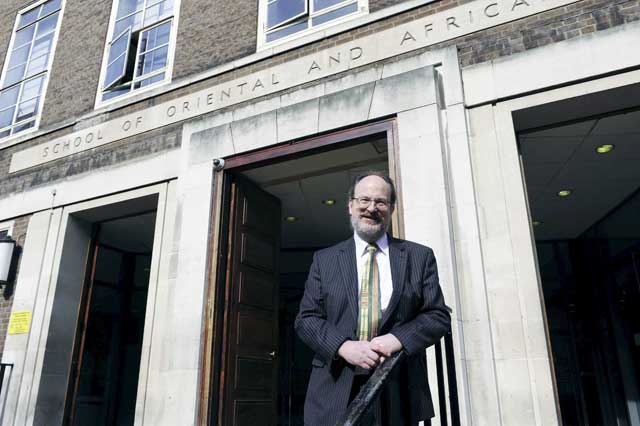
Nine months ago the director of the School of Oriental and African Studies, Paul Webley, was at the centre of a storm when 50 students occupied his office for 48 hours and harangued him, refusing to budge until he met their demands.
It wasn't to do with the Middle East, which is often a flashpoint at Soas, but everything to do with nine cleaners who had been arrested by UK Border Agency officials and spirited away to a detention centre.
It was a nasty experience for Webley, as anyone who saw the video on YouTube can tell. He was cornered and shouted at. Webley met some of their demands – he wrote a letter to the Home Secretary on behalf of the detainees and agreed to review the arrangements for hiring cleaners – and thereby defused the confrontation.
Although this was the first sit-in that Webley had experienced at Soas, he is no newcomer to student protest. During his time as deputy vice-chancellor at Exeter University, when the chemistry department was closed down amid intense protest, he saw how vicious opposition could be. Broken glass was deliberately laid outside the home of Exeter's vice-chancellor, Steve Smith.
Soas is, however, the kind of place where you expect aggro.
Specialising as it does in the culture, languages and politics of Asia, Africa and the Middle East, it tends to reproduce the political divisions of those parts of the world on campus. Webley denies, however, that it's a battleground. "What's important is that this is a university," he says. "We have a Centre for Jewish Studies, a Centre for Islamic Studies, a very strong Palestinian society. People are passionate. One of its distinctive features is that people's preconceptions are challenged. Students come from such a variety of different backgrounds that it makes them reflect on their own views. Many of them want to change the world but many are changed by their experience here. They come and are transformed."
The mild-mannered Webley hadn't expected the occupation. If he had he would have tried to anticipate it and do something, he says. "I wasn't surprised by the degree of passionate involvement it produced."
He had to address a conference of Indian vice-chancellors being held at Soas at the time, and found the experience oddly reassuring. "I left the office to speak to them and they were completely blasé about what was going on. They said they had similar events every year."
The sit-in didn't achieve much. Seven of the nine cleaners were deported on the grounds that they were illegal: a significant proportion had false Spanish passports. "Our view was that we have to comply with the law," says Webley. "Some of the protestors seem to think we should bar the door to the Borders Agency. Well, I can't do that."
Because of this Webley was seen as a bit of an ogre by some students, and the University and College Union (UCU) is pretty critical of him, but he goes out of his way to be sympathetic, as shown by the way he penned a note to the agreement he struck with students, saying he believed personally that undocumented workers should have their immigration status regularised. Soas didn't have prior knowledge of the Borders Agency raid, he says, a point that UCU disputes.
During his three-and-a-half years at Soas, the institution has gone from strength to strength. It has begun to do well in the Complete University Guide league table published in The Independent. In 2009, it rose to ninth position; this year it fell back to 15th, but it nevertheless appears in the top of 20 of most newspapers' tables.
Webley has long experience of how to run a university, having been at Exeter for 26 years. He is fiercely committed to Soas, relishing its focus on the parts of the world that matter and on issues like poverty reduction and human rights.
A psychologist by training, he is a professor of economic psychology, which covers saving, tax evasion and money management, useful qualities for a boss wanting to extricate an institution from its overdraft.
"We're making surpluses now," says Webley. "Before I arrived we used to make a loss each year. We're doing a better job of putting on successful courses and fees are priced more sensitively now."
That means that some fees have been raised, others reduced. For the first time this year Soas has a phone bank of students who raise money from alumni. Webley decided to build up the institution's fundraising.
Now the school has an alumni development office of seven people as opposed to two previously. "It's making a difference," he says. Our target is to raise £8.25m over three years and we're halfway through it now. We're reasonably confident we'll get there."
Next year, however, the budget is being cut by £500,000. That was anticipated and will not put the school into the red. Webley's aim is to make Soas work better. "It didn't seem to me to be an institution that quite knew where it was going despite the fact that it had this very defined agenda," he says. "One of the first things I did was to consult on a vision for the centenary in 2016 so that we could all agree on where we were going."
The school has restructured its professional services (non-academic staff) and is energetically refurbishing lecture theatres, lavatories, windows and its amazing library, home to all kinds of special collections, including a map of David Livingstone's and a collection of Hausa literature. It has grown a lot and now has 4,300 students on site and 2,500 off-site taking distance learning degrees.
Housed mainly in a block dating from 1941 and set in the heart of Bloomsbury's university district, the school has a wonderfully intimate feel to it – but is constrained by its site as well. The two campuses, in Russell Square and Vernon Square, have or are being enhanced as much as possible. The former will benefit in the next few years from a new building to be put up in a vacant spot at the top of Russell Square. It looks like a bomb site at the moment but, once Camden Council has given planning permission, it will be built on. All of this is being paid for with the £7m the school got from selling off land in Vernon Square, together with money from fundraising and the new surpluses.
On the academic front, Soas has not been idle. It has reintroduced Armenian with help from the Calouste Gulbenkian foundation and now has a chair in Zoroastrian studies, one of only two places in the world that does. This year it introduced a language entitlement for all students, so that they can do a language of their choice, such as Hausa, Hindi or Swahili or a major language like Arabic or Chinese, as an evening class. Take-up has been good, says Webley.
Anxious to expand its distance learning courses, it is aiming for 4,000 distance learners and is working on new Masters degrees in media and diplomacy as well as a new Masters in poverty reduction.
Webley is exercised about the government's emphasis on science, technology and engineering subjects, saying he finds it difficult to understand. "Ministers assume that science will generate income, but look at our employability rates, they're brilliant," he says. "If you have done a degree in Chinese and management, you're incredibly employable."
Some students and lecturers may take a dim of view of him but others recognise that he is doing a good job. "He has won our respect because he works hard for the school," says one postgraduate.
Join our commenting forum
Join thought-provoking conversations, follow other Independent readers and see their replies
Comments