Which candidate can unite the National Union of Students's warring factions?
After a winter of fees protests, all eyes will be on the election of the next president
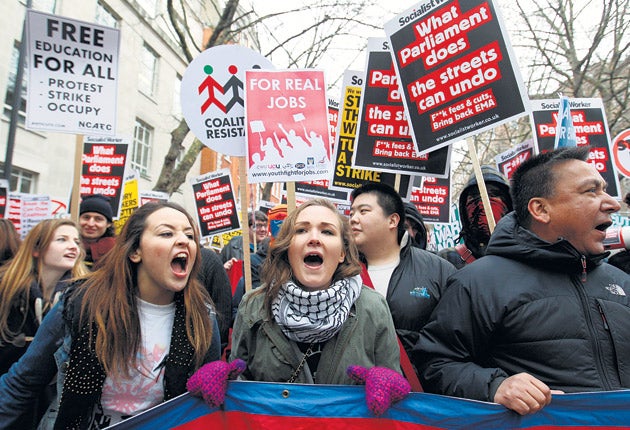
After the glare of publicity – and not always the right sort of publicity – settled on the current president of the National Union of Students (NUS) during the winter's student fees protests, all eyes will be on this week's election of a successor to Aaron Porter. The ranks of candidates vying to take his place include: the outgoing head of the NUS in Scotland; a "moderate" backed by Porter himself; a first-year student who recently left the Conservative Party; and a German far-left candidate who helped to organise the fees protests.
The ballot papers to be returned by delegates at the union's national conference this month, however, will not feature the names of any women or ethnic minority students. Each of the four candidates is a white man, something they themselves agree is an "embarrassment" and a "damning indictment" of the NUS.
"It is a shame we have no women running, as it is a shame that there are not any students from ethnic minorities standing," says Shane Chowen, one of that gang of four, and a candidate seen by many as a moderate and effective operator. "Especially given that this is a movement which parades its diversity, it is a serious problem," he adds.
Liam Burns, perhaps Chowen's closest rival and the outgoing head of the NUS in Scotland, calls the revelation "damning of the union in the extreme". Describing it as a "failing in the organisation", he insists that he has always supported programmes that promote inclusion. "I think that we need to make sure the next list of candidates is more diverse," he says. "At the moment, the list does not reflect the union membership as a whole and I think that it flies in the face of all of the work we are calling for to widen access to higher education."
This is coming from members of a union that only three years ago saw its last woman leader – Gemma Tumelty – leave her post. This was also the organisation that was credited with "breaking the mold" when it elected Trevor Phillips as its first black president in 1978.
Mark Bergfeld is – in his own words at least – "the most exotic" candidate. His views perhaps best represent the far left of the student body, and he argues there is a "great problem within the union". He points out that the union's officers are mostly men, saying: "The lack of women and ethnic minorities shows the weakness in what kind of student gets involved in NUS politics." The man seen as Bergfeld's political opposite is the self-described "underdog" – and former Conservative Party member – Thomas Byrne. He agrees with Bergfeld on this point.
The race to fill the void left by Aaron Porter, heavily criticised by sections of the student body, began in earnest when he announced in late February that he would not seek re-election. The candidates will face each other in a leaders' hustings at the NUS national conference, which will take place in Newcastle next Tuesday and Wednesday, before delegates cast their votes in order of preference. The results will be announced nearly a week later on 20 April. Despite the increasingly militant reaction to the tuition-fees debate among students and the growing backlash to his own perceived style of leadership, Porter says he believes there is "much less of a chance for a radical candidate".
He adds that, as there has been more interest in their movement, students have seen how "unhelpful" and how much of a "minority" the radical element has become. "There is a danger that a detailed post-mortem on tuition fees will provide a distraction from the ongoing issues that students face, such as the spectre of graduate unemployment," Porter says. "It is important that the next President focuses on those things."
Mark Bergfeld has most to lose should that backlash materialise as Porter predicts. But, as the candidate most able to rally the radical factions within the NUS, he also has the most to gain from Porter's very public recent demise.
It is the fight between the two favourites – both centre-left candidates who confess they are "very similar" – that is likely to decide the election. Liam Burns and Shane Chowen are expected to be in a straight fight for the same votes and, should one win a decisive victory, would expect to be elected with a healthy majority.
Should they take votes from each other, however – as they admit they might – either Bergfeld or Byrne could thus be allowed to sneak in. Still, according to Wes Streeting, the former NUS president, Chowen and Burns remain the favourites to be elected.
Streeting, who insists that he is not offering official backing to any candidate, believes this election is "too close to call". He calls the pair, who have both served the union at a high level, "very experienced and impressive candidates".
Their circumstances are considered peculiar because, traditionally, candidates occupying such similar political ground would not stand against each other for fear of splitting the vote. And Streeting believes that a lot of union members around the country will find it hard to choose between them.
The final candidate, Thomas Byrne, believes his presidency would be effective, rather than impressive. "I am the candidate who can get things done, not the one who goes on marches and protests and doesn't achieve anything," he says. "There is too much of a focus on tuition fees." He insists he is being ignored because, he believes, he is saying things that people "do not necessarily want to hear". He adds: "No one expected the Liberal Democrats to be in Government now but they are."
Standing for election at such a tender age (he is a first-year student) is, he concedes, "uncommon" but he accuses the other candidates of having nothing new to offer. "I wrote an article on tuition fees for The Guardian, from which I got some positive feedback and I wanted to test my ideas on a national platform," he says.
Accusations have been made that the far left of the Union would be unwilling to deal with ministers, something that could hamstring the anti-fees movement. And it is an accusation Bergfeld does not deny. He says he sees "no reason why we should be sitting down with the likes of David Willetts to discuss the merits of the Browne Review".
Bergfeld adds that the Liberal Democrats have stabbed the movement in the back and insists that the Government has no intention of talking to students.
His rivals, Chowen and Burns, however, take a more pragmatic view, insisting that while the battles may be fought on the streets and in campuses, the war will be won only around the negotiating table.
"The NUS as an organisation has never been comfortable with direct action and I was not born and bred on the picket line," says Liam Burns. "But we cannot write off what used to be referred to as the 'hard left' of the union.
"I am not going to take first-preference votes from a candidate like Mark Bergfeld," he adds. "He can mobilise those students who are keen on direct action but I wonder how he is going to take the entire Union with him."
Whichever of the four emerges victorious, it is clear he will have a difficult task uniting the whole movement, once galvanised by the belief that it brought a Government to its knees, under a single banner. Some have pointed out that the tuition-fees debate should not be allowed to hijack the election.
In any case, they may be wise to heed the advice of one of their predecessors, Wes Streeting, who tells them: "Never forget that responsibility to the students you represent and also to not be afraid to lead," says Streeting. "You will often have to listen but, sometimes, you have to lead from the front."
Meet the candidates
Mark Bergfeld, NUS National Executive member
One of the organisers of the anti-fees protests, he is standing on a far-left ticket. He will look to galvanise the union's radical element, which has grown in the wake of the debate. Born in Cologne, Bergfeld came to Britain in 2006 to do a degree in Philosophy, Politics and Economics and later a masters in Sociology at the University of Essex. Described as "the only household name" in the contest after appearing as a spokesman for the loose coalition of students and other protesters, but criticised for his opposition to negotiation with ministers.
Shane Chowen, NUS Vice President (Further Education)
One of two moderate candidates thought most likely to possess the experience to unite the majority of the Union. He has said that if students continue to allow the election to be simply about tuition fees they will have lost the fight. "It is about more than that, it is about higher education funding and student support as well," he says. Backed by outgoing President Aaron Porter, he admits he will be fighting Burns for many of the same votes but says: "Higher education is not just about going to university."
Liam Burns, outgoing President of NUS Scotland
The most natural rival to Mr Chowen and with a similar level of experience, having served as an executive in the NUS. He seeks to convince students to resist what he sees as the Government's attempts to label them as consumers. He also promises to fight to "get public funding back into higher education". Burns insists he is not "the establishment candidate". He says: "A campaign is not just about getting people out on the streets, you also have to get people around a table."
Thomas Byrne, first-year student of politics at York University
The underdog who says he has been turned down for interviews by members of the left-wing blogosphere because of his history with the Conservative Party. He believes he is being ignored because he is saying things many students are uncomfortable with. Byrne tells students that their Union has been run "either by ideologically driven left-wing radicals, or wannabe politicians striving for a position in the Labour Party. This has to stop." He insists that if he convinces "just one person" he would consider it a victory.
Join our commenting forum
Join thought-provoking conversations, follow other Independent readers and see their replies
Comments