Montessori schools: Where learning is child's play
The Montessori ethos transformed one tough primary – and many more are following suit
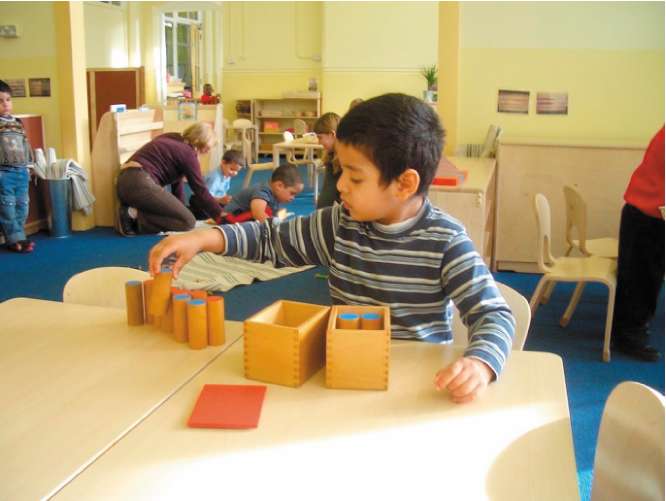
Montessori has come full circle. The education philosophy, developed by Maria Montessori 101 years ago to teach poor children in Rome, has been common in the past in well-heeled parts of London. Now, it's back in the hands of the people.
The method, which emphasises learning through play, teaching through observing and the use of wooden equipment and neutral colours, has been adopted for three- to seven year-olds at three state primary schools. Another, Spitalgate Primary in Grantham, has just secured £10,000 of funding from the St Nicholas Montessori charity, and at least one more school is being lined up. The plan is for 12 new Montessori state schools to be running within three to four years.
Indeed, Montessori has entered the Government's circle of trusted friends. The Department for Children, Schools and Families is paying for a booklet describing how Montessori fits in with the early-years foundation stage: apparently, this was the Government's idea. And in December, 15 teachers from the maintained sector graduated with the Montessori diploma – the first cohort to qualify.
So how did this come to pass? "All these things we've been doing for years are starting to be used in state schools. And now they're saying, 'Blimey, this is Montessori!'" says Philip Bujak, chief executive of the Montessori St Nicholas charity and the Montessori Schools Association.
The "blimey" factor is what hit Gorton Mount, the inner-city school in Manchester that first took Montessori into the state sector in 2005. After a brush with special measures, head teacher Carol Powell knew that she needed something radical. She introduced her own brand of "emotional literacy and development", which soon developed into Montessori for the youngest members of the school.
Since then, the school has charted constant progress. From special measures in 2004, the school now sits above the Manchester average for the foundation stage, although it remains below the national average. "That's joyous, because we've never been there before," says Powell. The most recent Ofsted inspection, in November, put the school at grade 2 (good) in all areas.
Powell attributes this to the Montessori ethos. "The children are much more confident, more able to concentrate because they're motivated, and playground behaviour has improved immensely. They're just more comfortable in themselves."
Other state schools have written to Bujak, expressing an interest in the philosophy. The charity then sends a specialist teacher to get an indication of the school's needs, after which the school is able to bid for funding for Montessori equipment and teacher-training.
But has Montessori, which once seemed so alien to conventional methods of education in Britain, had to meet the Government half-way in order to gain acceptance? "I think the Government is accepting our principles," says Bujak. "These schools have adjusted to us. We don't compromise on the core principles."
And what about testing? Montessori is a philosophy that tries to prevent all forms of competition and failure, while the Department for Children, Schools and Families is testing our children more than ever. Surely this is an issue over which Montessori and the Government should be at loggerheads?
Apparently not. "We observe all the time, but it's not formal testing," says Bujak. "It's individual – we don't line them up against each other." Bujak says that the children take exams and are sent home with reports. The apparent contradictions have been smoothed over by the relaxation of Key Stage 1 regulations. The emphasis is now on putting young children in for testing when they're ready.
The Gorton Mount experiment proved that Montessori could survive in a tough inner-city school. But not all of these state primaries are in special measures. Stebbing Primary School, for instance, is in an affluent village in rural Essex.
Kate Atherton, 35, has a daughter at Stebbing. She had secured a place at a local independent school but, with another daughter in the private Montessori nursery on the Stebbing site, Atherton decided to save the money and send her daughter to the maintained Stebbing Primary, which has adopted Montessori methods.
"I like the independence and the love of learning that my daughters are displaying," she says. "They're both very able to play and entertain themselves."
She admits that she feared her elder daughter would be held back at the state school. "But the free-play way of learning meant she could take herself off and keep learning on her own. The children are self-regulating, because all the equipment is out there in the classroom for them. She's certainly on a par with the girls who've been educated at the private school."
Join our commenting forum
Join thought-provoking conversations, follow other Independent readers and see their replies
Comments