Rachel de Souza: 'We went to pupils' homes and got them out of bed'
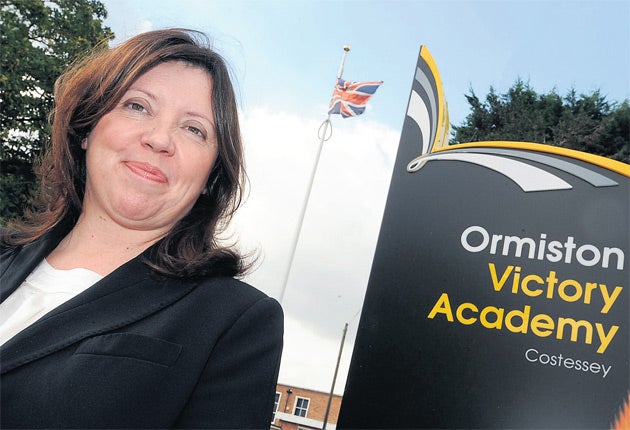
A year after headteacher Rachel de Souza took over at Victory Academy, the school is set to be named the most improved in the country. Richard Garner finds out how she did it

Sign up for a full digest of all the best opinions of the week in our Voices Dispatches email
Sign up to our free weekly Voices newsletter
Head teacher Rachel de Souza knew her pupils needed a wake-up call – literally – to improve standards. As a result, she arranged for teaching staff to go round to their homes during the Easter holidays and drag them out of bed to come in for maths revision classes. It is just one of the innovations which has transformed the failing Costessey secondary school in Norwich into the thriving Victory Academy within 12 months.
When exam league tables are published in the new year, it will be a strong contender for the most improved school in the country. The percentage of pupils getting A* to C grades in English has shot up to a remarkable 98 per cent – onaparwithleading private schools in the neighbourhood. On the traditional measure that schools are ranked on five A*s to Cs including maths and English, it has seen a year-on-year improvement from 38 per cent to 65 per cent. “
By Christmas time, we knew we were getting to where we wanted to be in everything except maths,” Mrs De Souza says. “We were at 52 per cent there – so we had a brainstorming session about what we should do.” Dusting down the school minibus and taking it round to children’s homes to corral them in for extra revision seemed the best idea. “We discussed it with the parents and only two objected to it because their childrenwere working,” Mrs De Souza adds. “We literally did have to get some of them out of bed.”
The staff decided to mix in some fun withtherevision – providing the pupils withlunchandthentaking them bowlingafterwards. It is a recipe that has been used before in the school – mixing hard workwithpleasure. Another example is arranging pizza nightsto help students to complete their English coursework.
Rachel de Souza is no stranger to turning around failing schools. Her first headship was at Barnfield West Academy in Luton, one of the first academies to be launched under Labour. It was sponsored by the local further education colleges.
The recipes for the two schools were not the same, though. Barnfield served anethnically mixed community, with the majority of its students coming from ethnic minority groups. One of the biggest problems was dealing with a gangculture. “My first exclusion there was for a gun crime,” she says.
It suffered from dire staffing shortages – it had not seen a qualified maths teacher for four years, had had five head teachers in three years and only 16 per cent of its pupils obtained five A* to C grades at GCSE including maths and English. That put it firmly on the Government’s hit list of failing schools. Within a year, this had risen to 47 per cent and it had cleared that hurdle.
Instilling a sense of pride in the school, though, was common to the rescue missions for both, but at Victory one of the biggest problems to overcome was a sense of isolation in the community. On the outskirts of Norwich, it was missing out on any facilities for the pupils to enjoy in the community, there was no sense of what Mrs De Souza would call a “can do” spirit, andpoor behaviour went unchallenged.
Luke Sycamore, aged 15, who has been at the school – both before and after the new regime – for five years, sums up the attitude of the majority of pupils. “The difference was in the consequences for poor behaviour,” he says. In the past, students had often been allowed to get away it, with the result that, in the end, the school had to resort to more than 300fixed-term exclusions a year. Under thenewregime there was a code of conduct. Students knew there was a line that was not to be crossed and the number of exclusions fell by 39 per cent.
A strict school uniform policy was brought in. Prefects stand by the door atassembly and have a quiet word with pupils not conforming to it, such as those with their top shirt buttons undone or shirts hanging outside their trousers. The uniform was designed by a Savile Row tailor and the prefects have gold braid around the lining – two strands, which makes it look reminiscent of a sailor’s uniform.
Which brings one back to the new name of the school – Victory was chosen because of Lord Nelson’s association with Norfolk. Some historical research in the village showed that it was an apt choice as some of the villagers had been recruited (or dragooned) to serve on HMS Victory at the Battle of Trafalgar.
Victory also, it was argued, would conjure up the aspirational nature of theschool. “Striving to be outstanding in all we do”, as the motto on the school bus – used to transport the pupils to theirmaths revision classes – proclaims. To emphasise further the good-behaviour policy, all pupils always stand up when a visitor enters the classroom.
Victory is one of the old Labour academies (actually New Labour, but it conformsto its original blueprint for academies). It has a sponsor – the Ormiston Trust, a low-key education charity that already has around 15 academies on its books. It specialises in science and health and also has the local hospital as a co-sponsor, ideal for forging workexperience links.
Misbehaviour is now dealt with via a pupil-referral unit on site. It means that the troublemakers still get a full day’s attention. They start their school day at a different time, have lunch separately and go home at a different time to makethe point they are there for a reason and cannot mix with the other pupils. They can be returned to mainstream classrooms once they show evidence they will respect the learning culture of the school.
“Previously the system wasn’t consistent and it failed,” says Laurence Cross, the teacher in charge of the unit, whoishimself an old boy of the school. “If Johnny misbehaved, his parents couldphoneupthe school and offer an explanation like ‘his cat’s died’ and he would be exempted and allowed back into the classroom,” he says. “Everybody knew it was a soft touch.”
One of themajor innovations has been developing links with role models in the community – ridding the school’s pupils of their sense of isolation. David Prior, the chairman of the local hospital trust, has become vice-chairman of the school’s governing body and he has enlisted the support of former England cricketer Matthew Fleming, who lives locally, to serve and work with the school – helping to develop leadership skills and sporting prowess. Fleming is an old Etonian and former Army officer whose four children have all attended private schools “I wanted to do more than just sit on committees and keep Rachel under account,” he says. “The adjectives used to describe the school in the past had been very negative – low discipline, failing. Theyconjured up a gloomy picture. But after becoming an academy, it managed to make great strides in a very short space of time. It was all to do with the atmosphere and the culture and the leadership of the school. If I compared the academy to Eton – where I went to school – at first sight the similarities are few and far between but it has been an incredible turnaround and the teachers here are every bit as good as the teachers at Eton.”
So, if he had his time at school again, would he be happy to come to Victory rather than Eton? “No,” he says honestly. “Academically, it would be fine and I’d be happy with everything Rachel and her team could do but I’d want those sports facilities – Eton has about 50 cricket pitches and the rowing lake.”
That, though, could be Victory’s next story. All right, it will never be able to match Eton, but a £13m development scheme has survived Education Secretary Michael Gove’s cull of building projects and Matthew Fleming wants to go into bat to secure an AstroTurf pitch for theschool. “That could make all the difference,” he says. “You could have football, rugby, cricket.”
Rachel de Souza is in agreement. Having got Victory to start performing on the academic front, she now wants both its staff and pupils to have a healthier lifestyle and is launching a weekly one-mile school run for all concerned with the school. Sport would give that project a huge boost, too, though
Subscribe to Independent Premium to bookmark this article
Want to bookmark your favourite articles and stories to read or reference later? Start your Independent Premium subscription today.
Join our commenting forum
Join thought-provoking conversations, follow other Independent readers and see their replies