The head who turned around a failing school...and became a YouTube sensation in the process
Stretford High was in special measures when Derek Davies took over. Now it is outperforming local grammars. Francis Beckett meets a head with ambition – and enough talent to be a hit on YouTube
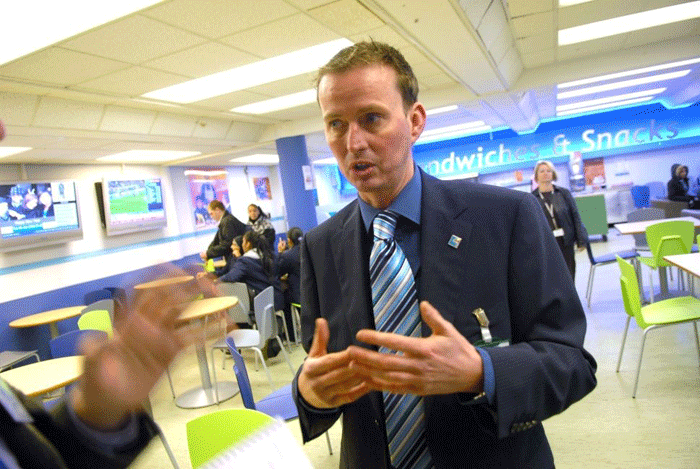
It's called Stretford High School, but Derek Davies doesn't have any illusions about what he's really running. "We're a secondary modern," he says, cheerfully. His local authority, Trafford in Manchester, has the 11-plus exam, and its grammar schools cream off the top 30 to 40 per cent of pupils each year.
He doesn't like the 11-plus. You can't make a proper assessment at the age of 11, he believes, and it means that each year he has to start by trying to persuade his new pupils that they aren't failures. There's also an inevitability about the social profile of secondary moderns. More than a third of Stretford High School's pupils are eligible for free school meals, English is a second language for nearly half of them, three quarters are non-white, and many parents are unemployed.
But ironically, the 11-plus gives Davies the most satisfying job he can imagine. "I've no desire to work in a grammar school. There's a moral sense of purpose in teaching in a secondary modern. There isn't a day when I think, 'I hate this job.' I love this job." Which is part of the reason why he has been able to take the school from being in special measures in 2004 to being top of the value-added league tables in Trafford, outperforming the grammar schools, and in the top 1 per cent nationally.
Yet teaching was not how he imagined he would earn his living when he took his Bachelor of Education at the Royal Welsh College of Music and Drama in Cardiff, or even when he started his first teaching job at another Trafford secondary modern in 1987. "I reckoned I'd teach drama for a year before going off to be a theatre director. But I found teaching compulsive."
Anyway, "being a head is one of the biggest acting and directing jobs you can have". You see what he means as he walks round his school. He also has the confidence to let students see him looking foolish. If you doubt me, log on to YouTube and open Mr Davies Amarillo. That man in the funny clothes and false nose, prancing through his school corridors singing, "When the day is dawning on a Texas Sunday morning," is the head. It's one of this theatre director manqué's finest performances.
A small, dapper, trim 43-year-old, with a clear, clipped voice, a mobile but disciplined face, a smart suit and tie and highly polished shoes, he has the air of someone who knows he's on display every moment of the day. He says a cheerful good morning to pupils he meets, and expects the courtesy of a reply. If he doesn't get it, he stops and asks for one, smiling but insistent. He marches noisily into classrooms and demands to know what's being taught, with no attempt to be discreet. He hails teachers he meets, always addressing them in a formal school manner – good morning, sir, good morning, miss – and they hail him back – good morning, sir. No one seems frightened of him, but they generally do what he wants.
His assemblies are precisely targeted performances. The day that I was at the school, Year 9 – the 11 to 14-year-olds – were getting their start of term pep talk. But first, one of his staff had to get the lighting to Davies's satisfaction.
The new year, he told Year 9, is "a chance to bury the past and start again. You know what kind of year you had in 2007. Were you a pleasure at home or were you a pain?" He drew on his drama training to do a passable imitation of a bad-tempered teenager. "What did you do to be a good son or daughter? To make your home a pleasurable place?"
Then came the key message: "Whatever you want, you can achieve it, if you want it that badly." He says the same thing in different ways from the day they arrive as 11-plus failures until they leave at 16 (for Stretford High School has no sixth form). "When they come here I talk to them straight away, even in Year 7, about going to university" he says. "Self-esteem, self-belief – we work very hard on this."
The YouTube video of Stretford High's Derek Davies clowning around
It is not as difficult as it used to be to take away their feelings of rejection, he says. "We can promote academic and well as vocational work. The curriculum is more integrated now that we no longer have different sorts of exams, with grammar schools doing O-levels and secondary moderns doing CSEs."
He remembers with pleasure a girl who wanted to be a hairdresser. "There's nothing wrong with being a hairdresser, but when she got 12 GCSEs she said, no, I want to go to university. Now she's doing A-levels at college and has a university place for next year."
The school around which Davies marches, friendly smile glued to his face and clear actor's voice on permanent standby, is hardly recognisable from the one he took over in 2004. "It was a very sad and depressing school, very little student work on the drab lime-green walls, it just seemed shabby and not loved." Then, he went round saying, "good morning" to everyone and they walked past with their heads down. Teachers would lock themselves and their classes into their classrooms, so as to get on with their lessons and ignore the chaos outside.
In January 2004 Ofsted placed the school in special measures. The head resigned, and Davies started as head after Easter, quickly removing the solid panel with its swipe card machine which used to guard the head's office. He walked round the school a lot, and invited staff to come and see him. Some of them burst into tears in his office. He split everyone – teachers, pupils, support staff – into groups to work out what had to be done. "This said: we're doing this together, it's not some superhead coming and saying what we're going to do," he says.
He made sure all pupils were involved, not just the good ones. Bringing in disaffected students, he says, "makes the problem part of the solution". He remembers a group of girls, of whom teachers had despaired. He describes them as "very vocal and strong-willed", which sounds like the empty political correctness of phrases like "challenging behaviour" but it isn't: he means it as a compliment. "By the time the girls had reached Year 11 they were part of getting the school out of special measures," he says.
The walls were repainted in brighter colours, and are now covered with student work, some of it startlingly original. He spent a lot of money on computers; on creating interesting new spaces out of forgotten or unused bits of a very traditional school building; and on an attractive new cafeteria area with plasma screens showing news channels, music channels and the school's own website. Some money came from the Government's Standards Fund, but he also saved money, partly by abolishing the supply teacher budget. With staff attendance at 79 per cent, this used to absorb £169,000 a year. Now staff attendance is 97 per cent. He covers the few remaining absences without supply teachers.
Partly, he raised teacher attendance by the unorthodox method of each year putting every teacher with 100 per cent attendance into a draw for a £50 and a £100 prize. Local papers attacked him for it, but "I spend £150 a year and save £169,000."
Naturally he did the organisational things, like restructuring his management team, but much more was probably achieved by changing the environment, and by the spring of his step, the bounce of his personality, and his evident love for the children in his care (he has none of his own). "You have to like children to do this" he says. "You can tell the teacher who likes children." Every child in the school gets a birthday card every year, personally signed by the head.
This year there's a second revolution in progress. "At first, I emptied the corridors, rebuilt confidence in teachers. Now we can move to the next stage." He is abandoning the traditional school day. This year, for the first time, there is no mid-morning break from 10.45 to 11, and no bells ring every 40 minutes or so. Teachers take a break when they think they should, and the bright new canteen, where there will soon be a cyber café and a smoothie bar, is busy all the time, from 7.45am to 5pm. So on Wednesdays, Davies teaches English (he thinks it's important for the head to visit the chalkface every week) for a solid four hours, taking breaks when he thinks he or the class need them. "Some will take advantage, but the minority should not be allowed to dictate what you do."
His friendly confidence seems to infect the school. A boy of 15 approached me to say that he wanted to be a journalist, and asked detailed and intelligent questions about the best way to go about it. Teachers, pupils, cleaners all smiled at me and said "good morning", even though Mr Davies wasn't there to make them. Every actor knows that you start with the externals – the smile, the false nose. The rest will follow.
Join our commenting forum
Join thought-provoking conversations, follow other Independent readers and see their replies
Comments