Why science teaching is an ethical issue
Testing hypotheses is the only way for pupils to understand concepts of what is true, argues the Nobel Prize-winning scientist Harry Kroto. So why are we neglecting this vital area?
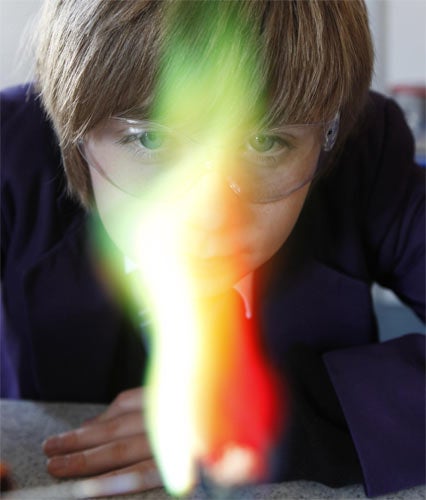
Let's think about education and what our children should be taught as they grow up to face so many social and sustainability issues. One thing that is undeniable is that science education in Britain is dire. The percentage of our population with science, engineering and technology (SET) doctorates is less than one per cent, perhaps much lower, and yet on a global scale, it is the scientists and engineers who created the modern world.
They have given us penicillin, anaesthetics, DNA fingerprinting, lasers, mobile phones, DVDs, computers, sewage treatment, bridges, and 747s, to name but a few. Pretty good value for the educational money, wouldn't you agree? What other disciplines have provided anything like this return? None, by several orders of magnitude.
A depressing and highly disturbing issue is that so few in positions of responsibility, in particular politicians, understand science on any level, yet they make decisions every day on technological issues. Although knowledge does not guarantee good decision-making, common sense suggests that wisdom is an unlikely consequence of ignorance.
A key issue about science is that it is totally misunderstood. In popular usage the word "science" does not convey its most important aspect – that it is the only philosophical construct devised by mankind to determine with any degree of reliability what is true, might be true, can be true and what, most importantly, cannot be true. Obviously truth is universal, and cannot vary from country to country or planet to planet.
Truth assumes that an experiment always behaves in exactly the same way and no mystical entity tampers with the observation – ie, praying will not affect the result. Truth is an "intellectual integrity" issue and thus "science education" is fundamentally an ethical issue.
An education in science, "The Method for Recognising Truth", inculcates an intrinsic attitude of confronting every issue, regardless of the specific domain of significance, with the question: is it true and how can one decide?
To take a simple example, which indicates how decisions are generally made: on arrival at Heathrow from outside the UK, immigration officials do not accept anyone's word as to their identity. They require evidence, usually passports. Why do immigration officers not trust me to tell them honestly who I am? Why do they want evidence? Even the inanimate gas pump asks for an area code when I pump petrol using a credit card. It wants evidence, too.
Here is my procedure for determining whether anything is true, my scientific method, my method of determining truth. I call it my "Four Out of Five Rule": if one makes a new observation or is presented with a concept claimed to be true, or one has a hypothesis, then carry out experiments to validate (or otherwise) the claim or hypothesis. If four tests out of five fit, the claim or hypothesis is almost certainly true and one has a "true" theory, indeed a law or a fact. If only one out of five fits, it is almost certainly wrong. The accent is on the word "almost", for all (good!) scientists must leave room for doubt and/or improved understanding. Indeed, everybody should, but unfortunately most do not.
Newtonian Mechanics can get us to the Moon, so it is a "good enough theory" for that, but to determine one's position using GPS one does need Einstein's relativistic correction.
An apposite quotation from the great American writer Walt Whitman is: "I like the scientific spirit, the holding off, the being sure... but not too sure, the willingness to surrender ideas when the evidence is against them, this is ultimately fine, it keeps the way beyond open." Science is the only philosophy for which doubt and questioning are fundamental tenets, and in which leaving the way beyond open to further and deeper understanding is an absolute.
Consequently, science differs fundamentally from the dogmas of politics and religion, which invariably impede progress by trapping acolytes in received concepts that are not to be questioned. If science is, as some claim, also a dogma, then the dogma is "No Dogma!".
My last quotation, another favourite, this one from President Kennedy: "The great enemy of the truth is very often not the lie deliberate, contrived and dishonest, but the myth, persistent, persuasive, and unrealistic. Belief in myths allows the comfort of opinion, without the discomfort of thought."
I often wonder to which specific myths Kennedy might have been referring? What myths are you thinking about as you read this? Whatever you think about the issues addressed here, surely one thing on which I hope we can agree is that we are honour-bound to teach our children how to recognise what is definitely true and what is, or may be, false among all the things that they are told.
I would argue that this is the most important thing children should be taught and thus a doubt-based "scientific" attitude to absolutely everything we are told is a prerequisite. After all, it is this approach that has created the technologies of the modern world and I argue that those who do not wish the evidence-based attitude to be taught to our children should not benefit from or use the fruits of scientific endeavour.
Harry Kroto (Sir Harold Walter Kroto) is a Nobel Prize-winning chemist, a member of the faculty at Florida University, and emeritus professor at the University of Sussex
Join our commenting forum
Join thought-provoking conversations, follow other Independent readers and see their replies
Comments
Bookmark popover
Removed from bookmarks