A 'New Statesman' kind of guy. Just not New Labour
Joy Lo Dico finds the political weekly adapting to changing times and a change in ownership as she talks football and French literature with Jason Cowley, its incoming editor

For free real time breaking news alerts sent straight to your inbox sign up to our breaking news emails
Sign up to our free breaking news emails
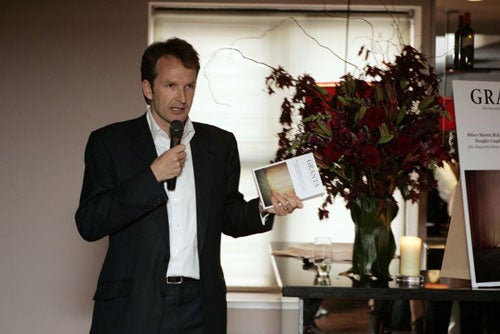
While David Cameron is hailing the end of New Labour, after the Tories' by-election victory at Crewe and Nantwich, the attentions of Jason Cowley are elsewhere. Last week the editor-designate of the New Statesman was coolly putting to bed the 102nd edition of the niche literary magazine Granta, from its serene white offices in a stuccoed Holland Park townhouse. Come September, however, this relative unknown in political circles will not be able to avoid the party politics and the machinations of Westminster.
The appointment of a journalist whose reputation rests on his cultural and sports journalism seems in contradiction to the New Statesman's central ethos of being at the heart of the Labour debate. But then again, the magazine is doing some serious rethinking.
What's not in doubt is that Cowley has strong credentials as an editor. He turned the Observer Sport Monthly into a writerly and considered publication, and his first edition of Granta, which he took over in 2007, has been well received. Cowley also knows the New Statesman well, having been its literary editor under Peter Wilby until 2003, and a contributing editor under the recently departed John Kampfner. But unlike his predecessors in the editor's chair, he has never marked out his place in the political arena.
"I'm not a Westminster insider," Cowley freely admits. A handsome, blond 41-year-old, he speaks with a very particular, measured intensity. "When they offered me the job, they didn't ask if I was a Brownite or a Blairite. What I am is an experienced editor and a writer and I know exactly what is needed to galvanise a magazine. And I know politics. I might not have been an op-ed pontificator but I certainly know the culture and who I want to write about it for the magazine."
What Cowley does have in reams is self-assurance, wearing his intelligence on his smart linen sleeve. Though he's an Essex boy, no one could accuse him of conforming to the stereotype. Within minutes of stepping into his office we are talking about Michel Houellebecq, Nicolae Ceausescu and the culture of sport. Cowley is a lifelong Arsenal fan, but the language he uses to describe his passion would not be out of place in a political essay. He talks of the 1989 championship-deciding game with Liverpool, on which he is writing a book, as "an expression of mass working class culture, of terrace violence, of camaraderie – it was stubbornly apart, it didn't embrace market economics". Thatcherite principles, plus the arrival of Sky broadcasting and new all-seater stadiums, created a "more bourgeois atmosphere" at matches, as he puts it.
Cowley's editorial tone became evident during his three-year tenure at Observer Sport Monthly, where he marked out his interest in fine writing – and silenced those who queried what could be made of sports journalism. One person he brought on board to do this was Andrew Hussey, a polymath after Cowley's heart, who crops up in the latest issue of Granta writing on the French banlieues.
If fine writing is Cowley's agenda, the obvious model is The New Yorker. Cowley, who says he does not believe in the distinctions of high and low culture, is an admirer of its editor, David Remnick. Reviewing his collection of essays, "Reporting: Writings from The New Yorker" in the New Statesman in 2006, Cowley praised the US mag's "range, quality and sophistication of so much of [its] journalism, notably its coverage of international affairs." He went on to say, perhaps with unwitting prescience: "One continues to read it with both admiration and longing, especially when Remnick himself is writing. Would that we had a magazine as well resourced and as rigorously edited in this country."
Yet when asked if his desire is to create a British New Yorker, he claims says the Statesman's raison d'être remains unchanged. "No, because The New Yorker is not a political magazine. I will have pieces of comparable quality to what is found in The New Yorker, and it should be for anyone interested in good writing, because newspapers have lost confidence in the long piece," he explains.
"There's a lot of work being done on the supplements but it's stunt photography. Editors of newspaper supplements are very influenced by Vanity Fair, and you can see its influence right across the newspapers. So I won't be doing that, though I can. I've done elements of that with Observer Sport Monthly. But first and foremost I want the Statesman to be authorative and respected for its writing. It will be very difficult to be published in my magazine: you would have to be a good writer."
What Cowley may yet have, is the sort of money that underpins The New Yorker. The last editor, John Kampfner, walked out in February after disagreements with the then-sole proprietor, the Labour MP Geoffrey Robinson. Under Kampfner, the New Statesman finally hit the psychologically important 30,000 circulation mark, but Robinson slashed the marketing budget just as the magazine looked like gaining momentum.
Since Kampfner's departure, the New Statesman has gone through a revolution comparable to the fate of the Labour Party. When Robinson, an old friend of Gordon Brown's, bought the magazine in 1990s, it acted as midwife for the birth of New Labour. Its pages helped to float policy ideas, build an army of thinkers around Tony Blair's new vision, and arguably fling open the doors of power. Eleven years later, with New Labour on its last legs, Robinson also looks like being deposed. In April, he sold 50 per cent of the New Statesman to millionaire Mike Danson. It emerged on Friday that Robinson would be stepping down as chairman before the next election and handing full control to his new business partner.
Cowley says it took some persuading to consider leaving Granta after only a year. He joined last September, during which time, under the new ownership of Sigrid Rausing, he has redesigned the magazine and launched a website. A move from such a stable, respectable quarterly, ticking along with a subscription just under 50,000, to the Staggers might not have been obvious but Cowley feels the wind is changing. "I think the circumstances are right with the arrival of Mike Danson," he says. "Danson is a brilliant guy, very direct and very honest, so that impressed me. They are also planning to invest in the magazine, a significant sum."
With Robinson soon out of the picture, and the rise of David Cameron, Cowley's discreet politics and broader agenda may well be his greatest virtue. "I'm unencumbered in the sense, and beholden to no clique. No one knows who I am." Yet.
Subscribe to Independent Premium to bookmark this article
Want to bookmark your favourite articles and stories to read or reference later? Start your Independent Premium subscription today.
Join our commenting forum
Join thought-provoking conversations, follow other Independent readers and see their replies