When brands play hard ball
In South Africa, it’s not just the footballers who are going head to head. Advertisers are fighting for exposure. But they risk an own goal. By Richard Gillis

For free real time breaking news alerts sent straight to your inbox sign up to our breaking news emails
Sign up to our free breaking news emails
The message from this World Cup is that there are few things that football can't sell. The competition on the pitch is rivalled in intensity by the battles being waged off it, as companies seek to associate themselves with football and the national team. The problem, claim health campaigners, is that football's selling power is contributing to two of society's major ills: binge drinking and obesity.
"The link between football and brands such as Coca Cola and McDonald's is sending out the wrong messages," says Teresa Nightingale general manager of the World Cancer Research Fund, a charity that attempts to educate us on the links between diet and cancer. "It's a shame that great events like the World Cup are so seemingly reliant on money from unhealthy food brands. Why can't it promote healthy food?"
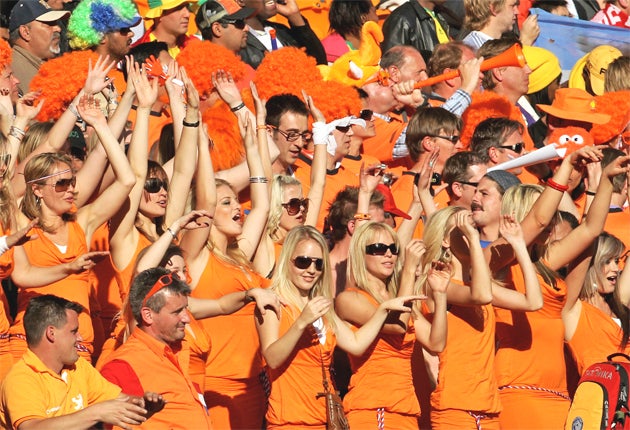
The deployment at the Holland-Denmark game of a battalion of young women in matching orange minidresses was an attempt by Dutch beer brand Bavaria to muscle in on Budweiser's monopoly of in-stadia beer advertising (and cost ITV pundit Robbie Earle his job for supplying the tickets).
Confectionery giants Mars and Nestlé are engaged in a 'chocolate war' over the latter's "Fingers Crossed" England advertising campaign for its Kit Kat bars. As an official FA sponsor, Mars is threatening court action, citing what it calls Nestlé's "passing off" of an association with the England team without having paid for the right to do so.
When the final whistle blows on 11 July, the World Cup will have been watched by a global audience running to tens of billions, and Fifa, the world governing body that owns the exclusive rights to the tournament, will bank sponsorship revenue 80 per cent greater than that realised at Germany 2006.
It started with Coke. Since the 1978 tournament in Argentina, Coca Cola has been ever present in the list of Fifa's commercial partners. The relationship between Fifa and Coke helped create the first global package of rights. It meant that international federations such as Fifa and the International Olympic Committee were able to sell themselves as truly global platforms, and multinational companies could reach young people in different countries with the same message. For rights holders, it raised the ceiling on what they could charge sponsors. "The concept of the rights package grew from that moment," says Patrick Nally, who brokered the original Coke-Fifa deal.
"Stadium advertising had been controlled by television, the stadium owner or anybody that felt like sticking something to a wall. No thought had been given to what was sold in the stadium, and as for the pouring of soft drinks – who cared?" Coke also demanded that the relationship should be exclusive in all markets, meaning Pepsi could not get a look in anywhere.
Mark Thomas, the comedian and campaigner, is a vocal critic of the deal. "Let's face it, if you're drinking something that is eight teaspoons of sugar in a 330ml can, you'd better be doing a lot of sport," says Thomas, whose book, Belching Out The Devil, investigated the marketing of the soft drinks conglomerate. "Coke is just sugar and water," he says. "It makes a product that is essentially worthless. If it stopped producing it today, there would be a few disgruntled Jack Daniels drinkers, but the rest of us would move quickly on. Coke knows that the value of its company is almost entirely in the brand." As a result, he says, "the role of PR and advertising is at the centre of what it does. It uses sport such as the Olympics or the World Cup because they are aspirational and tie them to our everyday lives."
A spokesperson for the European Sponsorship Association defends the presence of Coca Cola, McDonald's and Budweiser on Fifa's roster by pointing to the contribution their money makes to a range of youth, community, environmental and charitable causes: "These brands fully recognise that they are not operating in a vacuum, and are well aware of developing health issues. As a result, over the years all three brands have taken steps to adapt their sponsorship programmes and communication messages to take account of greater health consciousness in society."
Meanwhile, a walk down the aisles of the major supermarket chains reveals the extent to which football is being used to sell cheap beer. Tesco shoppers can buy 30 cans of Carlsberg, an FA sponsor, for the equivalent of 69p a pint. Asda offers cases of 20 440ml cans of Budweiser and other lagers for £9. Doctors, police and politicians have attacked supermarkets for selling alcohol below cost price, while pubs claim the tactic is driving them out of business. During the 2006 World Cup, a Competition Commission report found the four biggest supermarket chains had sold £112.7m of beer, wines and spirits below cost.
The football-driven sales push on beer takes place against a backdrop of the coalition Government's moves to tackle binge drinking, with calls for a ban on below-cost pricing by the supermarkets. The plan is likely to prevent retailers from running loss-leader promotions on lager, wine and alcopops.
The British Retail Consortium claims irresponsible drinking is a question of culture rather than price, but the health lobby is still pushing hard for restrictions on alcohol sponsorship in sport. This World Cup could provide it with all the ammunition it requires, and may be a watershed moment in the way alcohol is marketed in this country.
Richard Gillis is editor of 'Platform' magazine, which reports on sponsorship and marketing
Subscribe to Independent Premium to bookmark this article
Want to bookmark your favourite articles and stories to read or reference later? Start your Independent Premium subscription today.
Join our commenting forum
Join thought-provoking conversations, follow other Independent readers and see their replies