Citizen journalists leave no hiding place for politicos
As the Clintons have found to their cost, we are all the media now and no remark goes unremarked. Stephen Foley reports from New York
As his wife reluctantly bows out of the presidential race that she lost days – perhaps weeks – ago, spare a thought this weekend for poor Bill Clinton. The former Commander-in-Chief has provided more than a few of the long primary campaign's fluorescent incidents. Reflect on his colourful language, his backfiring attempts to attack Barack Obama, and his increasing bewilderment and impotent raging against the media as Hillary Clinton's presidential prospects faded.
Pundits will be hailing this as the end of the Clinton era in US politics. It is also the dawn of a new era in political reporting – a first-of-its-kind election dominated by bloggers of all political hues, by citizen journalists armed with camera phones and cheap digital recorders, and played out on YouTube and across the web.
The Clintons know how to dominate the mainstream media. But we are all in the media now. This is the age of omniscience – and Bill Clinton just didn't get it.
"Bill Clinton has had a tremendous amount of difficulty adjusting to the new era," says Charles Mahtesian, national political editor of Politico.com, a non-partisan news site set up last year to cover the campaign. "In the past he might have been able to be a bit loose with the facts, and everything could be 'the first of this or the most of that'. Now, with bloggers out there monitoring everything, more than once he has said something that has been knocked down within hours, at great consequence to his wife."
Whether it was defending his wife's claims to have come under sniper fire in Bosnia – when the footage showing otherwise had already been watched thousands of times on YouTube – or denying he had accused the Obama campaign of playing the "race card" – when his remarks were freely available on a radio station's website – he has appeared all at sea.
And when the Hillary Clinton campaign dispatched him away from the mainstream media to speechify at the small venues in the smallest media markets, citizen journalists were there with their video cameras, so no remark went unremarked upon.
The poor guy was at it again last week, railing against the writer of a critical Vanity Fair piece on his post-presidential career. Mayhill Fowler, a veteran Democrat supporter from a family steeped in Tennessee politics, nabbed Clinton after a local campaign event. He called the Vanity Fair writer "sleazy", "slimy", "a scumbag". The tirade went on and on – and Ms Fowler promptly went home and blogged about it.
Fowler, in fact, is a poster girl for this new era of political journalism. The Clinton tirade was not her first and not her biggest scoop, posted on the OffTheBus.net blog site run by the Huffington Post. Her first scoop was of a proportion big enough to earn that favourite political suffix. She is the reporter behind Bittergate. This was the furore that erupted in April when Obama was quoted telling an audience of campaign donors that small-town voters were "bitter" over their economic circumstances and "cling to guns or religion or antipathy to people who aren't like them".
Actually, some mainstream media journalists – and plenty of Obama supporters – would reject the term "scoop" to describe the story. They prefer something like "betrayal of trust". In a blog posting on Obama's website, one supporter lashed out: "It was great seeing Obama in a relaxed setting, in what was essentially a large living room. Too bad there were roaches under the sofa."
Fowler is an Obama donor and was invited along by another supporter. The media was not invited to the event but dozens of attendees were recording it. Fowler had her MP3 recorder on. Was she a journalist or a supporter? Was the event "off the record" or not? What is off the record these days? Certainly, she stewed for four days before deciding to report remarks she called "elitist" and knew would hurt the Obama campaign.
But report them she did, in the soft, musing style that has won her numerous followers. In doing so, she blurred a line that many in traditional US journalism have been ferociously trying to hold, against all the odds – namely the line between objective reporter and a partisan. "I'm 61," she told The New York Times later. "I can't believe I would be one of the people who's changing the world of media ... There are no standards of journalism on the internet. I'm always second-guessing myself. Is this the right thing to do? Am I being fair?"
But who wants to support a politician's right to say something different in private to what they do in public? In the age of omniscience – Facebook and YouTube and all these other sites – we get something closer to a 360-degree view not just of politicians, but of celebrities and even of our friends. The only things that are private now are secrets, and journalism has always been about finding out those.
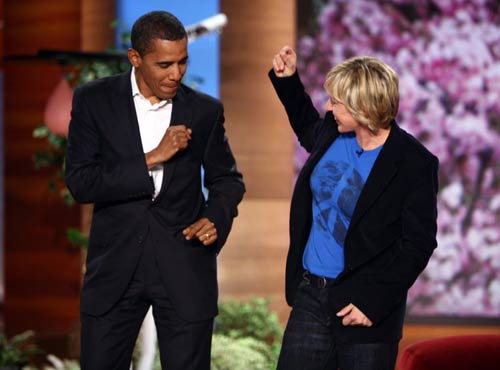
The internet has made this presidential campaign a first of a kind in all sorts of ways, many of them surprising and undeniably positive. First-time voters are seeking out whole speeches on YouTube and engaging in debates that tail down and down a web page underneath a provocative blog post. Clips like Obama dancing on Ellen DeGeneres' talk show can go viral and shape a positive view of a candidate just as easily as can a gaffe or the incendiary remarks of a pastor. Republican presidential candidates chafed when – in a CNN debate where questions were submitted by YouTube users – a snowman asked a question about global warming. But their answers got more attention than they would have if a CNN anchor had put the questions.
Without the borders of a printed page, or the constraints of the next ad break, online news and analysis can be richer, deeper, more trivial, more fun – in short, more engaging. Many of the journalists working online are also optimistic that this election is disproving one of the big fears about the new era, namely that readers – unguided by an editor – will head towards partisan silos and voices of misinformation.
In fact, websites such as the Huffington Post, set up three years ago as an online hang-out for liberal bloggers, has turned into a must-read.
Even traditional newspaper sites have blogs – The Independent's US political staff write "On the campaign trail" – to broaden their coverage.
"Readers now get everything that is in a reporter's notebook," says Mahtesian at Politico.com. "The mainstream media is as good as it has ever been, in part because of their multimedia coverage, and on top of that there is so much sophisticated analysis coming out on the web."
Of course, the proliferation of new media is bewildering to old-style campaigners like Bill Clinton, but it presents its opportunities too. No wonder the Conservative Party's director of strategy, Steve Hilton, has been "web- cameroning" his leader's travels.
At the party conference two years ago, David Cameron hailed John McCain as "the next president of the United States". But now he will be looking instead to the Obama campaign for ways to cultivate all those new journalists out there. That is, all of us.
Join our commenting forum
Join thought-provoking conversations, follow other Independent readers and see their replies
Comments
Bookmark popover
Removed from bookmarks