Murdoch Jr vs the man from Auntie: Sparks fly over BBC online
Robert Peston leaps to defence of the broadcaster's web services after News Corp attack, while Tories refuse to rule out forcing it to charge for sites
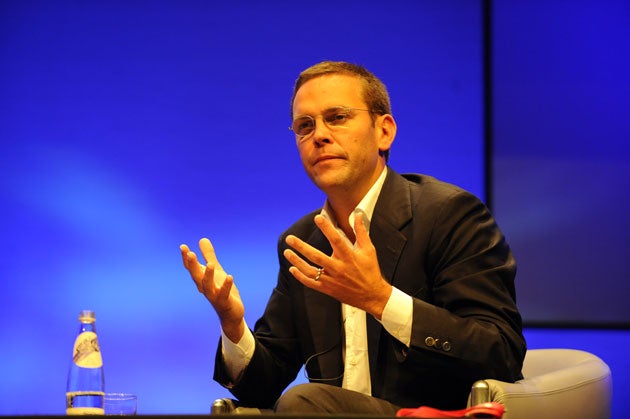
James Murdoch, the heir to his father Rupert's News Corporation media empire, clashed with the BBC's business editor, Robert Peston, yesterday as he called for the BBC's website to be "dealt with" in order to prevent it damaging the freedom of the press in Britain.
In a public debate at the Edinburgh Television Festival, Mr Murdoch stepped up an attack on the corporation which he had begun the previous evening in the formal James MacTaggart memorial lecture in which he described the growth of the BBC as "chilling".
He targeted the BBC's online operation, bbc.co.uk, which is one of the most viewed websites in the world. Mr Murdoch said the news element of the site posed a threat to the future of independent journalism in Britain. "The news operation is causing immense problems, huge problems for the independent news business, and I think it has to be dealt with," he said.
The comments will be seen as a response to Rupert Murdoch's comments earlier this month, made after the announcement of a sharp fall in profits at News Corp, that his newspapers would start charging for their online content.
And, in a clear signal that the Conservatives are increasingly in accord with the Murdoch world-view, the Opposition joined in the assault on the BBC website, raising objections to the millions the corporation is allowed to plough into its internet operation.
Jeremy Hunt, the Tory spokesman for culture, said he had no plans to force the BBC to charge for its websites in the future – but he would not rule it out.
The intervention will be seen as a significant indication that David Cameron's Tories are reluctant to cross swords with the Murdoch empire during a critical period when the mogul's endorsement could be a decisive factor in the general election campaign.
Mr Hunt said: "We recognise that the BBC news site is, for many licence- fee payers, an important part of the value they get from their money. But our concern is that it could make it difficult for other organisations to run viable operations."
But James Murdoch, the News Corp chairman and chief executive for Europe and Asia, was challenged by Mr Peston. The broadcaster warned that a commercial digital market in news could not be relied upon to "distribute information in a way that would support a healthy democracy".
He claimed that commercial news organisations were so beset by falling advertising revenues that "charging for online news will become the norm". But he suggested that commercial players would be drawn towards "the more sensationalist and titillating bangs for buck".
James Murdoch said earlier that the strong position of the BBC website, which was "crowding" the British news environment, made Britain the most difficult market for commercial media organisations to persuade consumers to start paying for news content. "The crowding out that occurs makes the UK the hardest part of the world by far to pull this off," he said.
Mr Murdoch said that a reduction in licence-fee funding to the BBC would be effective in focusing the organisation's resources on its core functions rather than encouraging it to expand into areas well-served by the commercial sector. "If you simply constrained the resources [of the BBC] with plenty of advanced warning, if you said the next [licence fee] settlement will be X... I think the BBC would prioritise pretty fast."
He suggested that Britain could not afford to give such financial support to the BBC, quoting a figure of £4.6bn a year, which he said included the licence fee and money generated by commercial ventures, such as BBC Worldwide. "We have got a huge debt pile in this country, we have financial issues," Mr Murdoch reminded his audience of television executives.
Some delegates to the festival reacted angrily to Mr Murdoch's thesis that British broadcasting was too state-controlled and over-regulated. In a heated exchange at a dinner on Friday evening after his MacTaggart speech, he was reminded by Mr Peston of the damage to the economy caused by deregulation of the financial sector.
Speaking yesterday, the BBC business editor predicted that all news organisations, except the BBC, would soon charge for content. "Every news organisation – with the exception of the BBC – will start charging very soon for any information that has any proprietary element to it. There is no way for these groups to survive unless they can generate this additional income. Against that backdrop, much of what the BBC does for free – especially the stuff we do online – may look like unfair competition." Mr Peston added that, as someone who had worked for commercial news organisations, "I feel the private sector's pain on all this."
But in a direct challenge to Mr Murdoch, he said there was a "counter argument" that commercial news media could not always be relied on to give the public the information they needed. "Will the new paid-for online model inform and educate on hard issues – financial matters, but also medicine, the environment, education and so on – that matter to us, or will it concentrate on the more sensationalist and titillating bangs for the buck?"
Mr Peston said there was an issue of "fairness" in distributing important knowledge to all who needed it. "Having just lived through the greatest failure in history to distribute financial resources in an efficient and equitable way, we certainly shouldn't assume that a commercial digital market in news will distribute information in a way that would support a healthy democracy."
Join our commenting forum
Join thought-provoking conversations, follow other Independent readers and see their replies
Comments