Oarsman at Google's helm keeps one stroke ahead of the world
Last year Matt Brittin helped Google make £1.26bn in UK ad revenues, but traditional media including ITV saw profits collapse. Is it the search engine's fault? Not at all, he tells Ian Burrell
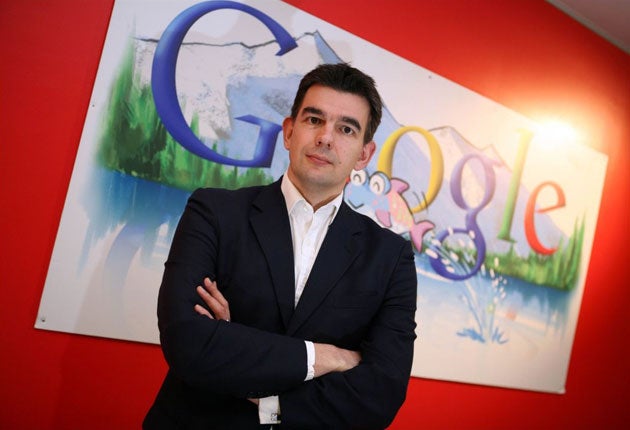
'When I was rowing I used to say that, if you spend your time focusing on the other crews alongside you, you're not going to move the boat as fast as possible," says Matt Brittin, the head of Google in the United Kingdom. "So you spend your time moving your own boat fast – and that's very much the philosophy here."
As an oarsman, Brittin was pretty proficient in propelling his boat. He was in the British Olympic team at Seoul in 1988, later won a bronze at the World Rowing Championships and has competed three times for Cambridge in the Boat Race. "Three silver medals," the former light blue comments forlornly.
Standing at nearly 6ft 4in, Brittin, is the UK "country director" for the most-visited website on the internet, the company that accounts for more than a third of this country's online traffic and one so powerful that one of Rupert Murdoch's senior lieutenants complained bitterly last month that Google was killing traditional media. Google was also blamed for the collapse of ITV's advertising revenues, which prompted a cull of 600 jobs last week.
Google's UK headquarters make every attempt to disguise the company's status as a multinational colossus. Staff can chill in striped deckchairs coloured blue, red, green or yellow, or they can seek inspiration in a games room that offers pool, table tennis, a guitar, drums and keyboards. Other Googlers gather in "microkitchens", snacking on dried banana and other healthy foods. The building, opposite Victoria train station, has enough London references to satisfy Boris Johnson, with old red telephone boxes so staff from overseas can call folks back home, and meeting rooms all named after tube stations.
Brittin, 40, pulls up a chair in "Sloane Square". As the former director of strategy and digital at Trinity Mirror, he is in a position to understand the relationship between the world's favourite search engine and more established brands on the British media landscape. "I spent several years working in the newspaper industry and I appreciate what it's like to see the changes that are going on in consumer behaviour," he comments. "Consumers have more choice than ever before of where they can go to get information. There's this whole environment that's opened up in a 10-year period very rapidly."
The UK is Google's second-largest market. Importantly, it is a world leader in online spending. "There's a remarkable story in the UK that I don't think is well-known," says Brittin. "We've got 20 per cent of the population of the US but 60 per cent of the e-commerce spend. In the UK, consumers are happier to spend and are spending more money online than they are in the US." He is also excited that nearly 19 per cent of marketing budgets are spent online in the UK, double the proportion in the US.
But, he says, Google is not the problem for traditional media but a potential saviour. "Google is a part of the internet but it is not the internet. We spend our time working on technologies that help people to get value out of the online environment, to get the right information and find people and places that are of interest to them. We think that's a good thing."
Robert Thomson, former editor of The Times and now publisher of the Wall Street Journal, would not agree with this. Commenting last month on Google's position bestride the internet, Thomson said: "Google is great for Google but it's terrible for content providers."
Brittin says the publishers should see Google as an ally and not a threat. "What we do is partner with companies online to help them make money from their blogs, webpages or newspaper pages. We are good at targeting, technology and online monetisation," he says. "We can help these guys make money from what they're publishing online." He says that Google generated almost £1bn for publishing partners through advertising on their sites in the final quarter of 2008 alone. "Every month we send about a billion clicks to publisher sites. So we provide a very helpful set of tools that help great journalism be found by consumers who are looking for it and help websites make money," he says.
"I can understand the frustrations that lead a traditional publisher to say the internet is changing consumer behaviour and taking readership away from me but I equally say that Google is trying to act in an extremely responsible way in this environment."
Does that mean he thinks that the largest British publishers have a viable future online? "We're still at an early stage of the online journey, Google was 10 years old last year," he responds, cautiously. "I'm encouraged that there's lots of experimentation going on and there are business models out there that work. Are they yet good enough to replace the historic business models of newspaper publishing in full? I think probably not yet."
But that's not just down to the internet, he says. "The cost of newspapers, physically, is very high. You have to invest in 30-year capital plant, you have to invest in newsprint and transportation to retail outlets and waste when you don't sell all your copies in the right place."
In a new world where "everyone can publish", real journalistic talent will always be valuable, he insists. "Editing skills are at a premium and we want to find content that we trust, analysis that we value, so I think the opportunities are huge... for some of those skills that newspapers and the traditional media are associated with."
Google's dominance of the internet (it has around nine out of ten searches in the UK and took £1.26bn in UK advertising revenues last year) is threatened by Microsoft's intention to launch a significantly improved search product. Brittin is phlegmatic about this prospect, pointing out that entering "search engines" into Google already provides a direct link to the company's competitors. "We are conscious consumers can go to anybody else," he says. "We want to make sure that our consumer experience is as fast and relevant as it possibly can be."
This is his credo, to rapidly respond to consumer behaviour in a time of extraordinary change. But even an athlete such as Brittin struggles to keep up. At Google, says the former newspaper man, "the pace is very fast". He tries to help the company's clients by briefing them on the sorts of developments revealed by Google Insights for Search, a facility open to anyone.
It shows, he notes, that interest in "eco-friendly" shopping has stalled but remains at a higher level than last year, in spite of the credit crunch. Recession, he points out, did not stop Marks & Spencer increasing online sales by 29 per cent year-on-year over Christmas, and HMV by 25 per cent. Businesses advertising on television, he says, need to keep in mind that 60 per cent of us are in the habit of watching the box while simultaneously surfing on our laptops.
With other companies, including T-Mobile, Google has developed the Android open source software which is challenging the iPhone in the mobile phone market. It is also in the process of digitising vast archives of books. "I think only 10 per cent of books are currently in print.
"So if you can digitise what is out of print and make it available that's a huge wealth of information that is potentially life-enhancing and important to our society."
Google might not produce content as such, but like the spiders of its search engine, it reaches into all areas of our lives.
Join our commenting forum
Join thought-provoking conversations, follow other Independent readers and see their replies
Comments