The Big Question: Could Rupert Murdoch's battle with Google save the newspaper industry?

For free real time breaking news alerts sent straight to your inbox sign up to our breaking news emails
Sign up to our free breaking news emails
Why are we asking this now?
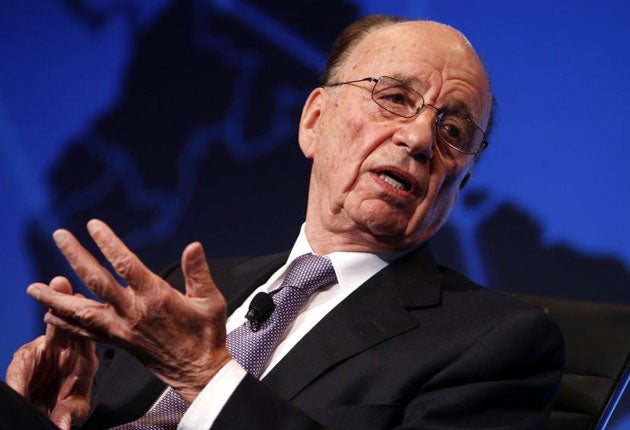
After a sustained campaign of verbal assaults and thinly veiled threats spearheaded by the News Corporation boss Rupert Murdoch, the search engine giant Google has offered an olive branch to the newspaper industry. One of Google's senior business product managers announced the company was to change how its systems crawled some news sites earlier this week, and debate has raged over how significant the move will be.
What does Murdoch think of Google?
During the Australian media tycoon's most recent tirade, he said: "To aggregate stories is not fair use. To be impolite, it is theft." His lieutenants have taken up the cudgels with glee, calling the company variously a "tech tapeworm," a "parasite", and "an internet vampire". Robert Thomson, editor of The Wall Street Journal, a Murdoch title, added that content aggregators "encourage promiscuity" among readers and a recent missive from the Dow Jones chief executive Les Hinton warned listeners to "beware geeks bearing gifts".
Why campaign against aggregators?
The newspaper industry is desperately looking for a way through the downturn and preparing for a digital future that brings revenues with it. The industry has been hit by the worst advertising downturn in living memory, forcing publishers to slash jobs and close newspapers. Many are looking at alternative revenue streams and the internet is becoming a top priority, but at the moment online advertising brings in a fraction of the sums charged for those in the newspapers. Charging fees for online content is the subject dominating board-level discussions – although by no means the only one – yet so far only The Wall Street Journal and the Financial Times have made it work.
What does Murdoch say?
News Corp objects to Google's strategy of using news content, generated at great cost by his and rival titles' journalists, and advertising against it on its search results page. This is advertising that should go to the titles, the group says. News Corp executives have said Google brings the "least valuable traffic" and makes the readers less loyal. Murdoch wants to re-educate internet browsers to see that "high quality, reliable news and information does not come free". Industry insiders added that it was about Google "not dictating terms".
What does Google say?
Google is keen to stress it is a technology company and not a publisher, and has hit out at claims it is stealing content. It brings together websites and articles from all over the world and provides an orderly way of searching them, sending readers to the titles' sites. Its UK managing director Matt Brittin yesterday likened it to a free newsagent. It has rarely veered from the line that publishers put their content on the web because they want it to be found. "Google is a tremendous source of promotion for news organisations, sending them about 100,000 clicks every minute. So very few choose not to include their material in Google's index," is the mantra. Brittin added yesterday the commercial opportunity was not huge for news on Google. There is no advertising on Google News, although there is against stories on Google search.
Can publishers avoid being found by Google?
A publisher can stop its sites being crawled by Google if it enables simple pieces of code, called robots, that make sites invisible to the engine. Google said: "The publisher is in control – if they ask us not to include their content, we won't. We work closely with the newspaper industry to help find long term and sustainable models for making money from news."
Should Murdoch do that?
He has always been ambivalent over the topic. The last time he was asked, he said no more than he would take them off as soon as the pay walls go up. Some analysts believe he sees the little revenue that comes from the traffic as better than nothing, until subscriptions come in. Others say his vocal attacks are little more than sabre-rattling in a bid to corral the whole industry into shunning the search engine and adopting the pay model. The real problem for Murdoch is that the industry has not reached a consensus on how to advance in the digital age. In the background, he may also be exploring alternate avenues from simply removing all content from the site.
What changes did Google announce this week?
Josh Cohen, Google's senior business product manager, said the company has introduced the "First Click Free" system to Google News, which will restrict access to subscription sites. This closes a loophole that allowed browsers to gain access to unlimited pages on a subscription site, simply by returning to the Google News homepage. Readers will now be limited to five views per day before payment is demanded. There is also no change to sites that are currently free.
Has News Corp declared victory?
No. Murdoch himself has not responded publicly as yet and Google's Brittin admitted he had "no idea" about the tycoon's reaction. Insiders say it's not much of a step but are enthused the search group has begun to engage. One industry expert said: "This is the first time Google has admitted there is an issue, and that is not insignificant." This will certainly help Murdoch's plans to put up pay walls at his newspapers, including The Times and The Sun in the UK. There is also a feeling that relations between the two sides may begin to thaw. Some of News Corp's language has softened a bit – Hinton this week said Google was "great. What it does to enhance and enrich our lives makes it a true wonder of the age".
Didn't Microsoft offer an alternative to Google?
Rumours emerged a few weeks ago that in a bid to boost its own search engine, Bing, Microsoft would consider paying news providers to feature their content. Insiders at Google believed its rival was just playing politics to win market share and get the newspapers onside. Microsoft has since distanced itself from the stories. Murdoch himself said there was no way any company could afford to licence content from every news provider in the world.
Does Google care if newspapers die?
Google's chief executive, Eric Schmidt, has been banging the drum recently about his desire for the newspaper industry to prosper. He said this week (in an op-ed piece in Murdoch's Wall Street Journal, no less) that a crisis for news-gathering "is not just a crisis for the newspaper industry. The flow of accurate information, diverse views and a proper analysis is critical for a functioning democracy". He added he wants to work with publishers to build their businesses, and yes, make more money. The company said it was exploring technology to help charge for content including subscription and micropayment systems.
Is Google responsible for the death of newspapers?
Yes...
* Some believe advertising revenue has moved from the newspaper sites to Google's search results
* Publishers claim that Google News discourages brand loyalty
* Readers are encouraged to think journalism should be provided for free; a young generation is growing up never having paid for news
No...
* It is actively working with the industry to help develop models for the digital age
* It brings billions of clicks to newspaper websites every month
* The recession (particularly the decline in advertising) and the march of the internet has caused more problems for newspapers than Google
Subscribe to Independent Premium to bookmark this article
Want to bookmark your favourite articles and stories to read or reference later? Start your Independent Premium subscription today.
Join our commenting forum
Join thought-provoking conversations, follow other Independent readers and see their replies