Wikipedia to stay free as readers rush to the rescue
Christmas appeal by founder raises $6m to save site from adverts and charges
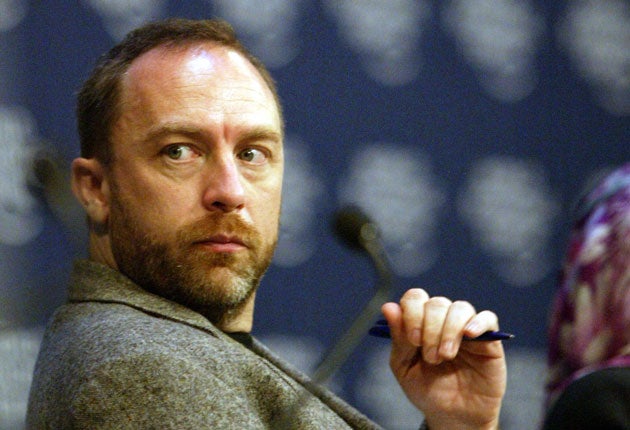
Users of Wikipedia have seen off a threat that the website would be forced to carry advertisements or charge for access, after one of the most successful online fundraising campaigns ever.
The free online encyclopaedia was struggling to raise $6m (£4.1m) to cover its running costs for 2009 and launched a campaign seeking donations on 3 November.
Money was coming in at the rate of about $30,000 a day but the drive appeared unlikely to reach its goal, which was $4.5m more than the $1.5m the site raised to cover costs last year. So Wikipedia's founder, Jimmy Wales, took the unusual step of publishing a personal appeal for donations, warning that unless the target was reached the site might be forced to start carrying adverts, which at the moment it does not do, and even introduce a subscription fee.
In his letter, which was posted online on 23 December, Mr Wales wrote: "Wikipedia is different. It's the largest encyclopaedia in history, written by volunteers. Like a national park or a school, we don't believe advertising should have a place in Wikipedia. We want to keep it free and strong, but we need the support of thousands of people like you. I invite you to join us: Your donation will help keep Wikipedia free for the whole world."
And his tactic worked. In the following 24 hours the site received 8,186 donations, compared to just 800 the previous day. Before his appeal the site, which attracts about 254 million visitors a month, was receiving about $30,000 a day, but that rose to more than $215,000 after the letter was published.
And, on 1 January, the total crept past the crucial $6m mark. Many of the donations came from individual users and were from as little as $5. The largest was an annual pledge of $1m for three years, and an anonymous donation of $250,000 was also received. Arcadia, a grant-making group based in London, gave $100,000. Jay Walsh, a spokesman for Wikipedia, said: "We're really thrilled that people have come out in force and made a clear statement that they care about this cause and they care about Wikipedia, even though we were kind of nervous after the economic news became really clear."
Wikipedia was founded by Mr Wales and Larry Sanger in 2001 with a format that allows pages on topics to be created and edited by the public. It has an editing team of 150,000 volunteers, but just 23 members of staff. In eight years the site has grown to 12 million pages and is seen by many as a first-port-of-call for information on pretty much any subject.
However it has suffered criticism. The reliability of the site has been repeatedly questioned due to the fact that anyone, without stating who they are, can change Wikipedia entries. This has led to many malicious and some entirely fictitious entries. This lack of reliability has also spawned rivals. Google launched Knol last year, while Mr Sanger left Wikipedia and launched Citizendium in 2007. The feature of both is that all entries are attributed to real people.
And while the site and its reliability have provoked some controversy, so too has its founder, Mr Wales. Last year he hit the headlines after a particularly acrimonious break-up with his ex-girlfriend Rachel Marsden, a US political pundit.
After altering his Wikipedia page to alert Ms Marsden to the fact that the two were separated – "I am no longer involved with Rachel Marsden," Mr Wales wrote – the entrepreneur faced bitter recriminations in the form of an eBay fire-sale of items of clothing he had left at her flat.
Join our commenting forum
Join thought-provoking conversations, follow other Independent readers and see their replies
Comments
Bookmark popover
Removed from bookmarks