Stephen Glover: A vicious press war with no real victors
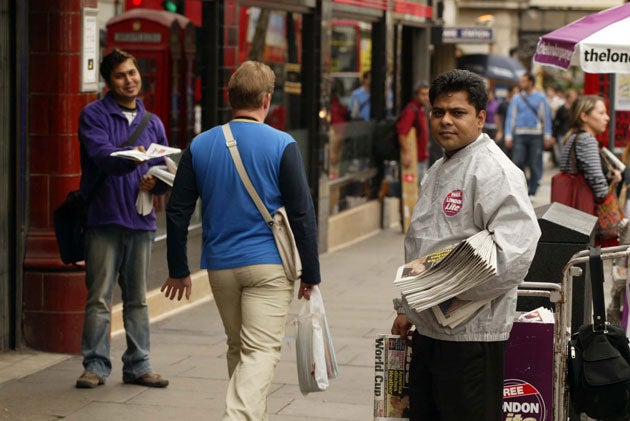
In the London freesheet war between Rupert Murdoch and Associated Newspapers, I used to think that Associated would blink first. Murdoch's group, News International, is the largest national newspaper publisher in this country. Behind it stand international assets which dwarf those of the Daily Mail and General Trust, which owns Associated. Murdoch is the toughest of the tough.
And yet the supposedly invincible media mogul has raised the white flag. He is closing thelondonpaper. In my view, of course, he should never have launched it in the first place. It was an expensive distraction that contributed little or nothing to good journalism. But he believed in it. He was prepared to absorb significant losses to open up an opportunity in the London afternoon market, and to weaken Associated's London paper, the Evening Standard. Now he has been forced to throw his baby overboard.
This is a humiliation, though perhaps not the greatest one he has ever suffered. He would not have closed the paper unless he had to. His decision can only be understood in the context of News International's general predicament. The company, which in its heyday was a money-making machine, is probably not even breaking even.
We know that The Times and The Sunday Times lost £51.3m in the year to 29 June 2008, and that Murdoch's other national titles, The Sun and the News of the World made a profit of only £55.1m over the same period. All these figures are likely to have worsened as the advertising recession has deepened. Then there are the losses of £12.9m on thelondonpaper in the twelve months to 29 June 2008, on top of the £16.8m it lost in the previous ten months after its launch in September 2006.
The plain fact is that, with News International in the state it is, Murdoch could not afford to continue bankrolling a freesheet that had no prospects of ever making a profit. Yet only a year ago, his son James, chairman of News International, resisted overtures from Associated, which had hoped to broker some sort of peace deal involving its own competing afternoon freesheet, London Lite.
Since then trading conditions have worsened at News International, as they have throughout the Murdoch media empire, which recently announced record losses of £3.4bn (which admittedly included some extraordinary items) in the 12 months to June 2009. The judgement of Murdoch, who is now 78, is being questioned by investors and others after he paid $5bn for The Wall Street Journal in August 2007 – a few months before the credit crunch began. The title is now haemorrhaging tens of millions of dollars.
All this helps to explain Rupert Murdoch's recent announcement that his newspapers will soon start charging for online access. More revenue is desperately needed. Anyone who cares about the future of newspapers must hope he will succeed, but there are good reasons for doubting that he will – not least, the apparent reluctance of other publishers to follow suit in charging, and the certainty that the publicly funded (and extremely effective) BBC website will not.
Murdoch is not yet in the position he was in 1991, when he nearly lost control of his company because it could not immediately repay a tiny debt, but these are difficult times, particularly for his newspapers. As I have suggested before, few men aged 78 are intellectually absolutely on top of their game, and events are moving faster in the media world than ever before. The closure of thelondonpaper may turn out to be the first episode of a much bigger drama.
If Rupert Murdoch has suffered a setback, what of Associated/Daily Mail and General Trust? I suspect its senior executives can scarcely believe their luck. They may have hoped, but can hardly have expected, that Murdoch would capitulate first.
They now have a ticklish problem – whether to close London Lite, which was launched as a spoiler to thelondonpaper. It has racked up considerable losses, though not as great as News International's, and even as the sole afternoon freesheet would be unlikely to make any money with the advertising market as it is. The logic is probably to close it. There is, however, another consideration which cuts both ways. With thelondonpaper out of the picture, the pressure on the paid-for Evening Standard diminishes. If London Lite closed, the Standard would be in a still stronger position.
In January Daily Mail and General Trust sold 75.1 per cent of the loss-making Standard to Alexander Lebedev for a nominal sum, retaining 24.9 per cent. The company may now be wondering whether that sale was such a good idea after all. On the other hand, owning a quarter of an Evening Standard unencumbered by any freesheet competitors would not be a terrible outcome.
This tired hyperbole is bringing tears to my eyes
All of us will have a long list of the ill-effects of the recession, as well as perhaps a few good ones. Admittedly low on the bad list, but extremely irritating nonetheless, is the widespread, almost manic use in the media of the adjective "eye- watering".
No doubt a few things were "eye-watering" before the recession but now the term is so rampant that every other serviceable adjective has been binned. For some reason the term is almost exclusively applied to financial shocks or excesses. It is tempting to blame Robert Peston, the BBC's business editor, as the prime mover of the trend. Many pieces of bad news he has announced – and there have been a few – have been "eye-watering". Mr Peston's eyes presumably resemble a small waterfall, and he must use up a box of tissues every day.
Even, or perhaps especially, the so-called quality papers have fallen victim to the curse. Last week the caption on a front-page picture in The Daily Telegraph of John Cleese and his former wife described the divorce settlement made by him to her as "eye-watering". In The Guardian the losses of thelondonpaper were described as "eye-watering" as, in another article, were the costs of medical care in the United States. Last Friday's Times wrote about "eye-watering" bonus deals, while The Sunday Times of 16 August mentioned President Obama's "eye-watering deficit".
And so on. Without even trying I come across examples in newspapers and on radio and television every day. If the term ever meant anything at all – is it noticeably good or bad to have one's eyes watered? – it has now become empty through repetition. Why not "grotesque" or "excessive" or "unwarranted" bonuses rather than "eye-watering" ones? Why not describe Obama's deficit as "ruinous" or "unprecedented"? Let me make this appeal to fellow hacks. Anything but eye-watering!
scmgox@aol.com
Join our commenting forum
Join thought-provoking conversations, follow other Independent readers and see their replies
Comments
Bookmark popover
Removed from bookmarks