Stephen Glover: The BBC has conspired with The Guardian to heat up an old story and attack Murdoch
How do stories emerge in the media? Some people believe reporters simply write down what happens. I’d say it was a bit more complicated than that. Take, for example, the recent hysteria over News of the World journalists hacking into the mobile phones of celebrities.
Most of this story was old. We already knew eight-tenths of it, though we had probably forgotten we did. Nonetheless, it was imaginatively repackaged by those symbiotic organisations, The Guardian and the BBC, and sold as new. The Corporation had been put on red alert by the newspaper at a senior level well before the story broke.
Last Wednesday, when I turned on BBC 2’s Newsnight, I knew something was up. Kirsty Wark was practically panting with joy, like a foxhound with the scent of the fox full in its nose. The fox in this instance was Rupert Murdoch, whose company News Group had (according to The Guardian) paid more than £1m to silence victims whose telephones had been hacked into some years ago by the News of the World.
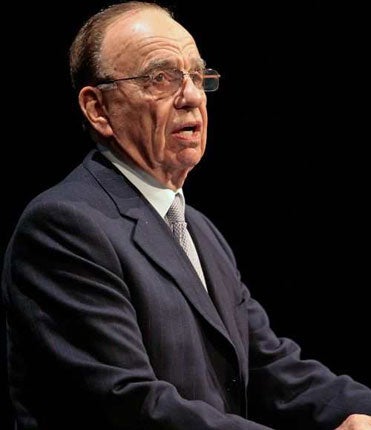
See it, for a moment, from the point of view of the BBC, which led every bulletin with the story for the next 36 hours. Mr Murdoch is the ancient enemy. His newspapers periodically bash the BBC. During the Andrew Gilligan affair, which culminated with the resignation of the Corporation’s chairman and director-general, they called for the BBC to be chopped into tiny pieces and sold off as fire wood.
The BBC has had to wait for several years, but this was payback time. Kirsty quickly conflated the sins of the News of the World into Rupert Murdoch’s personal ones. It was as though the old rogue had himself tapped all our mobile phones. Summoned as members of a kangaroo court directed to find him guilty were: Andrew Neil, who nurses a personal grievance against his old boss, Mr Murdoch, and is now a very senior executive in a rival media organisation; and Peter Wilby, whose grudge, stretching back into the very dawn of time, is ideological.
None of Mr Neil’s rather bulky baggage was mentioned. My very old friend Peter was introduced as a former editor of The Independent on Sunday when he is, more pertinently, The Guardian’s current media commentator, and therefore parti pris. Still, Mr Murdoch is not always fair, so why should the BBC be?
Let us examine the motivations of The Guardian. Like all newspaper editors, its editor, Alan Rusbridger, has had to watch enviously as The Daily Telegraph has carried all before it with its never-ending saga about MPs’ expenses. Two or three of his top reporters have chosen this moment to jump ship. Mr Rusbridger has been in a fretful mood and yearned for the limelight, where he loves to be. Fortunately, his colleague, Nick Davies, had been pumping up a story which, with the cooperation of the BBC, could restore Mr Rusbridger to his rightful place in the Pantheon.
Mr Davies is a journalist who dislikes much journalism, especially of the tabloid variety. He recently published a book which suggests that the press is wildly dysfunctional. I’ve never had the pleasure of meeting him, but he seems to me a misanthropic, apocalyptic sort of fellow – the sort of journalist who can find a scandal in a jar of tadpoles.
The scene was set, the button was pressed, and people assumed their pre-assigned positions. Labour MPs, tired of being undermined by the press over their expenses, were only too eager to let the News of the World have it, the more so because its former editor, Andy Coulson, is now David Cameron’s slightly spooky spin doctor. Various celebrities fell over one another to claim that their mobile phones had been hacked into by the News of the World. Indignation pulsed up and down the land.
The trouble is that most of what The Guardian and the BBC revealed was already known. In December 2006, the then Information Commissioner, Richard Thomas, disclosed that some 305 journalists on 31 publications had used private investigators to obtain information in ways he suggested were often illegal. The News of the World was actually only number five in the list of miscreants, with 182 requests for information. The Daily Mail topped the poll with 952 alleged requests. Other newspapers more modestly involved in the trade included The Observer (103 requests), The Sunday Times (52) and the London Evening Standard (130).
Then, in January 2007, the News of the World’s royal editor, Clive Goodman, was jailed for four months under phone-tapping legislation. A private investigator called Glenn Mulcaire was sent down for six. Goodman admitted hacking into messages on the mobile phones of royal aides, and voicemails left for the supermodel Elle Macpherson, the PR fixer Max Clifford, and Gordon Taylor, chief executive of the Professional Footballers’ Association. It was after this case that Andy Coulson resigned.
So two and a half years ago we already knew that obtaining data and listening into phone calls had been widespread over a number of years on many newspapers, and that Clive Goodman had been an arch practitioner. Last year the Information Commissioner alleged that 27 News of the World journalists had breached data protection law – in other words, Mr Goodman was not acting by himself – and four from its sister paper, The Sun.
What has The Guardian/BBC story added? The names of some more celebrities have been thrown into the pot. And The Guardian claims to have discovered that Rupert Murdoch has paid over £1m to three victims of hacking, one of whom, the aforementioned Gordon Taylor, received some £700,000. Details of his case were leaked to Nick Davies.
Very few people have made the obvious point – that these practices were already known and had been very widely criticised; and they took place some years ago. The Guardian does not suggest they still go on. Possibly they do, though my guess is that most newspapers have cleaned up their act. For example, Paul Dacre, editor of the Daily Mail, told a committee of MPs in April that the paper had sacked a journalist for unauthorised use of an outside agent to obtain personal information.
If there is new evidence, let it be brought forward. What we have here is an old story re-heated, and re-presented by The Guardian and the BBC in the most sensational manner. Two and a half years ago I strongly suspected that Andy Coulson did know what went on while he was editor of the News of the World, and I still do. However, no new evidence has been produced that proves his involvement, and the outcry against him is merely a more raucous reprise of what was said two and a half years ago.
Naturally I do not condone newspapers listening into the private conversations of celebrities, though I would have no problem in the case of a minister who was on the fiddle or betraying his country. I do know that the national press is weaker than it has been for more than a century, with most titles losing money, and I regret that, at such a time, The Guardian and the BBC should use largely old information to weaken it further.
scmgox@aol.com
Join our commenting forum
Join thought-provoking conversations, follow other Independent readers and see their replies
Comments