Over the top? Look who's talking. But maybe Campbell has a point on the press
The former arch-hack claims the media has 'suspended basic humanity'. And much as they dislike lectures from him, many in the industry agree. Vincent Graff reports
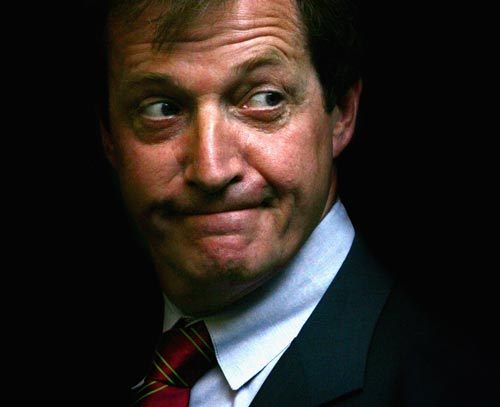
Right, let's get one thing out of the way. If anyone is to argue the media is ground down by negativity and lacking "basic humanity", it shouldn't be Alastair Campbell. Much as he might like to forget it, Campbell's own journalism is still publicly available in the archives. Dig around for a few minutes and you can find examples of his work in the mid-Nineties when he was political editor of the Daily Mirror.
Sure, Campbell was writing in a brash, tabloid newspaper about a prime minister who was clearly on his way out. But is it really appropriate for someone who described John Major as "a piece of lettuce" and "a shallow, lying little toad of a man" to cast the first stone?
Jeff Randall, editor-at-large of The Daily Telegraph, puts it succinctly: "The British press needs no lecture from Alastair Campbell on the vices of building up and knocking down. He's based his entire career on doing precisely that." Sometimes, of course, without bothering to do the building-up bit first.
And not just in his journalism days, of course: Campbell seemed perfectly happy being negative about Gordon Brown while Tony Blair was at No 10. We've never quite got to the bottom of which senior Downing Street official declared that Brown was "psychologically flawed", have we?
That said, Campbell's Hugh Cudlipp Lecture last week deserves attention. For even if he was not right in every respect, his central point appears to have some merit. His most recent comments on Britney Spears, sectioned on Wednesday, have real merit too. As he said: "Being a hard-nosed journalist does not mean you have to suspend basic humanity."
In modern reporting – everywhere from politics to sport to the economy – there is no room in the British media for shades of grey, argued Campbell. "We see and hear only the language of extremes." Take, for example, the coverage of Brown's arrival in Downing Street. For the first few weeks, he "could do no wrong. Then the mood shifted, the prism changed and he went straight from hero to zero... Neither phase of coverage was accurate because both remove what actually makes politics and life interesting – the shades of grey that provoke real debate. But shades of grey don't fit the formula. Triumph or disaster. Unalloyed success or total 'crisis', the most overused word in political reporting."
Anyone who has ever picked up a newspaper will recognise a glimmer of truth in what he says. Today's beaming, busty pop starlet is tomorrow's washed-up wastrel. Reality TV contestants are greeted as superstars the day they step into the limelight – and big-headed nobodies when it's time to shove them aside. (And if they do get ideas above their station during their heady moment of fame, who's fault is that?)
Freelance writer Quentin Letts, who writes the political sketch for the Daily Mail every day and is thus an expert in pointing out politicians' deficiencies, says: "The media are only reflecting human nature, in that they're interested in people when they first appear and we cut them a bit of slack. And then when they start getting a bit pleased with themselves, we start resenting it. We feel: 'We've had enough of that bloke now.' It's something that people like to satisfy, so it sells papers."
Perhaps the newspapers shouldn't be encouraging such a sentiment? Maybe not, says Letts, "but we're not here to correct human nature, are we?"
The hero-to-zero phenomenon is probably most noticeable in sports journalism. When Sven-Goran Eriksson arrived as coach of the England football team seven years ago, trailing his Italian credentials, he was greeted like a messiah – particularly as his team won five games in a row. Mick Dennis, football correspondent of the Daily Express, recalls: "We thought here was this gnomic intelligence from another land, and wasn't it great to have someone calm and sensible to manage us." Eventually – inevitably – the results on the pitch were less positive, "and we began to wonder if he wasn't saying much because he didn't have much to say".
Dennis adds: "Fabio Capello starts work on Wednesday and we'll get a period when we think: 'That's clever, what he's done.' And then he'll lose a few games and we'll hate him."
So why is it like this? "The problem for sports journalists is that we go through great emotional occasions like the World Cup and we react like fans. When England lose a football match, you're bitterly disappointed and you want to blame someone. Sometimes you just lose football matches – but that's never enough for football fans or indeed reporters. We've got to blame someone. And so we do."
And why are football writers reluctant to paint in shades of grey? "I don't think that's just a fault of journalism. I think that's a fault of human nature. We want simple solutions to things, easy answers. But life is much more complicated than that."
There's another factor, of course: the nature of newspaper editors. The type of person who gets appointed to the job (particularly in the tabloids) is rarely a consensual, gentle soul who's happy to see both sides of a story. They're hot-blooded individuals who enjoy terrific enthusiasms – and terrific downers, too. They thrive on conflict – and if they set their sights on bringing down a Cabinet minister who has accepted a dodgy donation or two, they won't want to stop until they've got their man.
But sometimes press attacks don't hit their target. Letts says that many papers have consistently had a pop at David Beckham and Bob Geldof, for example, and yet the public still likes and admires them. "Also Elton John – the press tries to bring him down quite often – but there are some people who reach a point in the public's affection where you can't get at them. And I think the public has cottoned on to this."
Business journalism, too, is a little different. Much as it irks him to say it, Jeff Randall agrees in part with Campbell. "I do accept that the press likes to jump on a bandwagon – up and down – in politics, sport, business, the arts. Yes we do. But in business journalism I think the nature of the game is a bit more objective."
Why? "Because it has to be: there are more tangible measures of whether people are winners or losers. If a company is delivering record results, its profits are rising and its share price is up, I don't think it matters what the press says. Conversely at the bottom end, no friendly puff piece is going to rescue a ruined reputation if a company's on the verge of bankruptcy and its shareholders are bearing huge losses."
So what's our conclusion? Oh dear – a rather nuanced one. Campbell is right – but only up to a point. Now what will my ever-so-consensual editor make of that?
Join our commenting forum
Join thought-provoking conversations, follow other Independent readers and see their replies
Comments
Bookmark popover
Removed from bookmarks