David Cameron did not want Leveson Inquiry, says Alastair Campbell
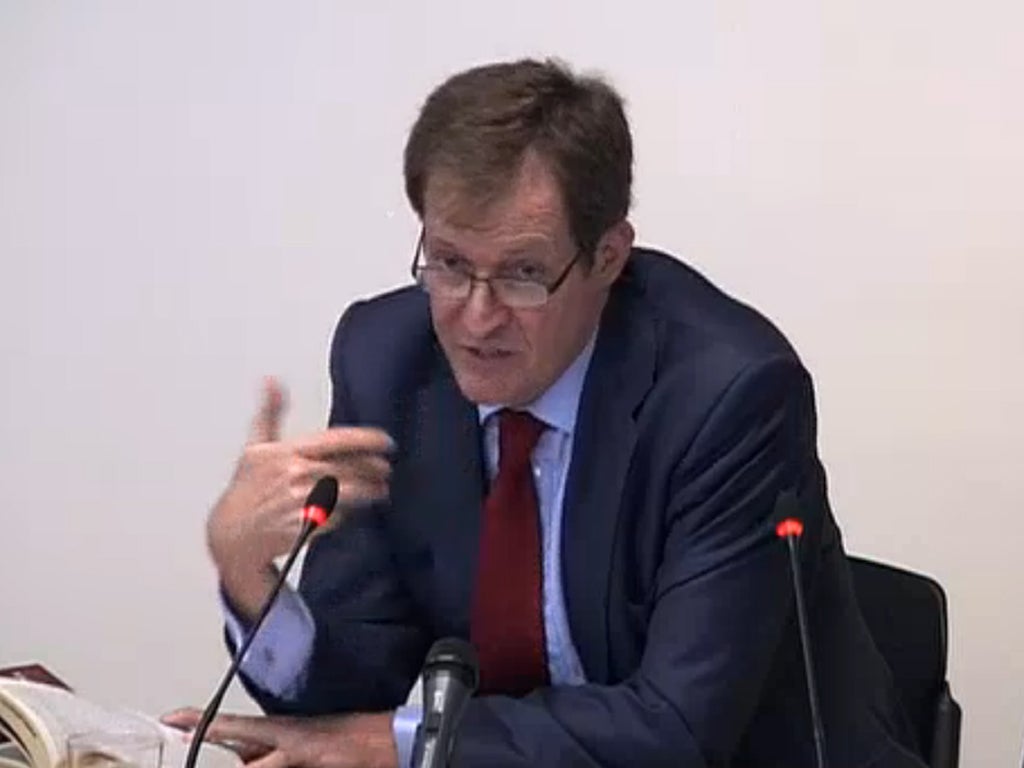
The former Number 10 communications director Alastair Campbell said today that David Cameron did not want to set up the Leveson Inquiry.
Mr Campbell said comments made at a Westminster lunch by Michael Gove in February were part of a wider Government strategy.
The Education Secretary said the inquiry had given rise to a "chilling atmosphere" which threatened freedom of speech in the UK.
When asked if there was a political will to regulate the media, Mr Campbell replied: "No, if I'm being frank. I thought that Michael Gove's speech to the parliamentary gallery was part of the political strategy.
"I don't think that David Cameron particularly wants to have to deal with this.
"I don't think he wanted to set up the inquiry. He had to in the end.
"I think it will be very difficult for him not to go along with whatever recommendations - or at least a very large part of the recommendations - the inquiry produces. But I don't think there's much of an appetite."
Mr Campbell was questioned about three telephone conversations which took place between Tony Blair and Mr Murdoch in the run-up to the Iraq war.
Asked why Mr Blair made time for the calls during a frantic period of diplomacy, Mr Campbell pointed out that Mr Murdoch was a "very significant figure in the media landscape".
"What I think was going on is that Rupert Murdoch has placed a call and Tony Blair has taken that call, and Rupert Murdoch is just wanting to have a chat about what is going on," Mr Campbell said.
"Rupert Murdoch, one of the things that makes him different to some of the other media owners, some of whom you saw last week, is that he is a news man. He is interested in what is going on in the world."
He added: "I think it is a combination of Rupert Murdoch trying to find out what is going on and also probably saying, 'You know, we're going to support you on this."'
Mr Campbell went on: "It doesn't strike me as that odd, not least because by then I think it is fair to say Tony Blair had very few strong supporters in the media left."
He pointed out that the men had only spoken on the phone a total of six times between 2002 and 2005.
Mr Campbell said that Mr Blair and other members of the Labour government had long believed there was a "real problem" in the relationship between the press and politicians.
However, he they did not take action to address the issues.
"I think there was a political point of pragmatism that Tony Blair would have taken the view that it was not politically sensible," he said. "It is no secret that this was one of the few things that we argued about."
He added: "He was further of the view that whereas it was possible to fight and win elections and to govern with consensus with some of the media offside, to seek to do so with all of them offside and in kill mode is very difficult indeed."
David Cameron's links with the media were too close, former cabinet secretary Lord O'Donnell said at the inquiry earlier.
The peer - who retired from the key post at the end of last year - said he had tried to ensure ministers worked through the civil service and maintained a distance from the press.
But, giving evidence to the Leveson Inquiry, he admitted that he had not always been successful.
"I think the Prime Minister himself, the current Prime Minister, has said that he felt his relationships had got too close, and I agree with that."
Mr Cameron admitted last July that he and other politicians had allowed themselves to get "too close" to media proprietors and editors, and he has since said that relations were "too cosy".
However, he has stressed that his contacts were not only with Rupert Murdoch's News International, but with a wide range of media organisations.
Lord O'Donnell told the inquiry into press standards that politicians from opposition parties should have a different relationship with journalists than Government ministers.
He said: "You have much fewer resources, so you do not have big press offices and the like, so you do tend to make closer personal relationships with journalists.
"There tends to have been swapping of mobile phone numbers, all of those sorts of things."
Lord O'Donnell said MPs should be "much more careful" once their party forms a government.
"Every single Secretary of State is subject to collective responsibilities much more important in government than we see in opposition. We have to be much more careful," he said.
The peer added that the inquiry had an opportunity to issue guidelines specifically for opposition parties on their relationships with the press.
"I think you would want to put it to the leaders of all the parties, 'Here is a set of rules that we think opposition parties should abide by', he said.
Lord O'Donnell was asked about the exchanges between Adam Smith, Culture Secretary Jeremy Hunt's special adviser, and News Corporation lobbyist Fred Michel.
Mr Smith resigned last month after admitting that the contacts over the BSkyB bid had become too close. Labour has been demanding that Mr Hunt quit for allowing the situation to get out of control.
Lord O'Donnell said it was for ministers to authorise their special advisers' activities, but there was not likely to be a written record of instructions.
"I would have expected the minister to be clear about what his special adviser should be doing," he said.
He insisted that "keeping all parties informed about process is perfectly reasonable, but not getting into substance".
The peer also defended his advice to then-prime minister Gordon Brown in March 2010 against holding an inquiry into media standards.
"There were stories that there was more information out there and I think there was still a question mark as to whether more would emerge ...
"On the basis of what we knew then I would stick with that recommendation."
Asked whether he had been unwilling to pick up a "hot potato", the peer replied: "I would say it was clearly a big potato. The timing was not ideal.
"If you are going to do this it would be good to have all-party agreement. Trying to broker such a thing in the weeks leading up to a general election would be quite difficult."
PA
Join our commenting forum
Join thought-provoking conversations, follow other Independent readers and see their replies
Comments
Bookmark popover
Removed from bookmarks