Farewell to Alan Watkins, the irascible giant of Fleet Street and sage of El Vino's
The Independent on Sunday writer, who died on Saturday, was a master columnist, writes Donald Trelford
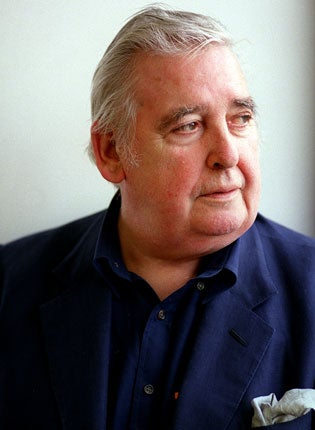
alan watkins was one of the last of the great Fleet Street characters. He called his autobiography A Short Walk Down Fleet Street – a title that so confused an Islington bookshop that I was directed to the section on the streets of London when I asked for a copy. In fact, his was quite a long walk up and down Fleet Street, having started his career more than half-a-century ago, in the era of Lord Beaverbrook – for whose retired mistresses he was required to wrap up gifts in brown paper parcels as part of his duties as New York correspondent of The Sunday Express – and ending it in the world of Google and Twitter.
Not that he allowed the digital world to intrude upon his well-ordered life. Until very recently he wrote his columns in long-hand, in ink on A4 paper, and dictated them by telephone to The Independent on Sunday. A creature of habit, he would then take a bus from his Islington home (it used to be a taxi until the paper economised on expenses) down Farringdon Road, where he would stop to buy a sandwich and a glass or two of champagne at El Vino's before catching the Docklands Light Railway to the office in Canary Wharf.
Looking dishevelled and faintly baffled, he would stare at a screen to ensure that no fool of a sub-editor had interfered with his subjunctives or his past participles. Fowler's English Useage, Vacher's, Wisden and Bagehot were his constant companions.
An ex-student of WA Robson at the LSE, he would have relished the constitutional niceties of our present hung Parliament.
He was my first appointment as editor of The Observer in 1975. Nothing, however, was straightforward with Watkins.
When I interviewed him for the job in the Blackfriars pub – or rather, made my pitch, since he was much in demand – we became uncomfortably aware that we were being watched, and that we may even have been followed down the street.
The man on surveillance duties, who appeared to be eavesdropping on our conversation from behind a pillar and scribbling in a notebook, turned out to be Geoffrey Wheatcroft. He was acting on behalf of The Spectator, which was also trying to poach Watkins from The New Statesman.
Alan's greatest interests in life, outside politics and his family, were rugby, cricket, wine and the English language – interests which happened to coincide with mine.
About a year ago I was in the dining room at the Garrick Club when he came in, spotted me, called my name and hobbled over on his walking stick.
The room fell silent as I stood up, and he whispered something in my ear then hobbled off again. "What was that all about?" asked my companion. What Watkins actually said was: "Worsley for number seven with the Lions."
In El Vino's or the Garrick, when approached by someone whose company we didn't fancy, we would go into a comic routine in which we recited the names of great prop forwards of the 1950s. This was usually enough to drive away the most persistent of bores.
He had more elevated table-talk, however, with the likes of Conor Cruise O'Brien, Frank Johnson, Philip Hope-Wallace, Peregrine Worsthorne, Terry Kilmartin or the snooper Wheatcroft.
His Private Eye sobriquet, Alan Watneys, belies the sophistication of his drinking. He may have drunk beer with MPs in Annie's Bar in the House of Commons, where he made some of his earliest and best political contacts, but in my company he preferred wine or champagne (maybe because I was usually paying).
I never saw him drunk or the slightest bit aggressive.
In fact, the more he drank the more he seemed to retreat within himself and enjoy watching others making fools of themselves.
He had that most precious gift in a journalist, of perfect verbal recall, especially when a politician was gabbing on unguardedly. He made a study of politicians' favourite tipple and I remember his shudder of distaste on discovering that Nigel Lawson drank Spritzer.
I rarely interfered with Alan's copy, except when I thought he assumed too much knowledge of readers. Once, I took him aside and said: "Alan, you and I remember that Ted Short was deputy leader of the Labour Party, but there aren't many of us left."
He solemnly agreed and thenceforth poor Ted Short was consigned to the dustbin of history. Alan's greatest scoop was when Michael Foot rang him (and no other journalist) to say that he was standing for the leadership of the Labour Party.
Watkins left The Observer soon after The Guardian takeover in 1993. When Guardian executives made their first address to The Observer's staff, he was heard to mutter: "They're a conquering army. I'm off."
He once told me (perhaps influenced by working under John Junor) that he only ever had truck with editors: "I don't take any nonsense from underlings because the editor is the only one who can fire you."
He said he regarded himself as a man pushing a barrow along Fleet Street with something to sell. He would stop off at one paper as long as they wanted his wares.
When he or they had had enough, he would up his barrow and move along the street. Even at the age of 77, he never ran out of clients.
The wisdom of Watkins
On Hugh Gaitskell's "fight, and fight, and fight again" speech at the 1960 Labour conference: "The speech was crude, vulgar, abusive and intellectually negligible. Inevitably, it was a great success."
Fleshing out the concept of "young fogeys" in 1984: "The young fogey ... is libertarian but not liberal. He is conservative but has no time for Mrs Margaret Thatcher and considers Mr Neil Kinnock the most personally attractive of the present party leaders. He is a scholar of Evelyn Waugh. He tends to be coolly religious, either RC or C of E. He dislikes modern architecture. He makes a great fuss about the old Prayer Book, grammar, syntax and punctuation. He laments the difficulty of purchasing good bread, Cheddar cheese, kippers and sausages ... He enjoys walking and travelling by train. He thinks The Times is not what it was and prefers The Daily Telegraph."
June 1991: "Politics, as I have remarked from time to time, is a rough old trade."
On Michael Heseltine's first party conference since his return to government, October 1991: I was hoping rather that someone would mount a noisy protest crying "assassin", "murderer", that kind of thing ... But, like a faithless lover, Mr Heseltine was welcomed back by his still adoring mistress. The years were peeled away, and they were in bed together as they had been in that decade of happiness which began in the mid-1970s.
On Tony Blair, April 2000 One of the services I try to perform is to draw the attention of the public to statements by the Prime Minister of that which is not the case. Let us call them mis-statements. No, let us call them fibs or, if you prefer, whoppers, but not on any account lies, because my mother taught me that this last word was not used in polite society.
On Cleggmania, from his final column on 18 April 2010: For the moment, Mr Clegg might as well accept his good fortune. Mr Clegg turned Mr Brown's blandishments aside, as if he were a beautiful girl who was rejecting the overtures of an ageing roué.
Join our commenting forum
Join thought-provoking conversations, follow other Independent readers and see their replies
Comments